

Surname analysis has been around for awhile. Nathaniel Weyl wrote a couple of fascinating books in the 20th Century about what could be discovered from comparing surnames to data sources of achievement vs. government counts of people by surname For example, I vaguely recall that he found that among people with Ashkenazi Jewish surnames, the single highest ranking one on becoming a doctor or some other worthy accomplishment like that was “Shapiro.”
Gregory Clark’s 2014 book The Son Also Rises is full of fascinating facts like that. For example, among the 25 most common surnames in Britain, by far the leader in graduating from Oxford are people named Hamilton with twice the national average. Here in the U.S., we recently endured a hit Broadway musical about how smart our most famous Hamilton was. And I’ve seen mathematicians tell biologists, in effect, that, sure, your William D. Hamilton was a creative genius, but not as much of a creative genius as our William R. Hamilton.
Kirkegaard and Van Pelt’s big innovation is that they integrated traditional surname analysis with 23andMe’s huge database of genetic ancestry.
New in Comparative Sociology:
Correlating Surname Genetic Ancestry and Socioeconomic Status across Millions of Americans
May 2026 Comparative Sociology 25(2):239-280
DOI:10.1163/15691330-bja10162
Authors:
Daniel Van Pelt
Emil O. W. Kirkegaard
Ulster Institute for Social Research
Genetic variation plays a significant role in shaping socioeconomic status. Conventional census racial categories (Black, White, Asian, Hispanic) obscure substantial variation among ancestry groups. Surnames reflect ancestral lineage and genetic heritage, enabling finer measurement. The authors combined 23andMe genetic ancestry data on surnames with surnames yielded from government financial records, criminal databases, Wikipedia entries, and physician licensure records. They found that genetic ancestry strongly predicted surname-level outcomes across all metrics, with substantial differences in social standing among ethnic groups. Ashkenazi Jews and Indians ranked highest; British/Irish and Iberian ranked lowest among Europeans; highly selected immigrant groups such as Arabs and Iranians scored above Europeans.
Surname analysis has been around for awhile. Nathaniel Weyl wrote a couple of fascinating books in the 20th Century about what could be discovered from comparing surnames to data sources of achievement vs. government counts of people by surname For example, I vaguely recall that he found that among people with Ashkenazi Jewish surnames, the single highest ranking one for becoming a doctor or some other worthy accomplishment like that was “Shapiro.”
Gregory Clark’s 2014 book The Son Also Rises is full of fascinating facts like that. For example, among the 25 most common surnames in Britain, by far the leader in graduating from Oxford are people named “Hamilton,” with twice the national average. Here in the U.S., we recently endured a hit Broadway musical about how smart our most famous Hamilton was. And I’ve seen mathematicians tell biologists, in effect, that, sure, your William D. Hamilton was a creative genius, but not as much of a creative genius as our William R. Hamilton. (Seriously, try looking up the Wikipedia pages of people named Hamilton. You’ll be impressed.)
Kirkegaard and Van Pelt’s big innovation is that they integrated traditional surname analysis with 23andMe’s huge database of genetic ancestry.
23andMe offers a page entitled Surname Discovery in which you can look up facts about clients with a particular last name. For example, here is “Trump:”
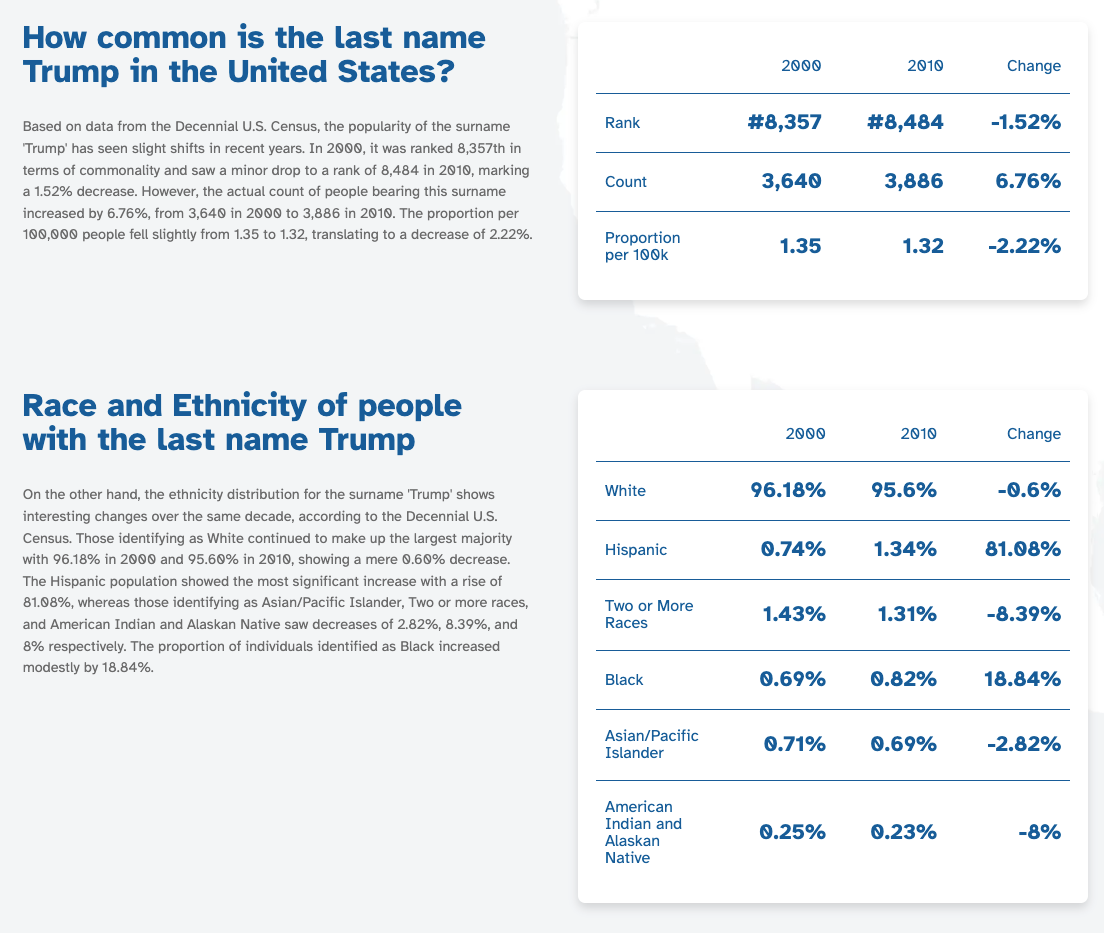
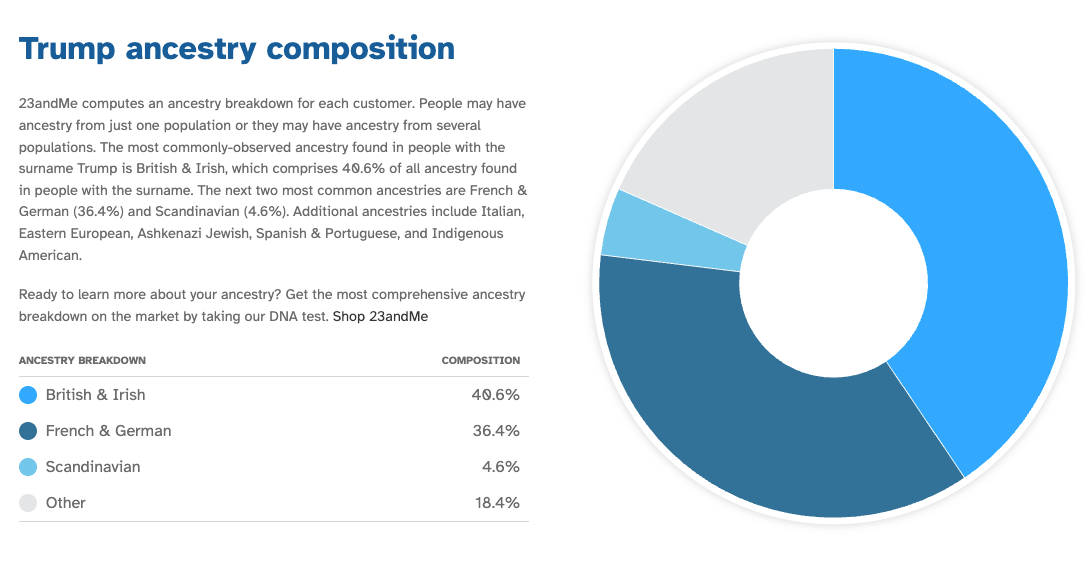
Interestingly, for a long time 23andMe didn’t break out English from Scottish, Welsh, or Irish even though there must be a lot of customer demand for that. They were just too similar genetically to cheaply distinguish.
Same with French & German.
And then there’s a bunch of microtraits of people named Trump like:
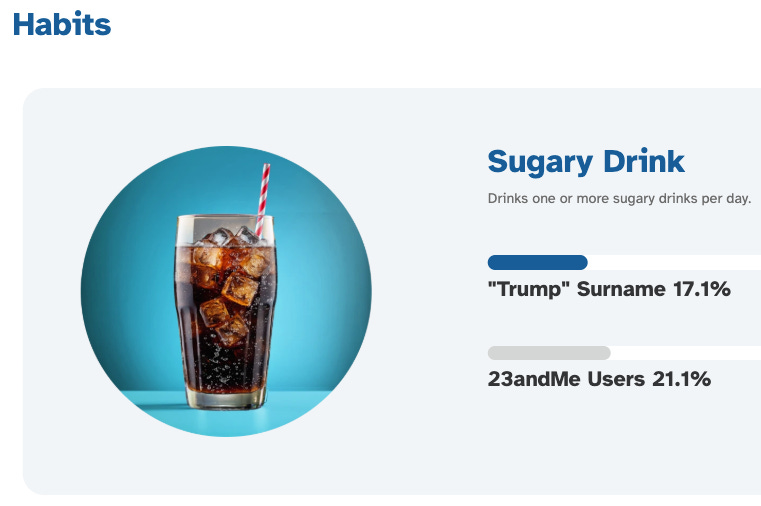
Well, that doesn’t sound like the President. I guess that Donald Trump didn’t sign up for 23andMe. (One advantage of becoming President is that you get your genealogy worked out in vast detail by hobbyists and publicity-oriented professionals.)
The two researchers burrowed beneath the three main ancestries listed to find the percentage stemming from each of 23andMe’s 45 ancestry categories. My favorite is “African Hunter-Gatherer,” meaning Pygmies and Bushmen-Hottentots, both of whom first split off from the rest of proto-humanity over 100,000 years ago.
We are always being told “Sub-Saharans are the most genetically diverse population.” But much of that diversity is from African Hunter-Gatherer category, which appears to be virtually non-existent in America. I enjoyed learning that the American surname with the highest African Hunter-Gatherer ancestry has only 0.13%.
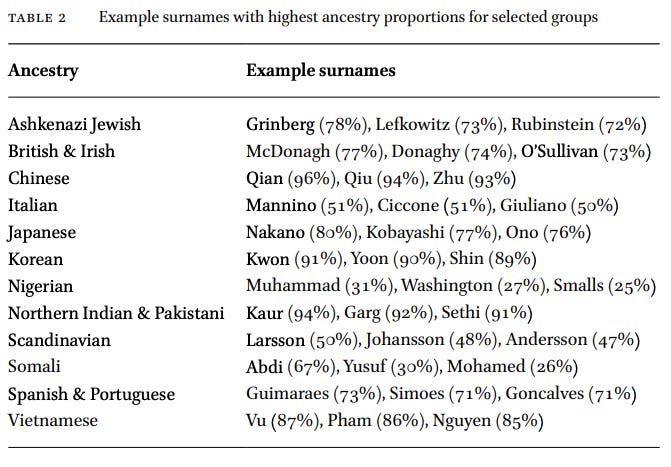
Here’s a table of the least admixed surnames to show that the authors’ basic methodology comes up with reasonable results:
On average, people in the 23andMe database are more admixed than you might guess from their surnames. Here, for example are the very blackest surnames by racial ancestry:
Paywall here.
