

From the New York Times opinion section:
A Black Helen of Troy? Fine. A White Obama? Not Yet.
May 21, 2026
By John McWhorter
Opinion Writer …
John McWhorter (@JohnHMcWhorter) is an associate professor of linguistics at Columbia University. He is the author of “Nine Nasty Words: English in the Gutter: Then, Now and Forever” and, most recently, “Woke Racism: How a New Religion Has Betrayed Black America.” …
The director Christopher Nolan has confirmed that in his film of “The Odyssey,” Helen of Troy — the mythical figure who launched a thousand ships — will be played by the dark-skinned actress of African parentage Lupita Nyong’o.
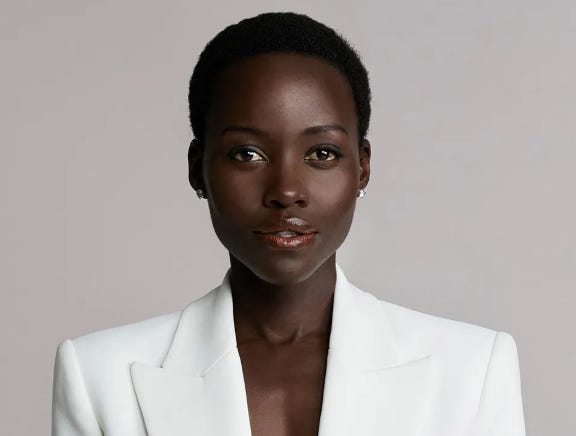
Lupita Nyong’o is a delicate-looking upper class Kenyan, born in Mexico City, where her father was teaching, and raised in Kenya.
Some people have implied this is a denial of history, a performative woke gesture. Would we tolerate white actors playing Black historical figures, they ask? “Casting a Black woman to play a White woman in a foundational work of European literature is no more right than casting a White man to play Shaka Zulu!” Elon Musk objected. The “End Wokeness” X account has pitched in to the outrage with a tableau of hypothetical movie posters of films with white actors playing various Blacks in Wax [huh … what does “Blacks in Wax” mean?], such as Anthony Hopkins cast as Nelson Mandela.
All of this lacks historical context. …
The people who think it’s wrong to cast Nyong’o because Brad Pitt shouldn’t be Shaka Zulu pretend there is no diachrony involved in how we judge such things. Never mind that Helen of Troy was a mythical character.
I would imagine Helen of Troy was a historical figure who became encrusted with legends and myths. A millennium later, Eratosthenes, the polymath who accurately measured the circumference of the Earth, came up with 1184 B.C. as the date of the sacking of Troy (during the late Bronze Age collapse). Which seems reasonable to many (but not all) modern scholars. As the chief librarian of Alexandria, he had access to sources we have lost.
But nobody knows for sure.
What we do know is that Greeks looked more or less the same 3200 years ago as they do now.
There are perfectly good reasons white actors should not be playing Black characters in our moment.
For one, Black actors don’t have as many opportunities as white actors. They should at least be the default choice for playing characters of their own race. It is true that opportunities for Black actors are opening up: a Black military commander in “Game of Thrones,” a Black Little Mermaid, and Black characters in the Regency romance series “Bridgerton.” However, it has only been this way for about 10 minutes, and Black actors still work under limitations. No one would say that a Black young actor, regardless of hotness or talent, could most likely have the opportunities that Timothée Chalamet or Sydney Sweeney has.
The vast majority of the great roles that humanity has created from Hamlet on down were dreamed up by white writers. So, far more great roles were written for whites to perform. Even today in America, the best screenwriters are disproportionately white, despite strenuous efforts during the Great Awokening to promote nonwhite writers, which hasn’t helped Hollywood’s prosperity.
On the other hand, blacks are well represented among recent characters. Consider 2019’s Avengers: Endgame, the capstone of Marvel’s long run at the top. (It was the top-grossing movie of all time for a couple of years.) It features an immense ensemble cast of movie stars. It should have won a special Oscar for Outstanding Achievement in Scheduling.
Out of the first 54 names listed in the cast on IMDB, from the first, Robert Downey Jr. as Tony Stark to #54 Samuel L. Jackson as Nick Fury, I count ten black actors, one of them a black Hispanic: Zoe Saldana. The others are Don Cheadle, the late Chadwick Boseman, Tessa Thompson, Anthony Mackie, Danai Gurira, Letitia Wright, Angela Bassett, Winston Duke, and Samuel L.
There are a lot of good black actors these days.
I’ll count Vin Diesel as unspecified. (There is some mystery around Vin’s ancestry, which he is only partially forthcoming about for personal family reasons. I respect his reticence.)
The really underrepresented racial group in modern American movies and TV are Mestizos. I don’t see any Mexicans or Mexican-Americans among the top 54 actors in Avengers: Endgame and one Honduran-American, Maximiliano Hernández. In contrast, there are two Filipinos in the top 54 (Dave Bautista and Jacob Batalon).
But nobody much cares about Mexicans.
The critics also ignore power relations. If Mark Wahlberg played Muhammad Ali, as End Wokeness’s mock-up has it, Wahlberg would be taking a role from actors in a not so powerful group. If Michael B. Jordan played John F. Kennedy, it would be punching up.
No, 5’8” Mark Wahlberg would have to punch up if he played 6’3” Muhammad Ali.
… Plus, white actors playing Black figures in “blaccents” of various degrees would verge on minstrelsy. It’s one thing that Black British or African actors such as Idris Elba and Thandiwe Newton do American blaccents in roles (and uncannily well). But Reese Witherspoon or Steve Carell? Um — no.
The last blackface role in a big budget Hollywood movie was Downey’s Oscar-nominated turn satirizing Daniel Day-Lewis’s fanatical dedication to Method acting in 2008’s hilarious Tropic Thunder.
Downey plays an Australian actor who has his skin surgically altered in order to portray an African-American sergeant in a Vietnam War drama. He stays in character throughout the gang’s misadventures in the jungle.
Everybody loved it back in 2008. Writer-director Ben Stiller has said he couldn’t get Tropic Thunder made today. (You’ll notice we don’t have as many funny movies anymore as we had in the first dozen years of this century, when it seemed natural that America’s funnymen would churn out a half dozen highly amusing comedies per year.)
In some future time we should have no problem with a talented white man playing the lead in “A Raisin in the Sun,” a white woman cast as Representative Barbara Jordan, or white people singing in “Porgy and Bess.” I didn’t say tomorrow — but sometime.
On stage, perhaps, or in opera, but on screen? Maybe if everybody watched movies only on their phone they could tolerate actors playing a different race. Or maybe if use of AI is accepted for race-changing purposes.
But if Americans continue to watch real actors on big screens, I doubt if we’ll ever see whites playing blacks in dramas again. I could imagine people going back to Tropic Thunder norms and tolerating comic tours de force. But not dramas or biopics.
The truth is that the races really are pretty different in looks and gestures. (It’s almost as if race isn’t just a social construct.) And big screen movies obtain willing suspension of disbelief by providing a high degree of apparent realism.
In contrast, Nolan cast his Irish go-to guy Cillian Murphy as the Ashkenazi Jew Robert J. Oppenheimer with great success: Oppenheimer made $900 million worldwide and Murphy won Best Actor.
The Irish and the Ashkenazis are pretty genetically different for populations within the Caucasian race, but the casting worked famously well because even Irish and Jews aren’t all that different by the standards of world-wide racial differences.
And both Oppenheimer and Murphy are extreme ectomorphs. That’s almost certainly partly genetic, but it’s more an individual idiosyncrasy than a racial trait when talking about Oppenheimer and Murphy.
Skinniness does have some racial element: Kenyans like Nyong’o are generally more ectomorphic than Samoans. But most of the diversity on this dimension found in humanity is within continental-scale races: e.g., NBA legends LeBron James and Kevin Durant are both of West African descent despite being strikingly different in body shape.
So, what do I think of Christopher Nolan’s casting choice?
Paywall here.
