

Eugyppius is a German scholar in one of those academic fields that Herr Professors have tended to be leaders in for the last 200 years. He was good enough at it to earn tenure at a wealthy American college, but eventually packed it in during the Great Awokening and went home to Germany to write his Substack. Here’s his insider perspective on Jacob Savage’s influential “Lost Generation” article in Compact.
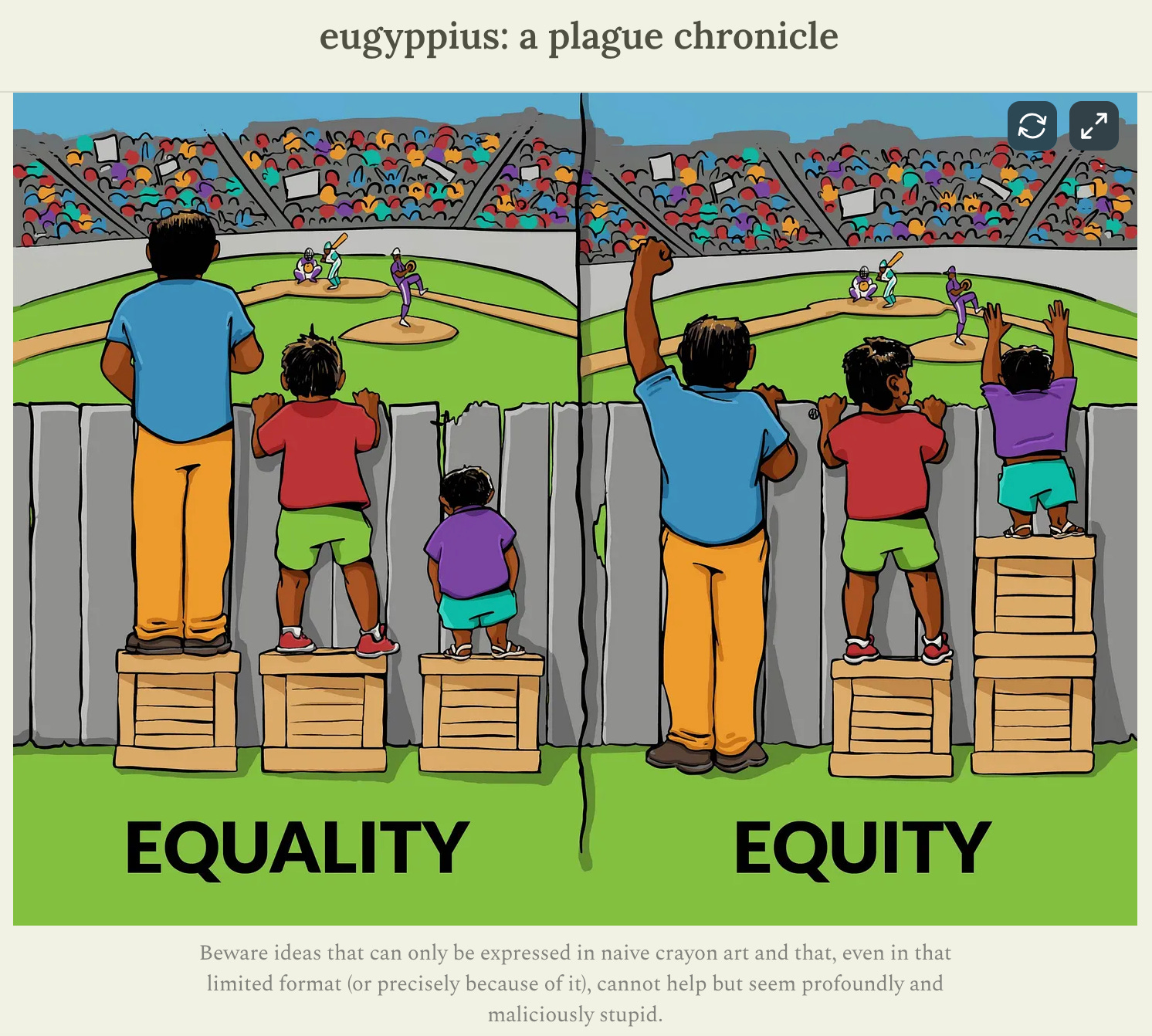
Savage’s ‘Lost Generation’, or: Thoughts on the DEI scam and what happened after 2015
eugyppius
Dec 23, 2025
… I got my first and only professorship in the early 2010s, just before the hammer came down. Of all the white men among my graduate school acquaintances, I’m the only one I know of who got a tenure-track job at all. Then, after I took up my appointment, I had the dubious pleasure of watching my university go crazy. After 2015, intense pressure from the administration and an increasingly powerful minority bloc within my own department made it all but impossible to hire white men, whatever the situation. In some cases merely interviewing a white guy was enough to risk veiled accusations of racism from the diversity enforcers. After I was nearly cancelled a few times, I decided that near-daily racial harassment wasn’t worth the salary. I abandoned my job and moved back to Germany, just a few years into the glorious American cultural revolution. I wasn’t getting paid nearly enough to recentre my professional life around the tiresome intellectual pretensions and imaginary racial grievances of undertalented, overpromoted angry black women.
I’ve had the good fortune to stay out of offices and thus out of office politics for the last 25 years, so I know mostly what people tell me and what I read.
One trend that was exceptionally obvious during the Great Awokening was the exaltation of black women due to the Theory of Intersectionality. Black women, you see, were victims not just of racism (like black men are) or sexism (like white women are) but of both racism and sexism. And since they were the most oppressed, they had to be the best relative to their current jobs. So, therefore, they deserved promotions the most because they had to have the most underexploited talent! The thinking was like the Underwear Gnomes’ business plan, just even more streamlined:
Step 1: Promote black women.
Step 2: Black women do amazingly great on the job.
Step 3: Profit!
As you may recall, a number of prominent institutions, especially in the media, publishing, academia etc, during the Racial Reckoning took this logic seriously and promoted black women to their top jobs (e.g., Claudine Gay at Harvard and Kamala Harris as the Democratic nominee).
It was in all the papers at the time.
My view, of course, was the opposite: the 50 years of the affirmative action era had shown there were good reasons why there were more white than black CEOs and more male than female CEOs, so Sailer’s Theory of Intersectionality implied that black women would tend to make the worst CEOs on average.
And, indeed, a lot of the black women crowned as CEOs, Editors-in-Chief, college presidents, and the like in 2020-2022 started getting fired in 2023-2025.
Don’t let anyone tell you they didn’t know what was going on back then. …
Savage’s service is subtler, in that he’s helped move the DEI craziness that took off after 2015 into the sphere of consensus reality. Since his piece came out, those years of lunacy have become something that people can discuss, criticise and perhaps even repudiate, confident in the knowledge that what happened back then (and, to varying degrees, is still happening now) is on a shared cultural map.
Even though Savage had been writing good pieces along these same lines (e.g., “The Vanishing White Male Writer”) at least since 2023, almost nobody had noticed him yet, which in the odd way that opinion journalism works, made his latest article more credible-sounding.
For example, when I published my well-documented articles in the 1990s pointing out then novel observations like Asian women and black men do better from interracial marriage than Asian men and black women or that contrary to conventional wisdom, the sexes wouldn’t converge in athletic performance and that most of the convergence in the 1970s and 1980s had been due to women runners benefiting more from steroids, these articles weren’t particularly controversial because I wasn’t Steve Sailer yet. I was just some guy who’d obviously put a lot of effort into researching these topics and had come up with plausible insights.
As time went by and I continued to demonstrate the broad utility of my general perspective, however, responses often became, “Well, that’s just what Steve Sailer says and we all know he would say that.”
Similarly, ten years from now Jacob Savage may find the same type of responses. But in late 2025 he was enough of a tabla rasa to have his article evaluated on its facts and logic rather than on what people think about that Jacob Savage guy.
For highly empirical opinion journalists like myself and Savage, the world often works the opposite of sociologist Gordon Allport’s 1950s Contact Theory that predicted that bringing, say, the Jets and the Sharks together would make them come to appreciate each other more as they got to know each other better.
Instead, with my kind of opinion journalism based on a lot of empirical data, familiarity often breeds contempt. For example, a lot of people dismiss anything Matthew Yglesias says that they don’t like based on a few really dumb things Yglesias has said over the course of his massively prolific career. (With me, it’s usually my most obviously true statements that elicit the most rage.)
Naturally, Savage’s article operates from within the world of liberal egalitarian assumptions and devolves at the end into naive pleas about the importance of race- and gender-blind meritocracy. These faults make his material more palatable to the liberal masses and therefore more effective.
In case it wasn’t obvious, the hordes of (mostly gay and/or female) “minoritised” black and brown people taken into the junior ranks of American cultural institutions do not represent a groundswell of heretofore neglected talent.
Paywall here.
