

I attended the final round of the 1985 United States Open golf championship at Oakland Hills in suburban Detroit, a fantastic piece of undulating golf land with endless mid-sized (20 to 30 foot hills) and micro-sized (2 to 3 foot bumps) elevation changes. I don’t recall much about the clubhouse other than it was a worthy backdrop to the drama of the 18th hole on which T.C. Chen of Taiwan almost holed out a bunker shot, clanging it off the flagstick, in his attempt to tie winner Andy North.
The century-old clubhouse burned down in 2022.
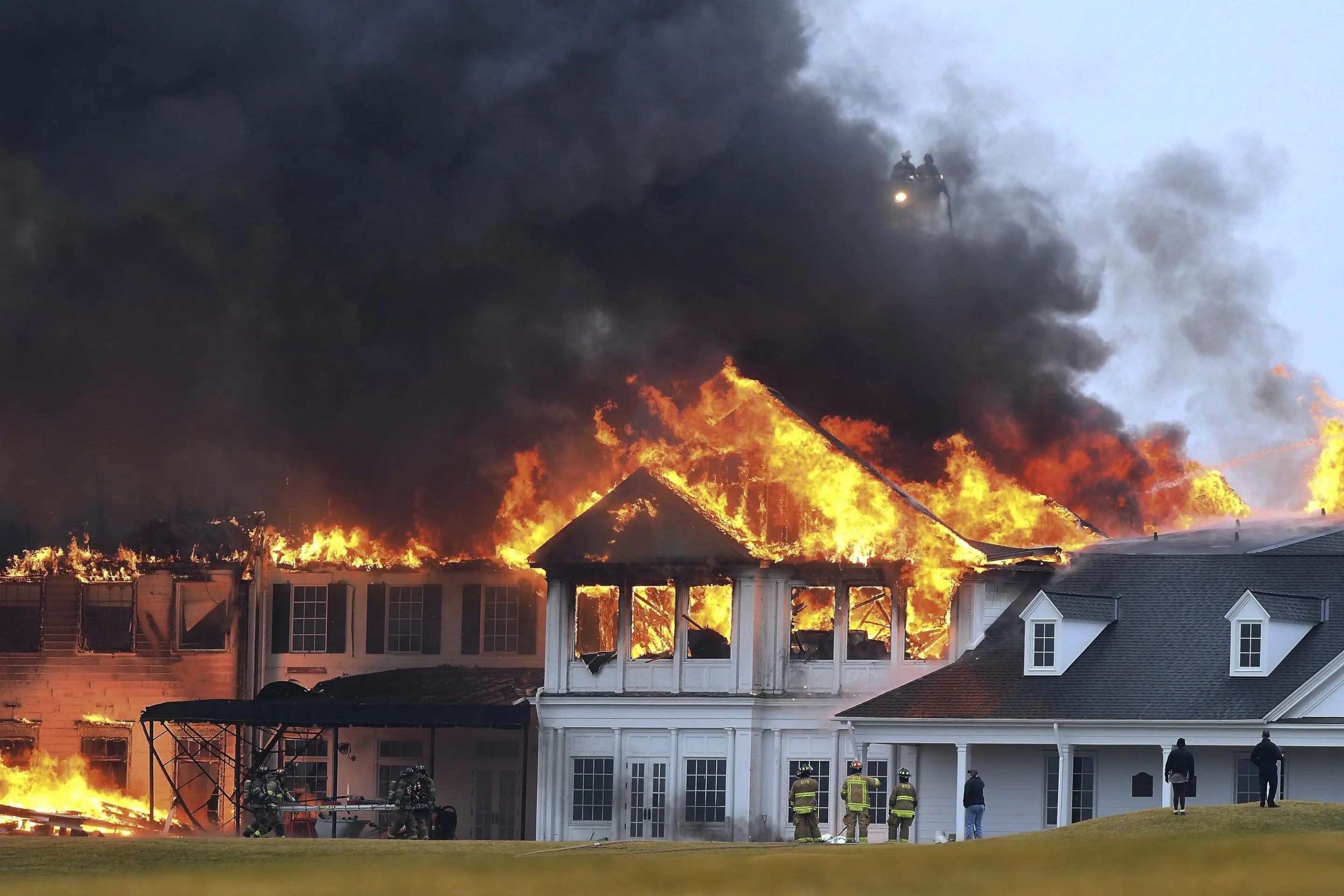
The membership decided to rebuild it to look the same on the outside, although the inside will, hopefully, be more fire-proof.
From the Detroit News:
Oakland Hills announces $100M clubhouse opening date, 4 years after fire
The new clubhouse will very much be a replica of the old, stately clubhouse, albeit with modern infrastructure and amenities.
Tony Paul
Updated March 18, 2026, 10:01 p.m. ET
This would make a fascinating research topic: after a disaster — such as fire, war, terrorism, earthquake, etc. — destroys a memorable building, who decides whether to replace it with something in the latest and greatest style or to rebuild it in the old look?
This question came up a lot when I visited five central European cities last summer.
Prague and Krakow had largely escaped destruction during WWII, so they are wonderful tourist attractions. This doesn’t mean that all their buildings are the originals. Like the ship of Theseus, a lot of the great buildings of Europe have been heavily rebuilt over the centuries. But central Prague and Krakow look much like they did before September 1939, which is great.
Vienna had suffered moderate damage during the Big One, but the Viennese had immediately made great sacrifices to repair by 1952 their towering Gothic cathedral, St. Stephen’s, which had been damaged by Allied air raids. It’s now wonderful, although the original stained glass has mostly been replaced by cheap modernist windows. I would hope the Viennese will someday finish the job, although judging by the immigrant fraction, that’s unlikely.
Berlin had been flattened. I only spent a day in Berlin, so my judgement may be faulty. But I got the impression that Berliners hadn’t gone all out in rebuilding their city due to guilt. I could be wrong.
I chose to visit Warsaw rather than, say, Budapest (which no doubt is lovely) because a lady at the conference I was attending outside Berlin endorsed Warsaw as a triumph of capitalism. (A pleasant feature of Internet-age tourism is that you can just make up your itinerary as you go along with few worries that you won’t be able to find lodging.)
I’d still like to see Budapest, but Warsaw in July was lovely.
There is much in the news this week about how resurgent Poland has surpassed utopian Switzerland in total (but not per capita) GDP with a trillion dollar economy. From the Associated Press:
Poland is now among the world’s 20 largest economies. How it happened
By CLAUDIA CIOBANU and DAVID MCHUGH
Updated 5:02 PM PDT, March 16, 2026
POZNAN, Poland (AP) — A generation ago, Poland rationed sugar and flour while its citizens were paid one-tenth what West Germans earned. Today, the economy of the country has edged past Switzerland to become the world’s 20th largest with more than $1 trillion in annual output.
It’s a historic leap from the post-Communist ruins of 1989-90 to European growth champion, which economists say has lessons on how to bring prosperity to ordinary people — and that the Trump administration says should be recognized by Poland’s presence at a summit of the Group of 20 leading economies later this year.
My impression last year is that …
Paywall here.
