

There’s a new paper on my old topic of Affordable Family Formation, arguing that children haven’t gotten relatively more expensive since 1990.
Here’s a graph of the total fertility rate (projected births per woman) among non-Hispanic white women from 1990 through 2025:
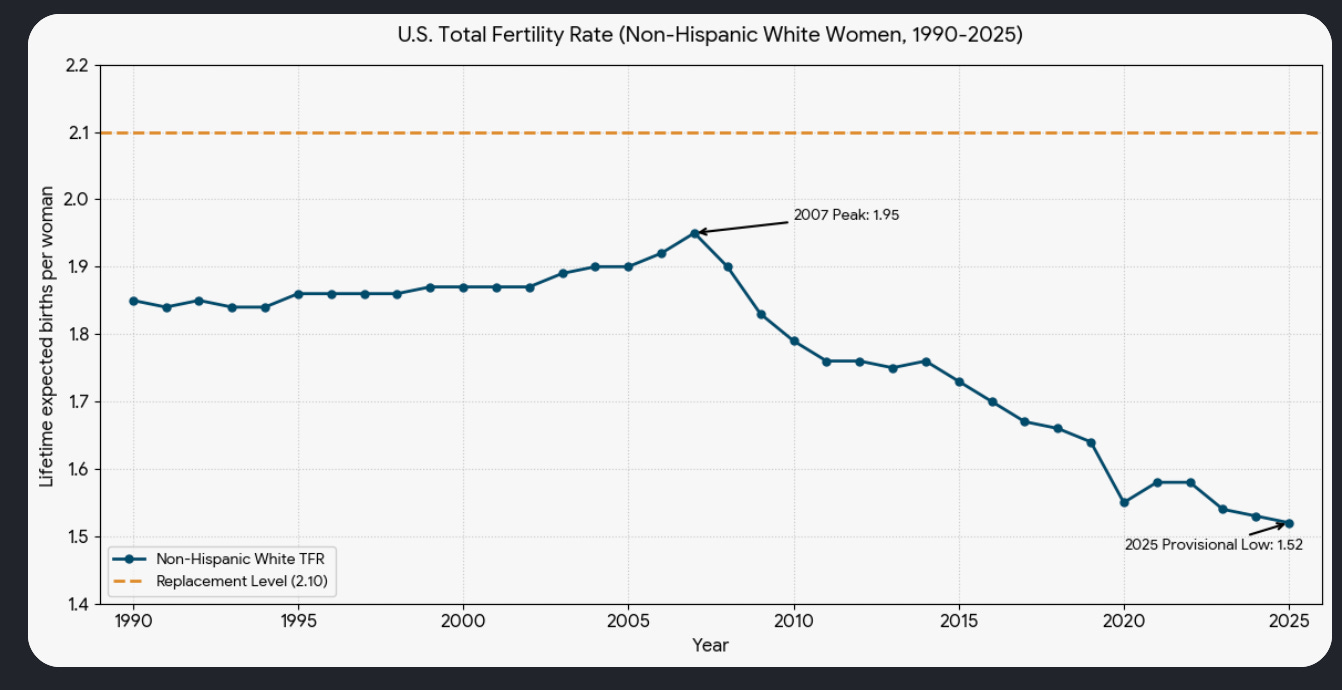
White fertility went up a little around the turn of the millennium, then rose notably during the Housing Bubble of 2006-2007. It then dropped rapidly during the Housing Bust, then stabilized in 2012-2014. But then came the rather mysterious drop from 2015 through 2019.
This new paper argues that (young) children haven’t been getting more expensive since 1990 relative to spending on adults:
Christina Patterson Chicago Booth, CEPR & NBER Heather Sarsons Chicago Booth, CEPR & NBER
July 2026
Despite rapid inflation in childcare and tuition prices, the goods-and-services CCI closely tracks adult prices, as these increases are offset by children’s lower exposure to shelter and by slower price growth elsewhere in the child basket. Households devote substantially more real resources to children than they did in 1990, but this increase parallels the growth of real adult consumption rather than reflecting a child-specific rise in prices. A similar offsetting pattern appears for parental time: the rising value of women’s time is largely counterbalanced by declining motherhood penalties in earnings and work hours, so forgone market work adds little to relative cost growth. The main departure from this stability comes from the growing amount of leisure displaced by childcare; valuing that time raises the CCI, although the magnitude depends on the shadow value assigned to leisure.
… Our central finding is that the monetary price of a child-year has risen at almost exactly the pace of the adult consumption it displaces. Children are expensive, but by the standard tools economists use to measure price change over time, there is little evidence that their relative price has risen dramatically. Only when we price parents’ forgone leisure does the relative cost of children increase meaningfully.
Declining leisure among parents has been noted before, perhaps most vividly in Dave Barry’s 2015 article about all the wild parties his parents threw in the 1950s. Note that Dave’s father was a Protestant minister, they had four children, and lived in Armonk, NY down the road from the IBM headquarters.
My guess is that labor-intensive child-rearing (e.g., today’s intensive concern about speaking to your small children to expand their vocabularies) got fashionable among the upper middle class awhile later, and has spread down the class scale in this century.
Nobody talks much about this, but my impression is that lower class people have gotten more responsible since perhaps 2008 about having children and how they bring them up. So, a lot of the big drop in fertility over the last half of a generation seems to have to do with people further down the social scale taking to heart higher class habits about when they can afford to bring children into this world.
But some of the study’s assumptions seem doubtful:
Paywall here.
