

Some of the ill-fated Great Awokening tracks back to white and Asian journalists getting hooked on Black Twitter about 15 years ago. The modern equivalent of Yo Mama jokes were highly entertaining, but when Trayvon Martin and similar serious-sounding incidents came along, pundits didn’t realize that conspiracy theories made up by blacks were probably even less likely to be true than conspiracy theories made up by whites.
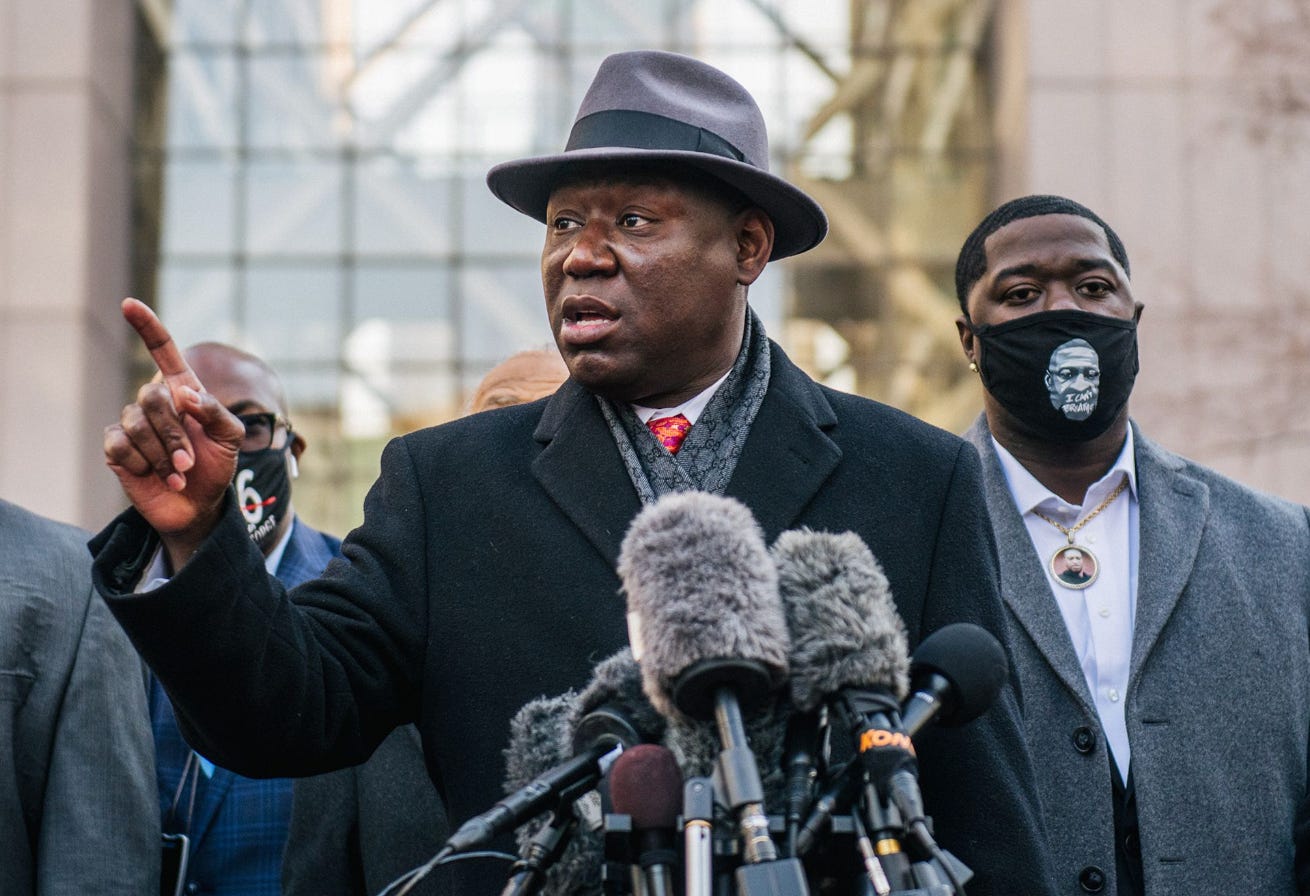
Within a few years, one obvious tell should have become that you shouldn’t get too excited over the cases taken on by attorney Ben Crump, such as Trayvon, Michael Brown, George Floyd, Ahmaud Arbery, and Jacob Blake. Each one would initially sound like Crump finally had Proof of the giant white conspiracy to murder innocent blacks. But then when the details finally came out, it was just more lowlife screw-ups.
Now, Crump is promoting three blood libel conspiracy theories that whites murdered three black youths, each of whom more likely died accidentally, two by drowning, one by self-inflicted gunshot.
Q. What’s Crump’s proof of his clients’ sons being murdered by Racist Whites?
A. They were socializing with their white friends.
And we all know that whites are constantly plotting to murder their black friends.
Why do young black males die by gunshot and drowning so much? I mean, it can’t possibly be the fault of black people, so therefore it must be the fault of white people.
The Guardian, which did such fine work when it finally weighed in on Jake Arday, has fallen hard for one of Crump’s stories. From the Guardian news section:
Uncertainty around the investigation into the death of the 18-year-old, whose body was found after a 4 July boat trip with friends, has led some to question whether justice will be meted out equally
Adria R Walker
Wed 5 Aug 2026 06.00 EDT
Almost a month after his body was found, mystery still shrouds what happened to Nolan Xavier Wells, an 18-year-old college student from Ocean Springs, Mississippi.
There are the facts: Wells was alive on the morning of 4 July when he and a group of friends took a boat out to Horn Island, a barrier island off the coast of Mississippi. Hundreds of people were on the island, enjoying a last hurrah before returning to work or school after the holiday weekend. Wells was due to report to Southwest Mississippi Community College the following Monday for football camp, but he never returned home with his friends that day. The last known photos of him were taken around 4pm that afternoon.
Three weeks ago in “Is Nolan Wells the New Emmett Till?” I pointed out that the CDC reports that black males age 15-24 die by drowning 2.9 times as often as white males of the same age:
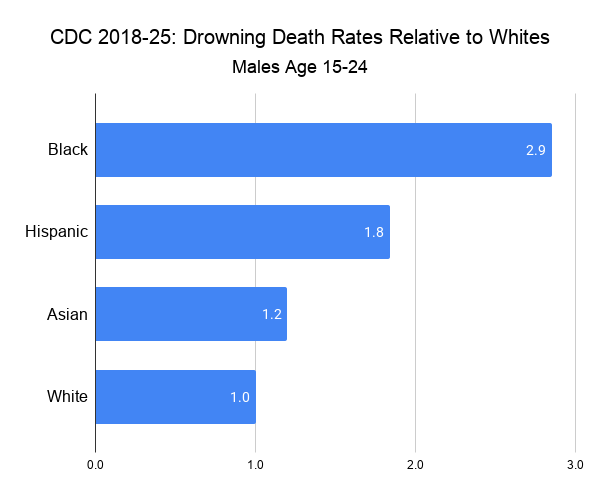
It would be a good deed for the press to Raise Awareness among young black men of the dangers of drowning. But the media would rather talk about the Murderous White Friends menace:
… In a widely circulated photo of Wells and his friends from the boat, scores of people on social media have pointed out the racial makeup of the group: Wells was the only Black person, while the three others with him were white, one of whom is the stepson of the Jackson county chancery judge Ashlee Cole. None of the others who were on the boat have been named as suspects in connection to Wells’s death, though Jackson county sheriff John Ledbetter has said that Wells’s friends were cooperating with authorities.
The case, and the uncertainty surrounding the investigation into Wells’s death, have sparked discussions about the history of racial violence in Mississippi and have led some to question whether justice will be meted out equally. …
That a local judge’s family member is one of the last people to be pictured with Wells hasn’t helped quell suspicion of the case’s handling, according to some community members who spoke with the Guardian. Cole, who has said that her family has been receiving death threats,
Cole is the judge whose white son was a friend of the dead youth. The Coles have been getting death threats from people who believe Crump’s racist blood libels.
wrote on Facebook that she and her family were cooperating fully with authorities and will “do everything within our power to assist Nolan’s family in their quest for answers”. She said that her family would not be speaking to the press at this time.
The Jackson county sheriff’s office said it interviewed witnesses in the days and weeks after Wells’s death. The state and an independent medical team organized by Wells’s family and the high-profile civil rights attorney, Ben Crump, completed autopsies of Wells’s body. Though the results of the state’s autopsy have not yet been revealed – Jackson county’s district attorney, Angel Myers McIlrath, said they would not be released until a grand jury is convened – the Wells family released the results of their independent autopsy on 22 July.
At the NAACP’s national convention in Chicago, Crump revealed that the state had turned over the body with Wells’s throat missing, and also said there was significant red discoloration along the back of his neck and head. The cause and date of death were both inconclusive.
In other words, Ben Crump’s hired coroner couldn’t come up with anything that even Ben Crump’s hired coroner would stand by.
“We are in Mississippi,” Crump said weeks ago. “These were three young white men. Nolan was the only young Black man. Had the roles been reversed, we know this investigation would be going differently. It would be like The First 48. They would be interrogating those young, Black boys.” (The Jackson county district attorney’s office has not responded to the Guardian’s request for comment.)
Crump is just asking questions.
Most recently, investigators hired by the family are looking into audio released by the Mississippi department of marine resources of a distressed phone call one of Wells’s friends made to a local boat company on 4 July. The person who made the call can be heard saying that the boat was sinking.
The case has received national interest – with figures such as the social justice activist the Rev Al Sharpton, the former NFL quarterback Colin Kaepernick and the film-maker Tyler Perry stepping in to support the Wells family. Kaepernick paid for the independent autopsy, Perry paid for Wells’s funeral, and Perry and Sharpton are offering a monetary reward for information.
In the absence of answers, some social media users and community members are trying to fill in the gaps themselves. “We are not getting any information or updates around the investigation, the progress of the investigation from either Jackson county sheriff’s department or the Jackson county DA’s office,” Lea Campbell of the Mississippi Rising Coalition, a civil rights organization, said. “We are left to fill a vacuum. There’s a lot of information being shared across social media, and it’s hard for folks to know what to believe and what not to believe.” Some, including Crump, have likened Wells’s disappearance and death to the 1955 lynching of Emmett Till, a 14-year-old Black boy who was murdered in Drew, Mississippi.
Of course they did.
… Last year, Ocean Springs, where Wells was from, was voted the “friendliest small town on the Gulf Coast” by World Atlas, a publishing resource for geography and travel. The town is nearly 80% white.
It’s nearly 80% white. And we all know what that means.
Nobody will ever be able to rest easy until that percentage is approaching zero.
Some locals painted a different picture, as tensions across the Gulf coast are “definitely heightened”, Campbell said. “Given the historical context here in Mississippi around the deaths of Black people and the white power structure in Mississippi, protecting white folks who have committed violence against Black folks or killed them, it’s understandable that folks don’t have a lot of trust at this point,” she said. “We want, and folks want, answers. Folks deserve answers. There’s a lot of anxiety that can’t be separated from the context of Ocean Springs itself.”
The Mississippi Rising Coalition was active in the statewide fight to change Mississippi’s state flag, which, until 2020, had a Confederate battle emblem on it, Campbell said. During those efforts, the Ku Klux Klan, a white supremacist and domestic terrorist hate group, threatened the activist organization. “There was a lot of racism that surfaced publicly then,” Campbell said. “This tragedy does not exist in a vacuum.
“The Jackson county sheriff came out very shortly after the body was discovered and made a public statement that no foul play was suspected,” Campbell added. “Then you have the state medical examiner who sends the body to the independent pathologist for an independent autopsy and doesn’t send the throat. Then you have the Jackson county DA coming out and giving a very nicely worded statement to all of us, lecturing us to have blind trust … Layer all of these things in and it’s no wonder this is getting the attention that it’s getting – it should be.”
That context and history are personal for John H Whitfield, a Black pastor who grew up on the coast near where Wells lived. As a boy, Whitfield said his parents told him to stay out of Jackson county. He recalls a memory from his childhood where a Black man was picked up by police in Jackson county, allegedly for driving while intoxicated. “He never walked out of that jail,” Whitfield said. “They said he hung himself and nobody ever believed that. You can’t look at these things in silos and isolation.”
In an effort to make sense of the distrust and skepticism from the local Black community about the case, Byron D’Andra Orey, a political science professor at Jackson State University, points to “a theory known as ‘racial threat’”. It argues that areas with a higher concentration of Black people have the most punitive laws and the most violent crimes. The state’s history, he said, was inextricable from how people, both in and out of the state, are responding to what happened to Wells.
“We’ve seen various incidents where justice was not handed down,” Orey said. “Violent incidents as it relates to violence against Black people – because it’s not just Black men, but Black people in this country. In many instances, we don’t see any justice. So when people see this nationally, and then to see that it’s Mississippi, folks have doubt as to whether or not justice will prevail. This is a pattern that’s occurred throughout the country and it’s a residual that people still sit with. People come in with a predisposition that Black lives do not matter, so we do not expect for justice to prevail.”
The search for Wells and his death were a “breaking point”, said Ash Dawn Caranna, an organizer of MS Gulf Coast Human Rights Organization. “We just experienced the pain and loss of a one-year-old baby in Senatobia, Mississippi, Kohen Wiley,” Caranna said of the Black child who was killed by a Senatobia police officer outside a Walmart on 14 June. “With the attention that was already being put on Mississippi, once we saw the situation with Nolan, it kind of reached a boiling point for people here. Nolan Wells was deeply, deeply loved, even by people that didn’t know him.”
On 30 July at a conference for the National Urban League, a civil rights organization, Wells’s parents and Crump were joined by the families of two other Black 18-year-old boys who died under suspicious circumstances.
Paywall here.
