

Canada barely had any slavery or blacks, so its Establishment devotes the energies that America’s Establishment poured into promoting Black Lives Matter's campaigns for more black deaths by homicide and car crash into making the lives of Canadian Amerindians even more poor, nasty, brutish, and short than they would be without their help.
For example, since the 1990s, Canada has had an official policy that judges should go easy in sentencing Indigenous people due to so many Indians and Inuits committing crimes that get them sent to prison. In the 1999 Gladue case involving a drunken Canadian Indian lady who stabbed her common-law husband, a fellow Indian named Rueben Beaver, to death for cheating on her with her sister (for which she did a full six months in prison), the courts invented the “Gladue report,” which lists for the sentencing judge’s edification all the excuses imaginable for criminal violence by aboriginals, such as:
Some elements included in Gladue reports are the history of colonialism, cultural oppression, poverty, abuse suffered, and residential school attendance experienced by the Indigenous offender.
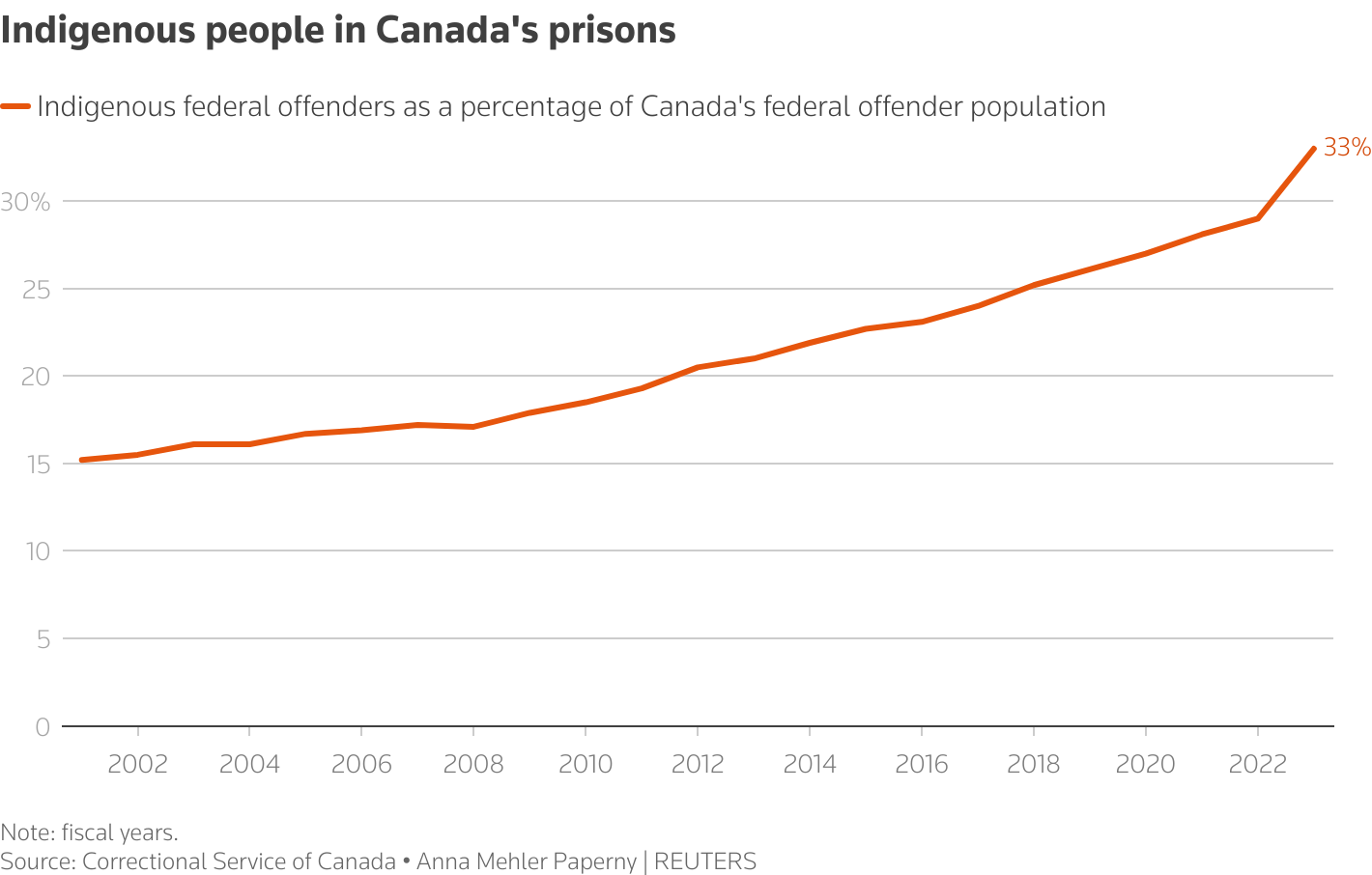
Not surprisingly, the percentage of inmates in Canada who are of Indigenous ancestry (less than 5% of the population) has only gone up since the Gladue initiatives to reduce their punishment for committing violent crimes. It’s almost as if less punishment equals less deterrence.
This is especially true among violent females criminals, such as Ms. Gladue, among whom Natives now make up about half of all women in prison.
Around 1990, a friend of mine was talking to a famous comedian’s brother who was a prison guard in upstate New York. Back then, before the big construction of more prisons in the mid-1990s, the state of New York was under a court mandate due to prison overcrowding to let killers out early. “Hey, is there anybody you really want to murder? Because, if there is somebody who really has it coming, now is the time to do it. We’ll have to let you out in 8 years.”
In contrast, Ms. Gladue did 0.5 years.
In the 1999 Gladue decision, the killer was a woman and the killee was a man, so it apparently did not occur to the judges that reducing homicide punishment of aboriginal killers would on average lessen deterrence of wife-murdering.
Much to the evident surprise of the solons who dreamed up the Gladue decision in 1999, but probably not to my readers, Canada now also has a mirror image criminal justice crisis: Missing and Murdered Indigenous Women and Girls. Indigenous women die by homicide about 6 times as often as other Canadian women.
Not surprisingly, the vast majority of murdered Indigenous women are murdered by Indigenous men.
The Canadian Supreme Court last week finally got around to confronting the inevitable conundrum between punishing Native wife-beaters less and protecting Native wives more.
From Canadian Lawyer Mag:
To be frank, the Canadian supreme court utterly failed to reconcile the two desired outcomes.
But it would be nice to assert that it had somehow figured out how to reconcile them.
So let’s just say it did.
A split ruling on Friday introduces a three-step test for reconciling the two requirements under criminal law
SCC reconciles need to address high Indigenous incarceration rates with protecting Indigenous victims
By Jessica Mach
Oct 09, 2026 / Share
Courts must apply a three-step test when balancing Canada’s criminal law requirements to consider the disproportionate incarceration of Indigenous peoples with the fact that Indigenous women and girls experience high rates of violence, the Supreme Court of Canada ruled in a 5-4 decision on Friday.
R. v. Cope represents the first time the high court has laid out the test, which aims to reconcile the Criminal Code’s approaches to what SCC Justice Michelle O’Bonsawin called “two intertwined social crises.” Writing for the majority, O’Bonsawin said the excessive imprisonment of Indigenous individuals and the abuse suffered by Indigenous women and girls are two issues shaped by the experiences of colonization.
In other words, the violence of Indigenous men upon Indigenous women is all the fault of white people. And blaming white people even more than before will somehow keep Aboriginal men from murdering their womenfolk.
“Addressing them together is central to the ongoing process of reconciliation,” the justice wrote.
Friday’s ruling also clarified that it is not a legal error per se when a sentencing judge fails to meaningfully consider the recommendations resulting from a sentencing circle – a process in which members of the affected Indigenous community, the offender, lawyers, and the sentencing judge come together to discuss an appropriate sentence.
However, this error could amount to a failure to properly conduct the second step of the sentencing analysis set out in the SCC’s 1999 decision in R v. Gladue, which requires sentencing judges to consider sanctions and sentencing procedures that would be appropriate given the offender’s Indigenous background.
Gladue was a landmark decision in Canadian criminal law. It requires sentencing judges to consider the aspects of an Indigenous offender’s background that stem from their position as an Indigenous person in Canada – like their experiences with dislocation, discrimination, substance abuse, high unemployment rates, or community fragmentation – when crafting a criminal sentence. The landmark decision clarified how courts should apply s. 718.2(e) of the Criminal Code, which came into force in 1996 to address the overrepresentation of Indigenous people in Canadian prisons.
The high court’s ruling in R. v. Cope
“Cope” is a hilarious name for this decision.
upholds a previous decision by the Nova Scotia Court of Appeal, which reduced the sentence of a Mi’kmaw man with severe mental health challenges from five to three years in prison after he violently attacked his partner, a Mi’kmaw woman.
SCC Chief Justice Richard Wagner and justices Malcolm Rowe, Mahmud Jamal, and Suzanne Côté dissented, stating they agreed with the original five-year sentence.
Jonathan Rudin, one of the lawyers who represented Cope, told Canadian Lawyer on Friday that there has long been confusion among lawyers and judges over how to balance Gladue with other provisions in the Criminal Code that aim to provide justice to Indigenous female victims of abuse and violence, with some wondering whether one cancelled out the others.
Indeed.
The high court’s new three-part test “helps people understand that this isn’t a contest between the Indigenous victim on the one hand and the Indigenous offender on the other hand,” Rudin says. “It’s not a battle.”
It would seem like it is inevitably a battle between Indigenous victims and Indigenous offenders, but as long as you assert that it isn’t, I guess I have to believe you for reasons.
Paywall here.
