

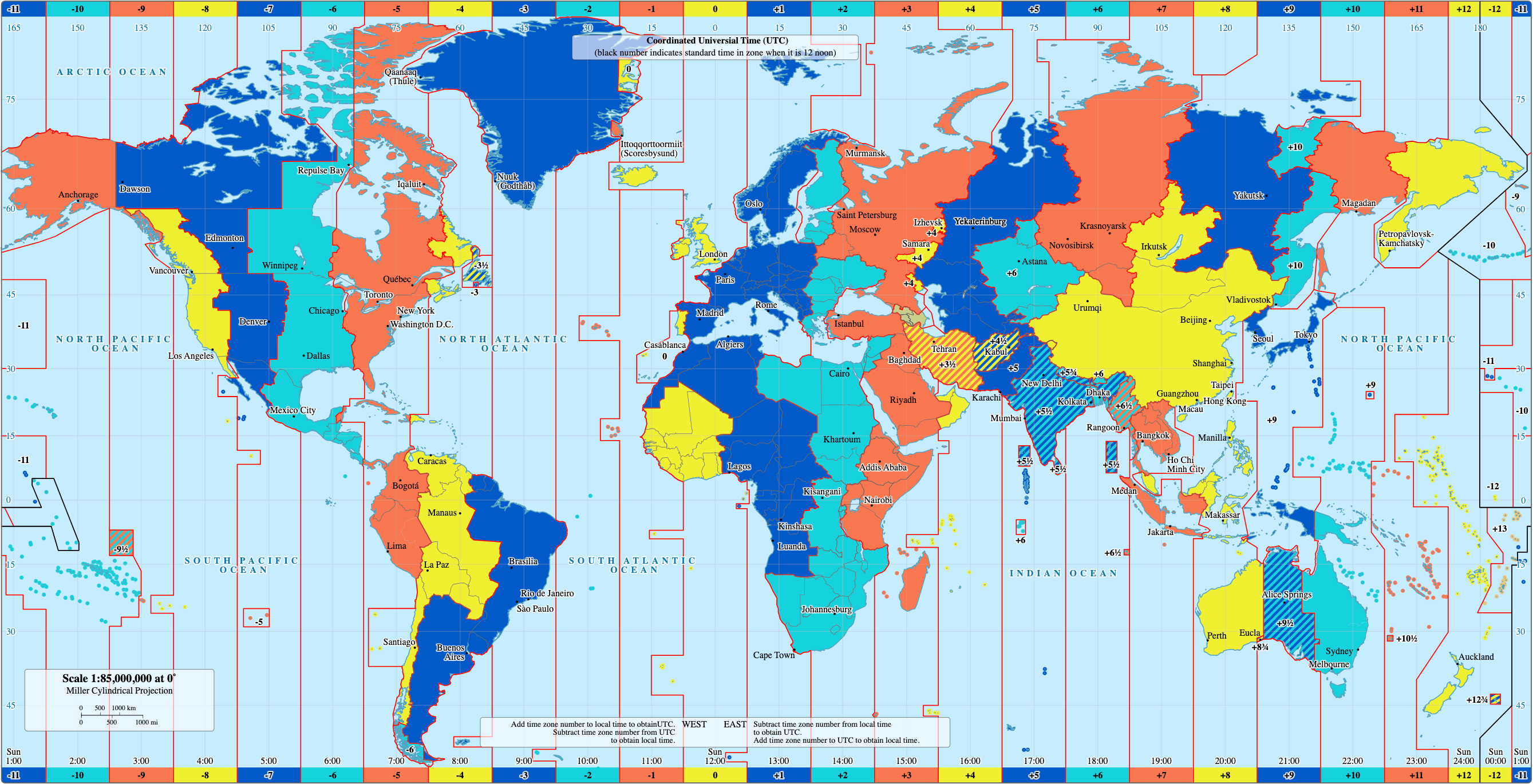
One of my more boring obsessions is the idea that time zones are important for future developments.
When I was young, it was widely assumed that just as lots of people in New York had moved to California for the nice climate (e.g., the popular music industry famously relocated from N.Y. to L.A.), in the future when electronic communications were perfected, lots of talent in California working in high end industries like finance and software would move to Hawaii for the utopian climate.
But that didn’t happen.
One reason is because after the Internet came along to make it more feasible to work from Hawaii, people stopped going outside as much, so climate mattered less.
Another reason is because Hawaii is a bridge too far in terms of time zones. Tom Wolfe wrote a funny vignette about all the guys in suits walking through the predawn darkness of San Francisco’s financial district because the New York Stock Exchange’s opening bell is at 6:30 am Pacific time. So you have to get up at, say, 4:45 am to get to the office from Marin County and get organized before trading starts. But that’s a sacrifice a reasonable number of people are willing to make to afford to live in Marin County. (Similarly, Michael Milken was able to roil Wall Street in the 1980s from Beverly Hills by starting work by 5:30 am every day.)
But the NYSE opens at 3:30 am in Hawaii, and there’s no way anybody with a nice job is going to get up at 1:45 am to get into the office.
Similarly, when I read about plans by sports leagues to expand globally in terms of fans and, later, teams, I try to figure out how that would work in terms of at what o’clock would the games be aired.
For instance, just within the United States, it’s easier for a college sports programs in the Eastern or Central time zones to get a big following than in the Mountain or Pacific zones.
When I was a kid, college sports fame mostly depended upon newspapers or, most prestigiously, Sports Illustrated, which arrived in the mail on Thursday every week. Hence, it was possible for UCLA to win 10 of 12 college basketball championships from 1964 through 1975, and USC won 4 national football titles over a slightly longer stretch.
Over the years though, appearances on cable TV came to dominate renown, and the two eastern time zones were a lot better for getting big audiences than the two western time zones. At present, about 47% of the population lives in the Eastern zone, 29% in the Central, 7% in the Mountain and 16% in the Pacific.
Hence, star high school athletes tended to be most enthusiastic about signing with colleges that they and their friends saw on TV the most. This has helped bring about the demise of the Pac-12 in football, with Stanford and Cal (Berkeley) joining the Atlantic Coast Conference (!).
From the Washington Post sports section, an article expanding upon the deeper meaning of the NFL game being held in Spain this weekend:
With new customers in their sights, every sports league is going global
All the world’s a playing field when there are potential new revenue streams at stake
November 15, 2025 at 4:31 p.m. ESTtoday at 4:31 p.m. EST
Column by Barry Svrluga
MADRID — What will happen Sunday afternoon at Santiago Bernabéu Stadium
This newly renovated 83,000 seat stadium is the home of the Real Madrid soccer team. Their rivalry with FC Barcelona, which was long the club of Lionel Messi and whose stadium Camp Nou is currently being expanded to 105,000 seats — is probably the most famous in world sports, being a non-lethal re-enactment of the Spanish Civil War of the 1930s with Real Madrid standing in for the Right and FC Barcelona for the Left. So, this is a big deal for American football in its putative competition with soccer.
The five biggest European soccer leagues (England, Spain, Germany, Italy, and France) have about $22 billion in revenue compared to $19 billion for the NFL, $12 billion for each of the NBA and MLB, $6 billion for the NHL, and $2 billion for America’s Major League Soccer. (College football is up there too, and college basketball isn’t tiny either. But both are hard to measure precisely.)
— yes, it will be afternoon over here while it’s morning back home — is at base a football game between the Washington Commanders and Miami Dolphins.
3:30 pm in Madrid, 9:30 am in Miami and Washington, and 6:30 am on the West Coast.
It is also quite obviously a tiny piece of a massive business plan. For the struggling Commanders and Dolphins, the game matters. For the NFL, the exercise in global marketing is far more important.
Sunday’s game is the 62nd that America’s most valuable sports league will stage as part of an “International Series” that dates from 2007.
Leaving aside sociological questions of how much Europeans can be expected to ever care about the expensive, violent, and idiosyncratic American sport of football — as far as I can tell, Spaniards like futbol just fine — I want to talk about a practical roadblock to the globalization of sports leagues: time zones.
The appeal of sports television to advertisers is that it’s just about the last programming that happens lives. The NFL’s Super Bowl gets 127 million viewers on average over the course of the game in the U.S. and approaching 10 million in each of Canada and Mexico. Nothing else American comes close.
On the other hand, nobody much cares about watching sports any time except live. I try to avoid sports headlines during the Olympics because I enjoy watching NBC’s tape-delay primetime broadcasts. But these are sports I only care about every four years. (Hey, it’s the Flying Tomato guy! I like him!)
But one obvious practical problem with expanding American sports leagues’ followings in Europe is that western continental Europe (as far east as Poland) is six hours ahead of Eastern Standard Time in New York, while Britain, Ireland, and Portugal are five hours ahead.
For instance, the Super Bowl kicks off at 6:30 pm EST to optimize U.S. ratings. But that would be 12:30 am in Madrid. Granted, Madrileños traditionally keep weird hours due to their siesta, but staying up until 4 am Monday morning would be asking a lot of Spaniards, much less of sensible Dutchmen and Poles.
And the NFL is better situated to get some European fans than other North American leagues …
Paywall here.
