

Nathan Cofnas writes a Wall Street Journal oped today:
How I Became the Scapegoat in the Jason Arday Affair
I have been smeared as a racist and threatened with violence. My university suspended me. All I did was tell the truth.
By Nathan Cofnas
Aug. 21, 2026 6:21 am ET
I broke the Jason Arday story on Substack on July 21.
Arday was hired to great fanfare in 2023 as the youngest black professor in the history of Cambridge University. I showed that he engaged in extensive plagiarism and had fabricated much of his extraordinary life story. His work that wasn’t plagiarized was of such low quality that it couldn’t justify a position at any university, let alone a chair professorship at Cambridge.
Within hours, my article had exploded on X and Substack. Three days later, it was picked up by the Telegraph, then the Times of London, Retraction Watch and all the rest. Finding every lie that Arday told since childhood became a national sport. U.K. newspapers published 249 articles about him in a 22-day period.
After initially dismissing Arday’s critics as waging a “vile campaign,” on Aug. 5, Cambridge announced that it would investigate him. A few hours later, Arday resigned. On Aug. 14, he was found dead of an apparent suicide.
Arday was an adult who was morally responsible for his actions. But he was mostly responding to incentives that were created by other people. His punishment went far beyond what was justified by wrongdoing he may have committed.
For me, this story was never about Arday or even Cambridge. It was about the system of DEI—diversity, equity and inclusion—which applies different standards to people based on identity characteristics like skin color. Arday was an extreme example of how DEI policies can create a mismatch between qualifications and position.
I reject DEI in favor of treating people as individuals. The whole range of talent exists within every race and both sexes. But I don’t believe in equal outcomes as a moral ideal, or as something that is likely to occur in a free society.
Who is responsible for the tragic outcome? Start with the university. The Cambridge administration has been aware of Arday’s plagiarism since at least 2023, when they were tipped off by another academic, Dave Harris. They also knew about his propensity for fabulation since at least last year, when he falsely reported being attacked by a racist with a knife in his Cambridge office. They had years to find a way to let Arday down gently, for example by moving him into a nonresearch position. Instead, they apparently planned to cover up the scandal for three decades until his retirement. They set him up for humiliation.
When the story became public, the Cambridge administration didn’t learn any new information. Nevertheless, when Arday became an embarrassment, they signaled that they would no longer protect him. He was used as a pawn from beginning to end.
What about the press? Two-thirds of the 249 articles about Arday were published after he resigned from his professorship, and the whole world already knew that he had lied and committed plagiarism. It is questionable whether most of this had legitimate news value.
But it was amusing.
Then there’s me—a former Cambridge philosophy fellow and (until Thursday morning) postdoc at Ghent University in Belgium—who wrote a single article pointing out the truth.
I have been flooded with death threats, smeared in countless newspaper articles, and accused of targeting Arday because I think that, as one commentator put it, “people like Cofnas simply don’t believe that Black people deserve to be professors at all.” Speaker after speaker at the vigil held for Arday in Trafalgar Square on Monday denounced me by name, including a prominent politician. Many have claimed that I fabricated the evidence against Arday, although this is easily refuted.
On Aug. 18, the U.K.’s National Union of Journalists released a “Statement on the Death of Jason Arday.” After “condemn[ing] attacks against individual journalists,” the statement singles out one person for criticism: me. “That one of the highest profile critics of Arday was Nathan Cofnas, a former Cambridge academic and self-described ‘race realist’, is deeply concerning.” Although no one has found so much as a mistaken comma in the article I wrote about Arday, I’m apparently not entitled to protection against attack for telling the truth.
On Thursday afternoon, I received a message from the rector of Ghent University, Petra De Sutter, notifying me that, in the wake of the backlash from the Arday affair, she was suspending me from my position as a postdoctoral researcher. Her letter made it clear that the school has laid the groundwork to fire me.
I’m an easy scapegoat because I hold views about race that are controversial and easily misunderstood. I argue that differences between ancestral populations aren’t entirely due to environmental forces, and that some group disparities stem from natural differences for which no one is to blame.
But where’s the fun and profit in not blaming another race with deep pockets for your race’s shortcomings?
I made a widely quoted statement: “Under a colorblind system that judged applicants only by academic qualifications, blacks would make up 0.7% of Harvard students.” That sentence has been cited repeatedly as evidence that I’m a racist.
From CEOUSA’s analysis of Harvard’s internal report:
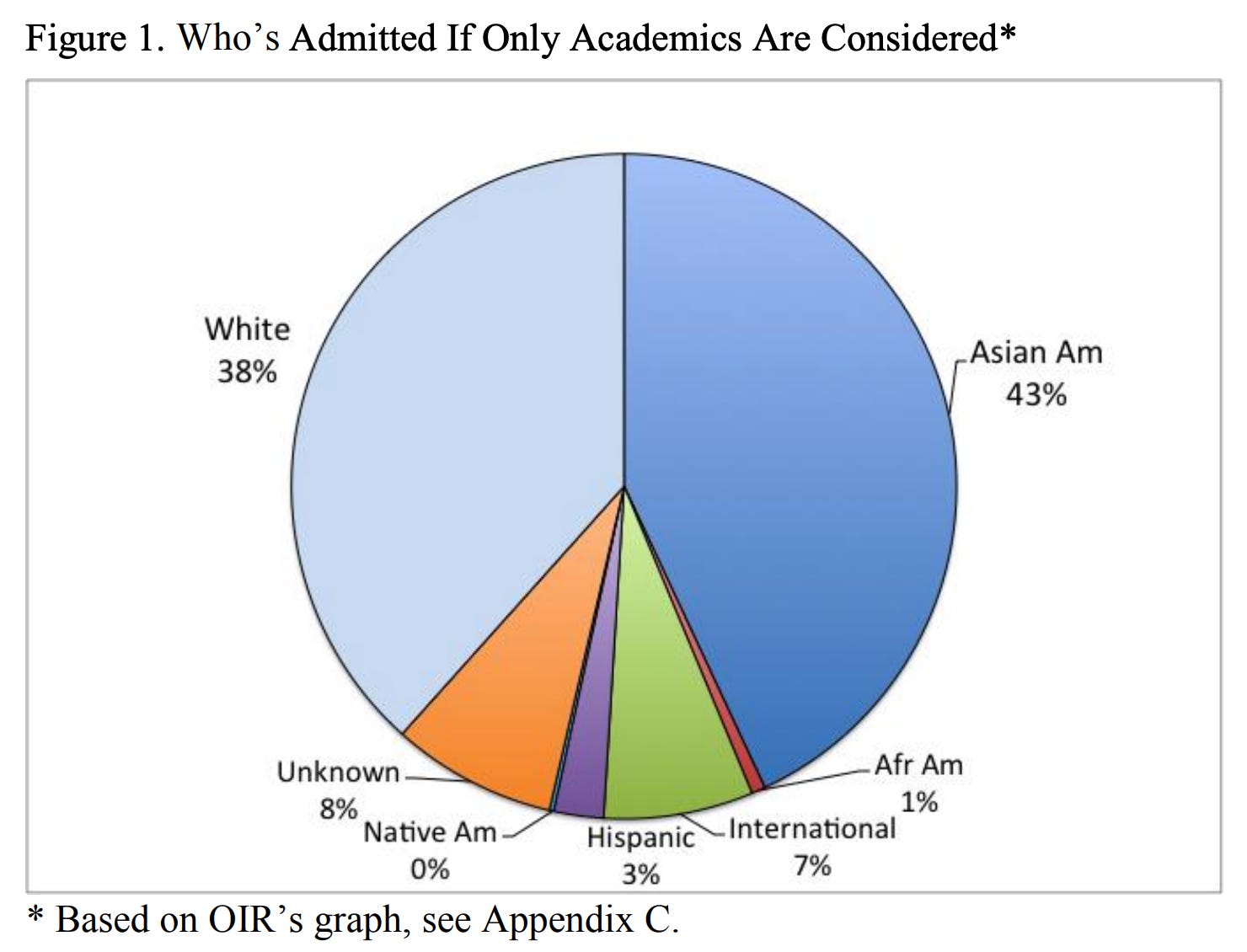
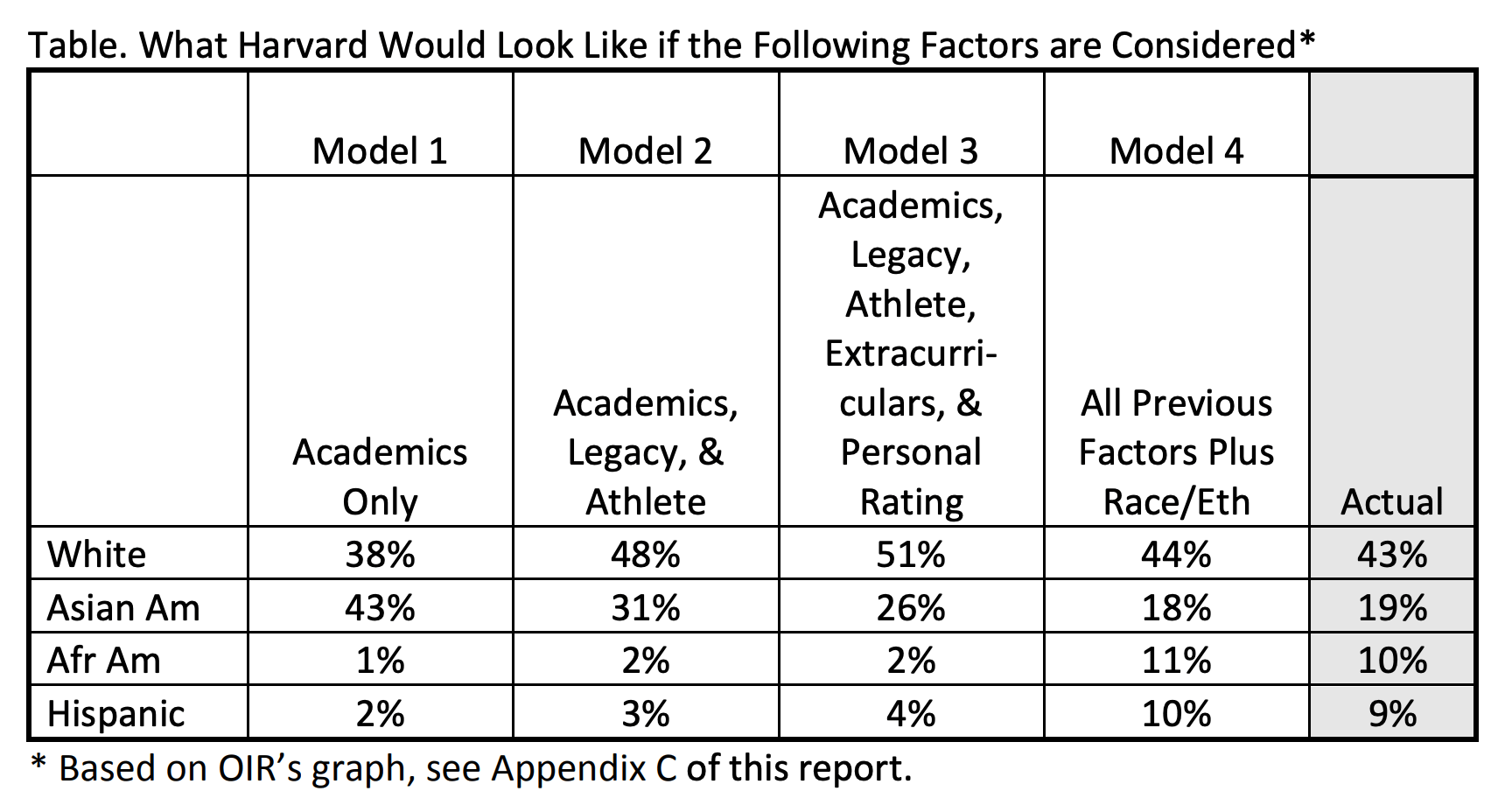
Few people are aware that my statement about Harvard admissions was summarizing a finding by Harvard itself. In the course of the Students for Fair Admissions v. Harvard lawsuit, Harvard disclosed an internal study conducted in 2013, which found that, if admissions were based only on grades and test scores, the undergraduate population would be 0.7% African-American—a significant reduction from current levels. Racial representation at many American institutions is maintained by Harvard-style affirmative action.
And Harvard faculty would presumably be even less black under a purely meritocratic system of academic hiring than would be Harvard undergrads. So Cofnas’s conclusion that Harvard’s faculty black percentage would be approach zero sounds plausible.
Note, however that that’s for Harvard, not for Wayne St.
On the other hand, many undergrads are admitted for reasons other than academic potential such as:
Athletes
Charismatic personalities
Race and Ethnicity
Celebrities
Legacies
Faculty children
Donor’s kids
Blacks do pretty well toward the top of this list — even in legacies. We are now entering the third generation of black affirmative action beneficiaries at Harvard since 1969, so there are likely black admittees arriving at Harvard around now who got admitted due to being beneficiaries of both affirmative action and racial preferences for the second generation in a row after their grandparents got in as affirmative action beneficiaries in the early 1970s.
But, yeah, if you let Steven Pinker design an undergrad admissions system with the lone priority of finding the most academically brilliant undergrads (as he proposed in the New Republic in 2014), very few African-Americans would make the cut.
Of course, most colleges aren’t as hard to get into as Harvard, so black representation would be higher in the ranks of the undergrads at Northeastern Podunk St. Yet, the percentage of black professors would still be low in many top 100 colleges.
These days, many people don’t realize how significant affirmative action / DEI is to maintaining some degree of black representation at cognitively ultra-elite institutions like Harvard or Supreme Court law clerks. As we see in the countless condemnations of Cofnas, it is widely considered racist to be informed of the real numbers.
These attempts to cancel the handful of public figures who publish the facts helps explain why affirmative action is in so much trouble at present politically: few besides Nathan Cofnas, Charles Murray, Amy Wax, myself, and other notorious crimethinkers know how dependent black representation in cognitively ultra-elite institutions would be without preferences for blacks.
Most pundits today act like they figure black representation at, say, Yale would drop 20% rather than, say, 80% if we honestly got rid of race quotas.
You can see how low the black numbers can go at the rare ultra-elite institutions that sometimes don’t strongly prioritize affirmative action. For example, Timothy Noah complained in Slate way back in 2002:
A crude but telling measure of racial progress.
By Timothy Noah
Oct 21, 2002 5:59 PM
Here’s a fact that won’t be discussed much between now and Election Day: The current freshman class at the California Institute of Technology contains only three black students. This isn’t quite as shocking as it sounds; though very prestigious (the faculty includes four Nobel laureates), Caltech has a very small undergraduate student body. Its freshman class consists of a mere 260 people. Still, three out of 260 comes to 1.2 percent, which is shocking enough, particularly when you consider that the Massachusetts Institute of Technology (whose faculty includes 10 Nobel laureates) has a freshman class that’s 6.2 percent black. That’s about half the percentage of African-Americans in the U.S. population. Apparently there were a couple of years during the past decade when the percentage of blacks in Caltech’s freshman class was zero. (Chatterbox gleans these facts from a new survey in the Journal of Blacks in Higher Education.)
A 2005 survey by the Journal of Blacks in Higher Education found that Caltech had the lowest percentage among elite colleges of black professors at 1.4%.
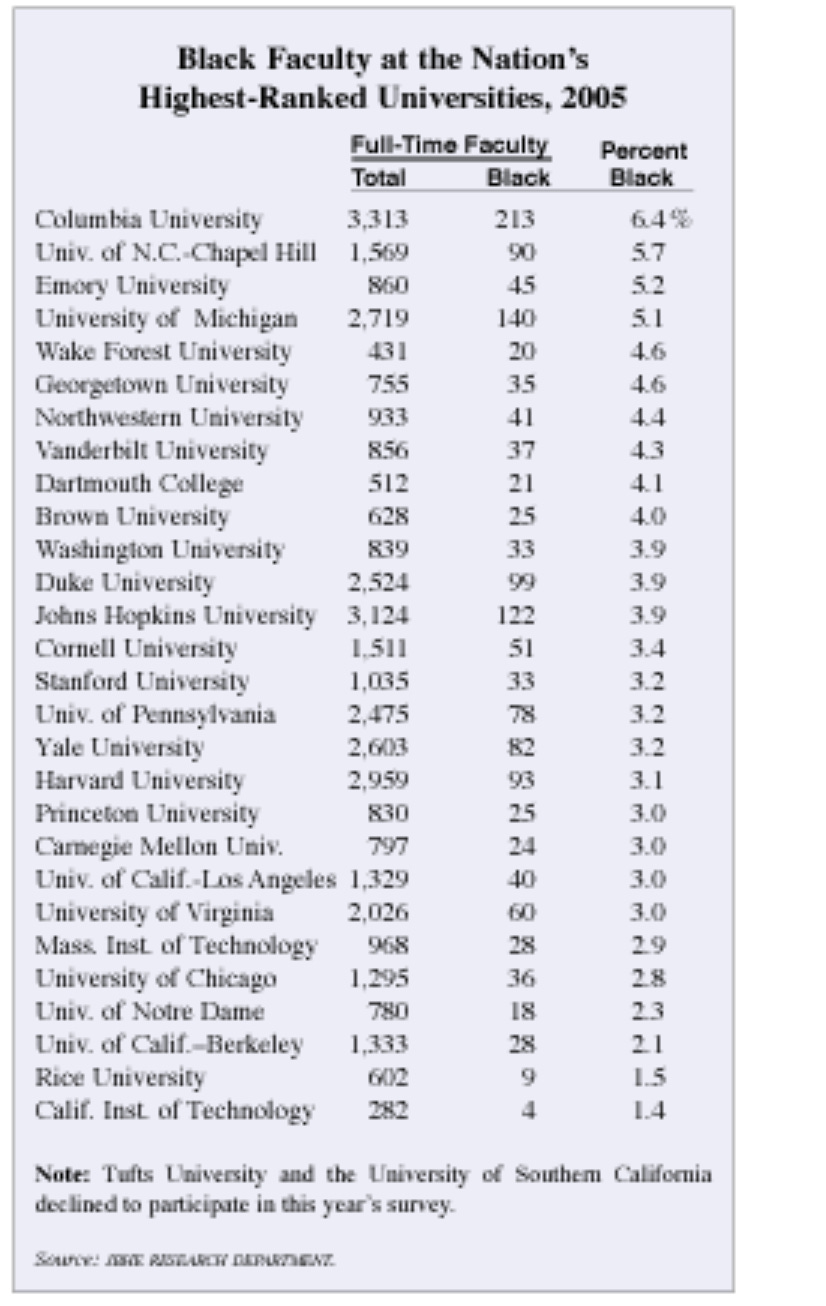
Second lowest was Rice U., another STEM college.
Reed College in Portland is a strongly principled hippie college that long refused to use affirmative action. That didn’t help its rankings.
Highest share of black faculty was at Columbia at 6.4% followed by U. of North Carolina - Chapel Hill at 5.7%.
UNC has no engineering school.
I’m guessing that the white-black race gap is smaller among female than male academics, and largest in the hardest subjects, like Caltech’s famous emphasis on physics since the days of Millikan and Oppenheimer.
Nowadays it’s considered terribly old-fashioned to assess racial progress by numerical means, but Chatterbox doesn’t really see how else to do it. It can’t be good news, for instance, that the University of California at Berkeley has only 142 black freshmen this year, constituting 3.9 percent of the total. That’s about half as many blacks as Berkeley had before California’s Proposition 209, which banned “preferential treatment” based on race, took effect during the 1998-99 school year. Affirmative action critics often complain when colleges accept a higher proportion of black applicants than of all applicants; it’s taken as a sign that standards are being lowered. But why don’t they complain now that Berkeley and UCLA, the two most prestigious universities in the University of California system, accept a lower proportion of black applicants than of all applicants?
Because a lower proportion of black admittees is a sign of higher standards?
Cofnas sums up:
Paywall here.
