

From Chalkbeat:
U.S. moves up in PISA test score rankings because other countries are doing worse
By Matt Barnum and Erica Meltzer | September 8, 2026, 12:31am PDT
In the early 2000s, politicians and pundits were swept up in anxiety about U.S. performance on a key international test known as PISA. Delegations traveled to learn from high-achieving countries like Finland. Journalists and researchers wrote books on the topic. Leaders like President Obama bemoaned the country’s dire results.
From 2013 onward, I pointed out that the U.S. did pretty well on PISA scores, adjusted for racial results. U.S. Asians tended to score as well as northeast Asian countries, U.S. whites tended to score at least as well as European countries, and U.S. Hispanics and blacks tended to scores better than Hispanic and black countries.
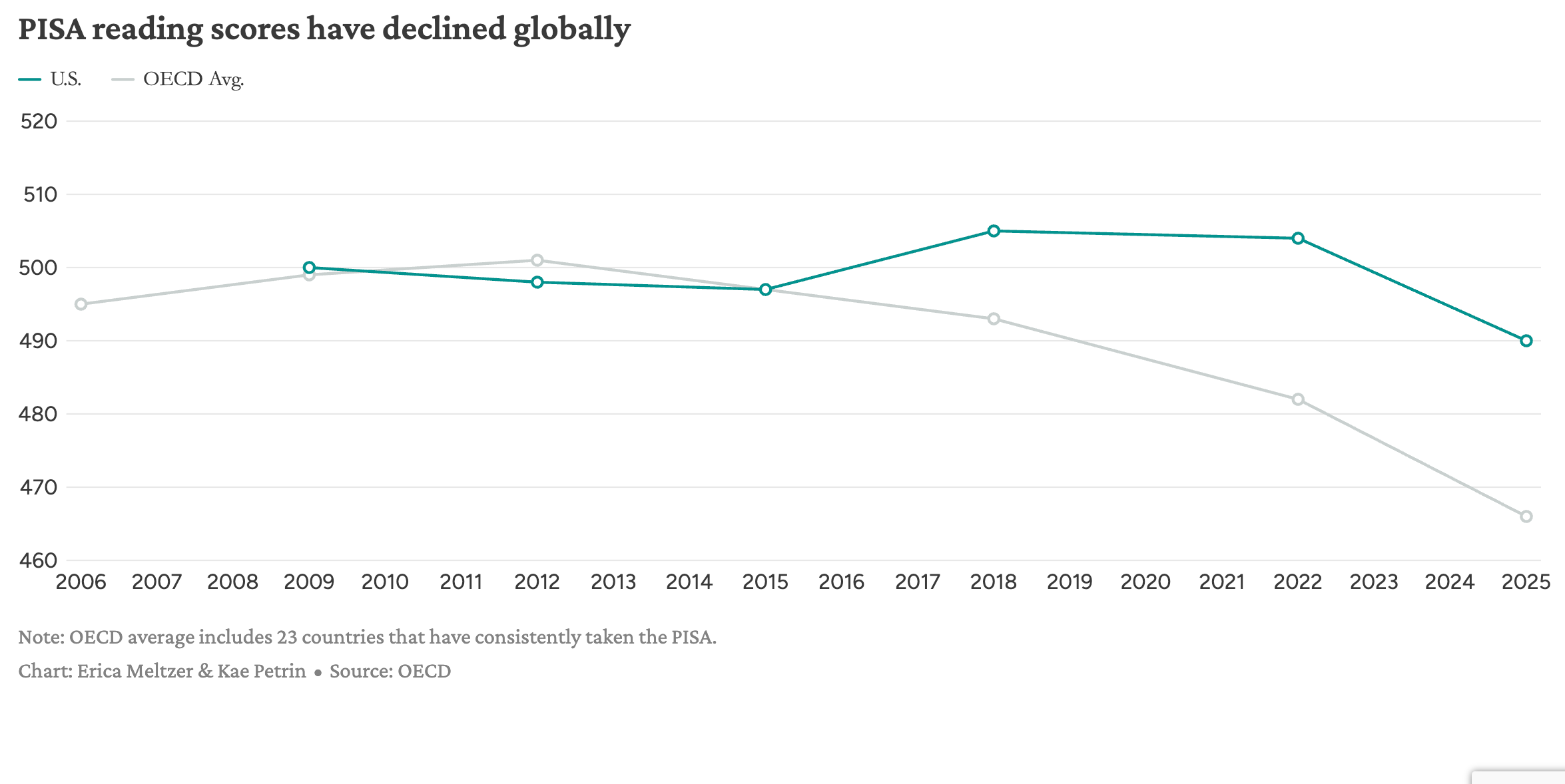
The good news from the latest PISA results, released Tuesday, is that the U.S. has gained relative standing in recent decades. Today, U.S. students score well above average in science and reading. Math scores, long America’s weakest subject, are now on par with other developed countries.
The bad news is how this happened. The U.S. has steadily moved up largely because other countries’ scores have deteriorated faster than ours over the last decade. A bevy of data points show American students are learning less than they used to. Even U.S. PISA scores in math and reading are at or near their lowest level.
Tuesday’s international release suggests student achievement is not something that only the U.S. is struggling with. Whatever factors are driving down scores here — and academics aren’t sure what those are — might also be affecting children elsewhere.
“There’s an ongoing global decline, and it seems like the pandemic has a long, long tail,” said Tracey Burns, chief of global strategy and research at the National Center on Education and the Economy, an organization that studies education systems globally.
The declines in reading proficiency are particularly concerning, Burns said, due to the role reading plays “not just in scholastic and later life success, but also democracy and civic participation.”
Scores have declined across the globe with smaller dips in U.S.
PISA is an international test administered by the Organisation for Economic Co-operation and Development to 15-year-olds from countries across the world. Thousands of American students from dozens of schools sat for the exam last year. PISA tests problem solving skills in math, reading, and science. Each test is scored on a scale of 0 to 500, with roughly 60-70 points representing the difference between proficiency levels.
U.S. scores were reported with an asterisk — literally. OECD chose to report the U.S. results but warned that because of incomplete responses from schools, it “is not possible to rule out bias in PISA performance results, nor to determine its most likely direction.” That means U.S. students might be doing better or worse than the test results suggest.
While many countries have some issues with sampling, only Albania’s results were flagged with a similar level of uncertainty this year.
If you can’t do better than Albania …
In most countries, math and reading scores fell sharply between 2022 and 2025, which follows similar drops between 2018 and 2022.
“Learning outcomes have stagnated or declined in many countries, in some cases for well over a decade, and gaps in achievement persist across socioeconomic groups,” wrote OECD’s Andreas Schleicher.
Singapore, Japan, the United Kingdom, and Canada were among a handful of countries that scored better than average on all four tests.
In the U.S., reading scores fell, but math and science results were essentially flat between 2022 and 2025. Seventy-four percent of American 15-year-olds reached basic proficiency in reading, compared to 69% among 38 relatively affluent countries that are part of the OECD. In math, U.S. proficiency was 65%, the same as the OECD average.
These are more encouraging proficiency rates than those reported by the U.S. federal government on the widely cited NAEP test. This reflects the subjective nature of measuring mastery.
U.S. students scored above average on a new test measuring computational problem solving skills in the digital age. American students were also less likely than those in other countries to hastily respond to questions, indicating that most 15-year-olds here took the exam seriously.
By some measures, the U.S. has unusually unequal educational results. The gap between the top and bottom performers in science and reading was larger in the U.S. than most other countries.
Ya kidding me?
Paywall here.
