

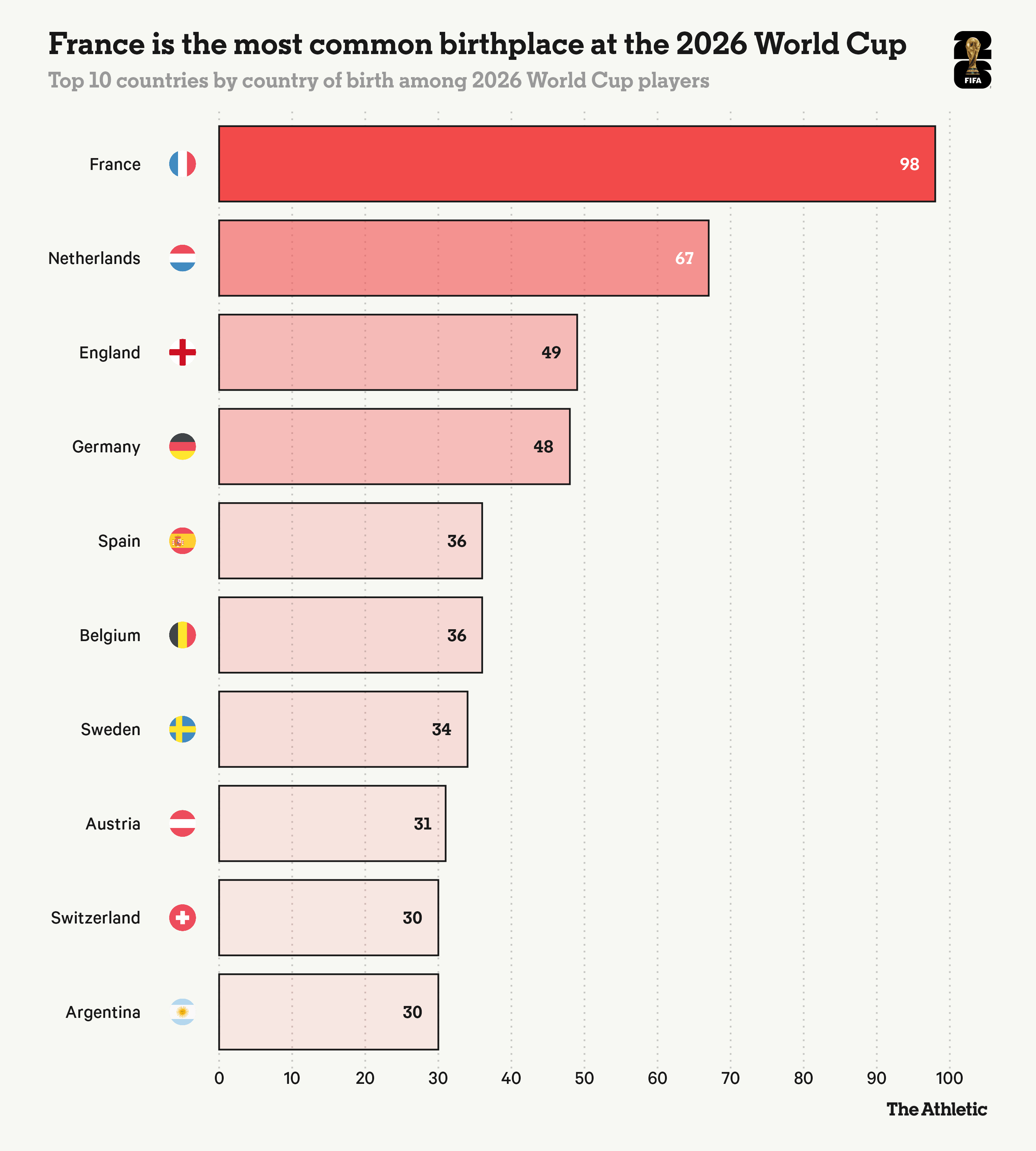
One of the most striking features of this World Cup is that while the rosters of European teams are becoming more African by nature, Third World teams (which have shot up in number due to the expansion of the World Cup from 32 to 48 countries) have become increasingly European by nurture.
With 26 players per the 48 countries, there are 1,248 players in this World Cup. Yet 262, or 21%, were born in just four of the 48 participants: France, Netherlands, England, and Germany. Three-fifths of the players born in those four European countries are playing for other teams, typically in the developing world.
This has also long been true for English-speaking countries that don’t much care about soccer, as well. (Because the Anglosphere invented so many major sports in the second half of the 19th Century, English-speakers are less likely to care about English-invented soccer than just about anybody else.)
For example, on June 18, 1994 I was in Ireland playing 36 holes at Ballybunion.

After putting out, I was invited to the Ballybunion clubhouse to watch Ireland play soccer against defending World Cup champion Italy on TV. I said I didn’t realize the Irish cared about soccer. (Ireland hasn’t qualified for the World Cup since 2002.) The locals said they didn’t actually like soccer, but it was the first game of the World Cup, so come watch it on the telly with us and have a pint (or two or three or four).
Amazingly, Ray Houghton kicked a left-footed top-spin lob over the Italian goalie and Ireland won 1-0 in the most famous Irish soccer victory ever:
Granted, Houghton was born in Northern Ireland of the UK, grew up in Scotland, had a Scottish accent, and tried out for the Scottish U18 national team. But he was Irish enough by ancestry for the World Cup, and he has since enjoyed a pleasant career as an Irish national hero.
There was much celebrating in Ireland that evening.
If you ever visit Ireland, try to schedule it for the night Ireland defeats the reigning World Cup champs in the World Cup.
On the other hand, don’t schedule your flight back to America for the next day.
I dragged myself to the Shannon airport in time for my noon flight. But the Aer Lingus 747 to Boston was four times announced as being delayed, and on the fifth announcement was cancelled until the next day. All 400+ of us we’re put up in a hotel.
The next morning, the local newspaper explained that the Aer Lingus crew had been still too drunk to fly.
The greatest pleasure in traveling is having your stereotypes confirmed, and I don’t recall any tourism event more fulfilling than that.
From the New York Times:
By Charlotte Harpur and Joshua Kloke
June 15, 2026 Updated June 16, 2026
… There are 98 players born in France at the World Cup, but there are more French-born players (76) representing other nations than any other country at the tournament. Senegal’s squad has 10 of them.
Senegal are not, however, the nation with the most. That is Algeria (13), followed by Haiti (12), with the Ivory Coast and the Democratic Republic of Congo also heavily represented.
Indeed, 292 of the 1,248 players involved were born outside the country they are representing, and all but eight nations at the tournament have a foreign-born player in their squad.
The team with the most number of players born outside their country is first-timers Curacao.
Curacao got their first ever point in the World Cup by tying Ecuador 0-0 as 37-year-old goalkeeper Eloy Room made 15 saves.
That’s the most since American Tim Howard recorded 16 against Belgium in the 2014 octofinals.
Room was born in the Netherlands.
The Caribbean island is part of the Kingdom of the Netherlands and all but one of their squad is made up of Dutch-born players, with the group also overseen by Dutch manager Dick Advocaat.
Most of the squad have connections to Rotterdam, the world’s largest seaport outside Asia, and a gateway for migration.
By contrast, some teams are very multinational.
During the second half of Morocco’s game against Brazil, all 11 Moroccan players on the field were born outside Morocco,
Morocco made it to the semifinals in 2022 and looks good again this year.
while Qatar’s squad features players from 11 other foreign nations: Algeria, Belgium, Brazil, Egypt, France, Ghana, Portugal, Senegal, Somalia, Sudan and Tunisia.
The 48-team expanded World Cup is the largest ever and squads feature players born across the globe, including from non-qualified countries such as Cameroon, Denmark and Italy. …
FIFA eligibility is built around nationality. A player can represent a country if they hold its citizenship, whether acquired automatically at birth or later through naturalisation, a legal citizenship application process.
Dual nationals must have a genuine [sic] connection to the country either through birth, ancestry or residency. For example, a player might hold both French and Senegalese nationality but, in order to play for Senegal, they must meet at least one of these criteria:
They were born in Senegal
Their mother or father was born in Senegal
Their grandmother or grandfather was born in Senegal
Wow!
1/4th!
They have lived in Senegal for at least five years (or three before the age of 10)
Before 2004, representing one country at youth level tied a player to that nation, but the Algerian Football Federation lobbied FIFA to change the rules as they struggled to attract players.
… a player who has played up to three senior competitive matches before turning 21 can now switch once three years have passed since that appearance, if they never played at a major finals tournament. …
The process of identifying eligible players has become increasingly refined. Some countries employ scouts whose sole focus is to uncover dual nationals. …
All of Senegal’s players born in France came through Ligue 1 academies and yet their family history is rooted to the country which has put them on the international stage.
White countries tend to be …
Paywall here.
