Hundreds of schools will suspend some or all classes on Monday, the education minister said, as students protest conditions in the education system.
They are protesting school conditions such as that not enough schools are on fire.
Thousands of protesters have been arrested and hundreds of people injured.
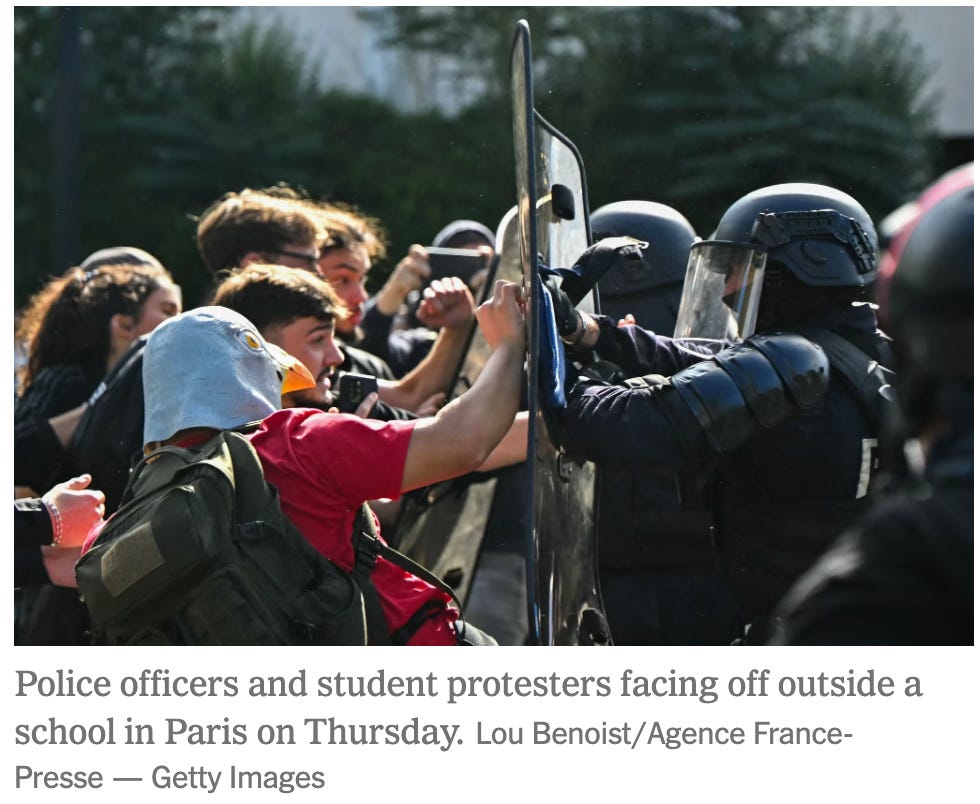
Just stereotypical French kids, young Musketeers. It’s not like the NYT would ever highlight an unrepresentative photo of rioters. Nothing to notice here. It’s a boring story. Wouldn’t you rather be reading the NYT’s 27th article about Cornell frat rapists this week?
By Lynsey Chutel and Zane Irwin
Published Oct. 3, 2026
Updated Oct. 4, 2026, 6:03 p.m. ET
Up to 500 schools in France will remain partially or fully closed on Monday, the education minister said on Sunday, as thousands of angry students have blockaded high schools around the country in recent days to protest poor school conditions and teacher shortages.
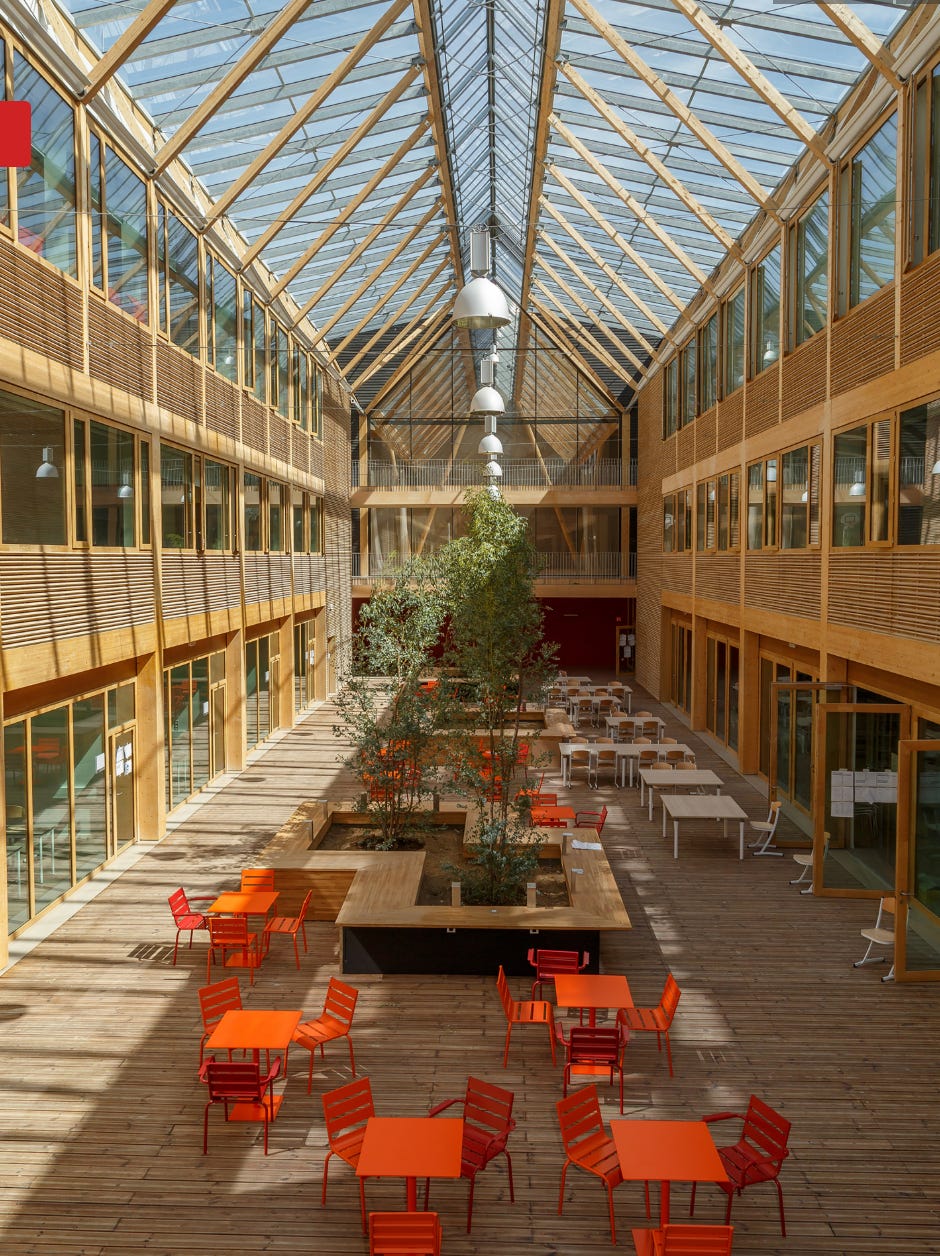
For an example of poor conditions, here’s the Nelson-Mandela high school in Nantes, which opened to ecstatic coverage in architectural journals in 2014:
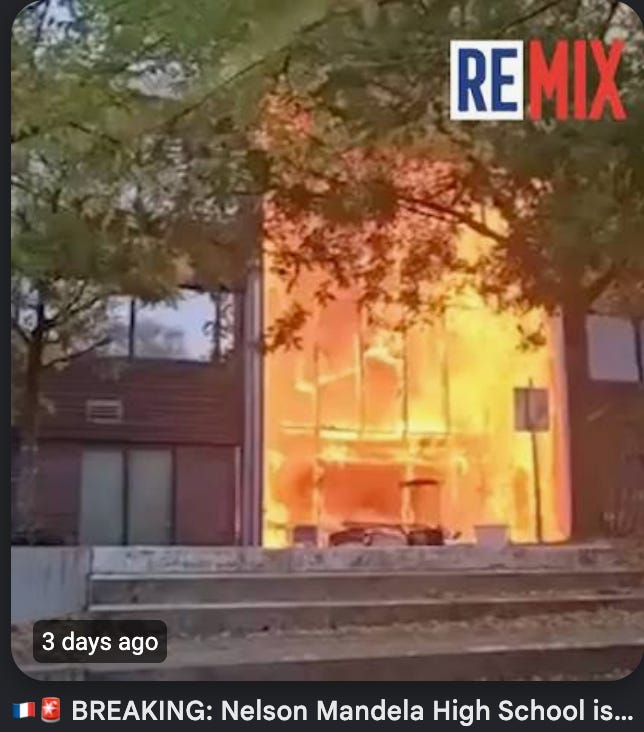
And here’s how much conditions at Nelson-Mandela HS have improved once students protesters had their way with it last week:
These pictures are not in the NYTimes. It’s not something to know.
Hundreds of people have been injured since the protests began last month amid escalating clashes with riot police. Thousands have been arrested, most of them minors, law enforcement officials said. The protests erupted in a heated climate, as the government tries to pass a belt-tightening budget and as France approaches presidential elections next year.
At least 24 schools had been ransacked or set on fire, Édouard Geffray, the education minister, told France 2 on Sunday.
That should do wonders for school conditions.
Teachers’ unions and some political figures have joined the protests in solidarity. The French government has called some of the students’ demands legitimate but has condemned “urban violence” and accused far-left party France Unbowed of stoking the demonstrations.
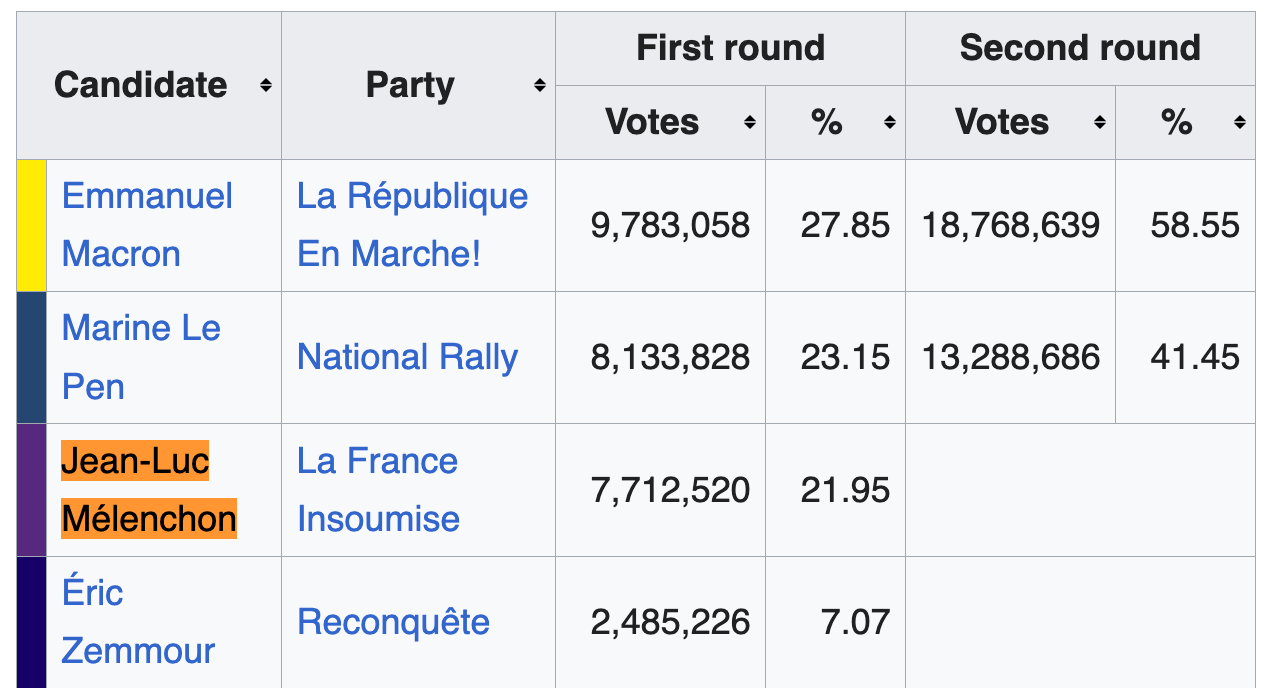
That’s the party of Jean-Luc Mélenchon who just missed making the runoff in the 2022 president election.
The party has rejected the accusation.
Some students have distanced themselves from the violence, but there are calls for more protests in the coming week.
Here’s what to know:
Why are the students demonstrating?
Because France has a long tradition of fighting in the streets, as the Rolling Stones noticed in May 1968?
From roughly 1789 into early 1848, fighting in the streets was a plausible method of bringing about political change in France. But in 1895 the elderly Friedrich Engels advised his revolutionary comrades:
Rebellion in the old style, street fighting with barricades, which decided the issue everywhere up to 1848, had become largely outdated.
Let us have no illusions about it: a real victory of insurrection over the military in street fighting, a victory as between two armies, is one of the rarest exceptions. … If they succeed in this, the troops fail to respond, or the commanding officers lose their heads, and the insurrection wins. If they do not succeed in this, then, even where the military are in the minority, the superiority of better equipment and training, of uniform leadership, of the planned employment of the military forces and of discipline makes itself felt. The most that an insurrection can achieve in the way of actual tactical operations is the proficient construction and defence of a single barricade. … In addition, the military have at their disposal artillery and fully equipped corps of trained engineers, means of warfare which, in nearly every case, the insurgents entirely lack. …
But since then there have been very many more changes, and all in favour of the military. If the big towns have become considerably bigger, the armies have become bigger still. Paris and Berlin have, since 1848, grown less than fourfold, but their garrisons have grown more than that. By means of the railways, these garrisons can, in twenty-four hours, be more than doubled, and in forty-eight hours they can be increased to huge armies. The arming of this enormously increased number of troops has become incomparably more effective. In 1848 the smooth-bore, muzzle-loading percussion gun, today the small-calibre, breech-loading magazine rifle, which shoots four times as far, ten times as accurately and ten times as fast as the former. At that time the relatively ineffective round shot and grape-shot of the artillery; today the percussion shells, of which one is sufficient to demolish the best barricade. At that time the pick-axe of the sapper for breaking through fire proof walls; today the dynamite cartridge.
On the other hand, all the conditions of the insurgents’ side have grown worse. … Up to 1848 it was possible to make the necessary ammunition oneself out of powder and lead; today the cartridges differ for each gun, and are everywhere alike only in one point, namely, that they are a complicated product of big industry, and therefore not to be manufactured ex tempore, with the result that most guns are useless as long as one does not possess the ammunition suited only to them. And, finally, since 1848 the newly built quarters of the big cities have been laid out in long, straight, broad streets, tailor-made to give full effect to the new cannons and rifles.
On other hand, what if the revolutionaries aren’t revolutionaries, but are just …
Paywall here.
Continue reading this post for free, courtesy of Steve Sailer.