

In 1754, Benjamin Franklin wisecracked in Poor Richard’s Almanac:
“Love thy Neighbor; yet don’t pull down your Hedge.”
Ben didn’t make that one up. English poet George Herbert wrote much the same thing in 1640, and who knows how long that aphorism had been around before then?
But in 1914, Robert Frost famously penned the post-Puritan view in “Mending Wall:”
Something there is that doesn’t love a wall …
There where it is we do not need the wall:
He is all pine and I am apple orchard.
My apple trees will never get across
And eat the cones under his pines, I tell him.
He only says, ‘Good fences make good neighbors.’
Spring is the mischief in me, and I wonder
If I could put a notion in his head:
‘Why do they make good neighbors? Isn’t it
Where there are cows? But here there are no cows.
Before I built a wall I’d ask to know
What I was walling in or walling out,
And to whom I was like to give offense.
Something there is that doesn’t love a wall,
That wants it down.’ I could say ‘Elves’ to him,
But it’s not elves exactly, and I’d rather
He said it for himself. I see him there
Bringing a stone grasped firmly by the top
In each hand, like an old-stone savage armed.
He moves in darkness as it seems to me,
Not of woods only and the shade of trees.
He will not go behind his father’s saying,
And he likes having thought of it so well
He says again, ‘Good fences make good neighbors.’
In contrast, 15+ years later, English Catholic convert G.K. Chesterton wrote:
“Do not remove a fence until you know why it was put up in the first place.”
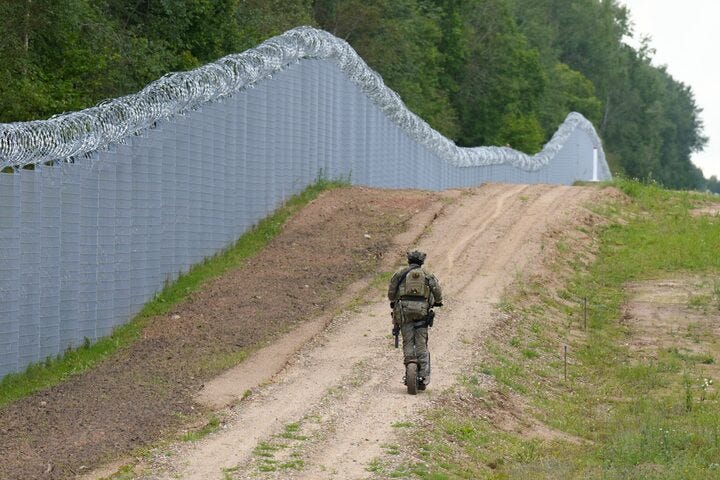
Latvia in the Baltic region has over the last couple of years put up anti-immigrant border fences.
Normally, the New York Times is against countries building fences and walls to keep immigrants out. But …
Paywall here.
