

The Harvard Jewish Alumni Alliance, not a wholly disinterested party, but also not one whose views can be dismissed as obviously lowbrow, has a fascinating new report out:
Jewish Enrollment at Harvard and Its Peers, 1967–2025: A Narrowing Gate
Prior coverage established the headline: Jewish undergraduate enrollment at Harvard is down, the trend is real, and the cause is unknown. This report asks the next question. It tests seven structural explanations against data from eight peer institutions, and measures Harvard’s Jewish enrollment decline against a benchmark no prior analysis has applied: the rate at which White nonJewish enrollment fell at the same institution over the same period. The gap between Harvard and Princeton, two schools facing similar structural pressures, is the analytical core of what follows. That reporting identified a pattern. This report identifies an anomaly.
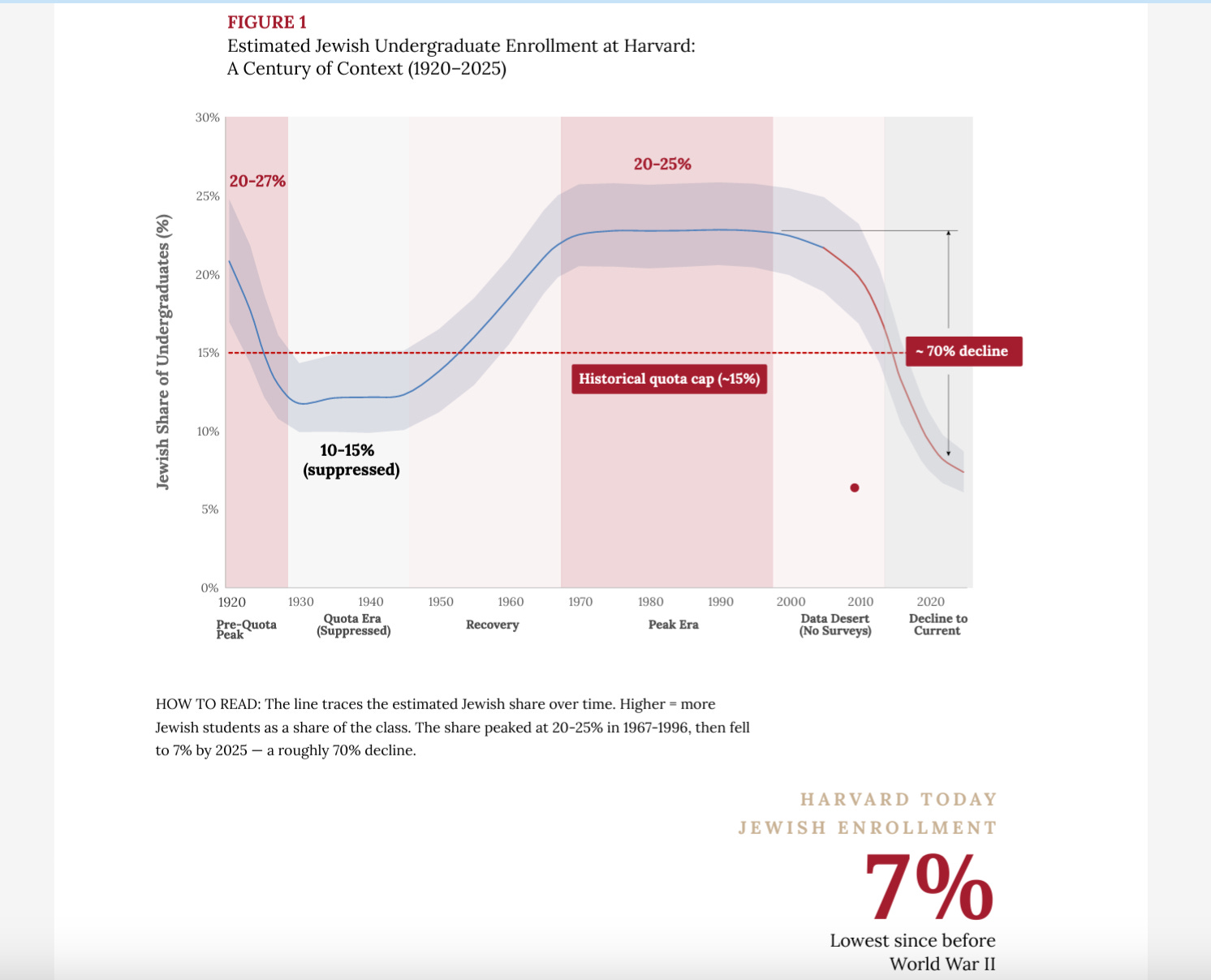
… Harvard’s Jewish undergraduate enrollment stands at 7 percent today, the lowest level recorded since before World War II and the lowest of any Ivy League institution with reliable data. That is roughly half what it was a decade ago, and less than a third of the 25 percent share Jewish students held for much of the latter twentieth century.
One problem with measuring the decline in Jewish enrollment at Harvard College is whether you are using the same methodology over the same generations. And a second problem is whether the utility of a particular methodology changes over time. The authors of this report by the Harvard Jewish Alumni alliance are really smart Harvard Jews, so they try really hard to deal with the methodological questions.
Among well-documented peer institutions, no school has seen a steeper recent-decade decline. This decline is not explained by national trends, demographic shifts, or diversity policies. Harvard’s J/WNJ ratio (the rate of Jewish enrollment decline relative to White non-Jewish peers at the same institution) is 1.5–2.3×.†
In other words, the percentage of Jews at Harvard in this century declined a couple times faster than the percentage of gentile whites at Harvard.
Yale’s is 1.4×. At Princeton, operating under every similar structural pressure in the same decade, the ratio is 0.1×, exactly as neutral policy predicts. At Brown, which faced nearly identical overall structural pressure to Harvard across every factor this report tests, Jewish enrollment held or grew. …
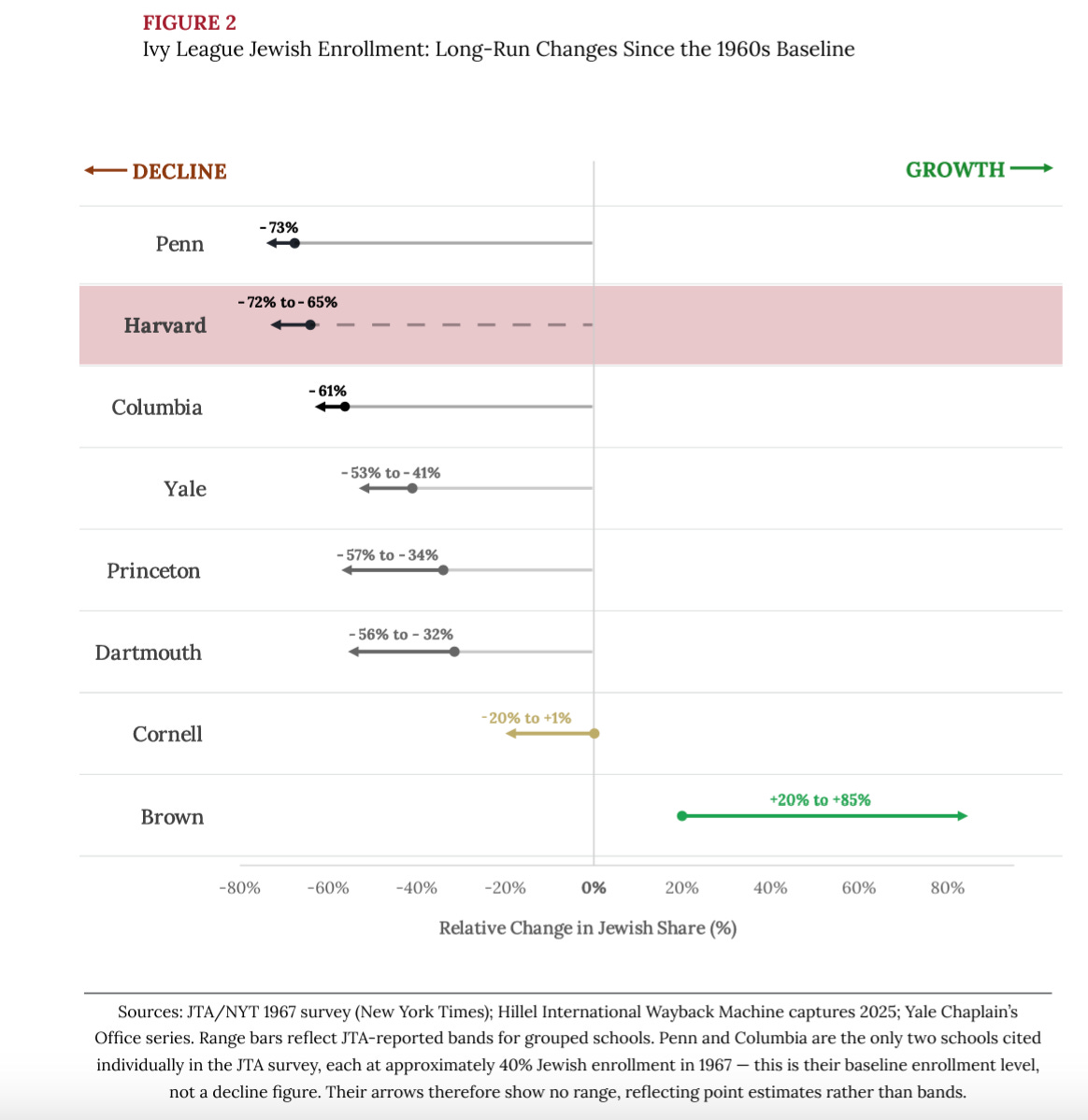
We tested seven potential structural explanations: None of them fully accounts for the gap: geographic diversification, financial aid targeting, diversity expansion, legacy contraction, international growth, athletic recruitment, and academic credential shifts, tested individually and in combination across all nine universities. The gap between Harvard and Yale on one side and their peers on the other is large, consistent across multiple independent data sources, and not fully explained. None of the structural explanations fully accounts for the gap.
… The absence of data is itself a data point. Harvard tracks and publicly reports enrollment by race, gender, geography, income, and first-generation status. Jewish students, a federally protected group under the Civil Rights Act of 1964’s Title VI, fall outside every one of those categories.
A lot of liberal Jews didn’t really grasp until quite recently, perhaps after the Jewish Great Awakening on October 7, 2023, that for DEI bureaucratic purposes, almost all Jews are just plain white, i.e., the oppressors who deserve to be despoiled in the name of the Racial Reckoning.
A group that lost half its representation over a decade did so without a single public institutional response. Harvard collected religious preference data from incoming students through the early 1990s and then stopped. The decline is believed to have begun around 2004, meaning the monitoring gap preceded it by roughly a decade. By the time the pattern was visible from the outside, it had been compounding for years. Harvard measures what it chooses to measure. It chose not to measure this. The result is a monitoring gap that went unaddressed for a decade.
Let me point out that Jewish organizations in the United States have traditionally been averse to non-Jewish organizations “counting Jews.” This is generally explained as a simple precaution in case, say, Harvard or Paramount Studios or Goldman, Sachs get taken over by genocidal Nazis. Without a count, who would the Harvard Nazi administrators know to send to the gas chambers?
A more plausible suggestion is that even in an age obsessed with Equity, Jews tend to be disproportionately high achievers, which raises all sorts of uncomfortable questions that liberal Jews would prefer not to be asked. So let’s not encourage the New York Times to publish data on the topic of Jewish over-representation, so that these awkward questions about why some racial groups (e.g., Jews) do better in the Ivy League or Wall Street than others (e.g., blacks) don’t come up in polite New York Times-reading society. And what better way to keep the New York Times from publishing data on how much more over-represented Jews are at Harvard than by never collecting the data?
On the other hand, Israeli and American Jewish-ethnic media enjoy publishing lists of highly-accomplished Jews, such as billionaires.
And a few neutral observers such as myself have laboriously counted the Jewish share of leading figures on lists made up for other purposes, such as top pundits (The Atlantic), billionaires (Forbes), and political donors (Open Secrets).
For example, I took The Atlantic’s 2009 list of the 50 most influential pundits and came up with 23.75 of the 50 being Jewish. (In case, you are wondering about the decimal places, Matthew Yglesias had 3 Jewish grandparents, and Jonah Goldberg and Hendrik Hertzberg 2 each.)
Our ask is simple. Harvard already counts, audits, and publicly reports on every demographic group it formally recognizes (consistent with its own Anti-Discrimination and Anti-Bullying Policy, effective September 1, 2023). We are asking it to apply that same standard to a federally protected group that has lost half its representation over a decade.
This report goes into intriguing detail on why data suggests that the Jewish share at Harvard collapsed even before October 7, 2023. After the paywall, I offer in-depth critical analysis of the Harvard Jewish Alumni Alliances’ theses:
Paywall here.
