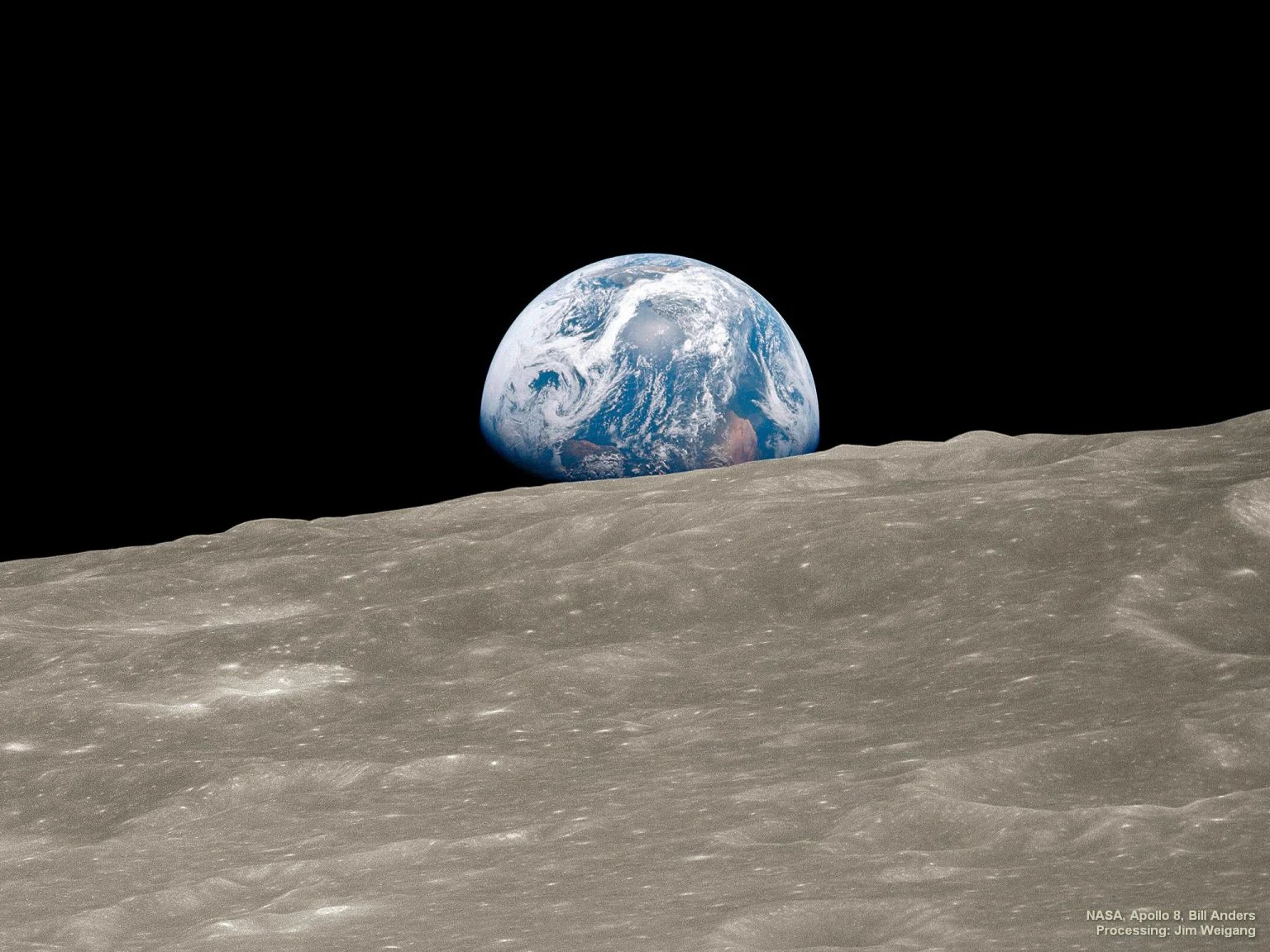
As an only child, I was always vaguely interested in family birth order social science.
For instance, I recall reading in Boys’ Life in the 1960s that all the Mercury and Gemini astronauts, who were rigorously selected by every conceivable test that scientists had ever dreamt of subjecting healthy young men to,
were either first born sons or only children. (That wasn’t exactly true, but it was pretty close.) And they performed well under pressure:
Here’s the New York Times article that Boys’ Life was probably channeling:
By Richard D. Lyons, special to the New York Times
Dec. 24, 1968
Digitally colorized version of B&W photo shot by Bill Anders before he switched to color film, December 24, 1968
HOUSTON, Dec. 23—In addition to being the world’s fastest and farthest travelers, the three Apollo 8 astronauts share another common bond—each is an only child.
This familiar quirk exhibited by Col. Frank Borman, Capt. James A. Lovell Jr. and Maj. William A. Anders also is a mark of most of the other astronauts. Nearly every man selected for astronaut training here at the Manned Spacecraft Center is either the only child in his family or, in cases in which there are siblings, is the eldest son.
Psychologists who have made studies of birth order have deduced that parents lavish more attention and assign more responsibility to only children or eldest sons. The scientists have pointed out that eldest sons are treated better, disciplined more and trained better by their parents. The result, according to the psychological theories, is that they are better achievers in life because they are more completely prepared to meet its challenges and climb the ladder of success. Parents also expect more of them so that they tend to be competitive and successful in their careers.
This pattern has certainly been true in the space program. The men selected for astronaut training are chosen for qualities of maturity, leadership, intelligence, competitiveness and level of achievement in their military or scientific careers. In fact, 21 of the 23 astronauts who have been launched into space missions are either only children or eldest sons.
Even the two astronauts who are not eldest sons are exceptions that appear to prove the rule that such sons are more successful. Lieut. Col. Donn F. Eisele. the command module pilot of the Apollo 7 mission, did have an elder brother. But he died in infancy and Colonel Eisele was raised as an eldest son.
The other exception is Lieut. Col. Michael Collins, who performed a space walk during the Gemini 10 flight in 1966 and who today was the capsule communicator with the Apollo 8 astronauts during their television transmission of the pictures of the earth from space. “The psychologists have discussed the eldest-son theory around here and they have been interested in me because I apparently don’t fit the pattern,” Colonel Collins said in an interview. “But when they found out that my elder brother is 13 years older than I am, the psychologists said this was the case of the exception proving the rule.
“They said that if the difference in age between older and younger brothers is large the parents often repeat their eldest-son treatment of the new baby because the eldest son is almost grown and about to leave the sphere of parental influence.”
Until the 20th Century, when childhood and maternal mortality plummeted, it was often hard to categorize people as first-borns or whatever.
For example, consider Hitler. His father, who married three times, had no children by his first wife, and two by his second, who were The Hitler’s older half-siblings. Adolf was the fourth of his father’s six children by his third wife. But his three older full-siblings died in infancy or early childhood, as did one of his younger siblings.
So was Hitler a first-born, a third-born, a fourth-born, or a sixth-born?
You could rationalize each categorization depending upon your theory of the mechanics of birth order. For example, if you are focusing on biological changes experienced by his mother with either each pregnancy or with each male pregnancy (as in Ray Blanchard’s research pointing to younger brothers being slightly more likely to be gay), he’s either his mother’s third son or fourth child. (There could also be biologically significant miscarriages unrecorded by history.)
Socially, he was his mother’s oldest child for most of his life, but she also had two step-children she cared for, who were her husband’s children, Alois Jr. and Angela. They were 7 and 6 years older than Adolf and grew up in the same household with him.
In other words, Hitler’s early years were complicated, but then so were a lot of people’s back then.
Well, enough about Hitler, not my favorite guy.
So, you can see why old-time Europeans didn’t have as many theories about birth order as we do: too complicated.
Instead, they had sayings based on the day of the week you were born — e.g., “Wednesday’s child is full of woe”. Even more than astrology, the influence of weekdays seems implausible, but at least you could categorize everybody fairly easily that way. James C. Scott famously pointed out that we shouldn’t overlook the importance of “legibility.”
I used to review heavyweight social science books for National Review:
All in the Family
by Steve Sailer
Published in National Review, 12/9/96, 1,050 words
Born to Rebel arrives on a crest of imposing hype, with serious scholars comparing its importance to that of the works of Charles Darwin. For 26 years, this statistically inclined MIT historian has labored to uncover why it was Darwin who originated the theory of natural selection. After building a database of 6,566 scientists and other historic figures from the 16th through the early 20th Centuries, the answer’s now obvious to him: Darwin was the 4th child born in his family. To Dr. Sulloway, much of history is literally sibling rivalry writ large, an eternal struggle between conservative, authoritarian, and closed-minded “firstborns” and liberal, rebellious, altruistic, and open-minded “laterborns.” (Pop quiz: Name Sulloway’s birth rank and politics.)
Despite the author’s tendency to torture his examples to fit his comically obvious prejudice that firstborn = conservative = bad (one of his illustrations of a firstborn with a “conservative ideology” is the Unabomber), there is almost certainly some truth in his general idea. Sulloway’s findings agree fairly well with popular stereotypes, the urban folk wisdom of our time. One of his accomplishments is to solidly ground his logic in Neo-Darwinian sociobiology rather than academically popular literary movements like Freudianism: sibling rivalry is genetically motivated competition for scarce parental resources. Older, bigger children defend their privileges, while younger kids try to subvert the status quo. As the twig is bent, so grows the tree. (The “only child,” by the way, appear to be too variable to generalize about.)'
The British seemed to do pretty well with a system of primogeniture in which the oldest aristocratic son would inherit the estate and country house and go into Parliament, while younger brothers had to more or less figure out their own paths in the world. Thomas Jefferson helped get rid of primogeniture in America, but it’s surprisingly non-obvious that the more flexible Jeffersonian system worked better overall.
After 1776, the British Empire had a good run under the leadership of disproportionately first-born sons.
A careful reading reveals, however, that Dr. Sulloway does not actually explain the cause of Darwin’s creativity. It turns out that laterborn scientists are not significantly more innovative. (Kepler, Galileo, Newton, and Einstein were all firstborns. Genius remains largely inexplicable.) Instead, laterborn scientists are merely more receptive to other’s innovatory theories, especially when there isn’t much evidence one way or another. Once solid data becomes available, this gap rapidly closes. (Firstborns, in turn, seem to deserve some credit for resisting new but bad ideas like phrenology, the once-popular pseudo-science of predicting personality from skull bumps, which laterborns were ninetimes more likely to favor.)
Birth order, it appears, primarily influences opinions, not accomplishments. Keep in mind that those of us who get our opinions published tend to vastly overrate the historic importance of published opinions.
Despite heroic research efforts, lucid prose style, and admirable zeal for statistically testing hypotheses, at times Sulloway can sound like Matt Groening’s Seventh Type of College Professor: The-Single-Theory-to-Explain-Everything-Maniac. (”The nation that controls magnesium controls the universe!!!”)
Yet, family dynamics are a curiously impotent Single Theory. No nation can use birth order to control the universe because no nation can control birth order. The great engines of history remain cultural differences propagated through families, not differences between individuals spontaneously generated over and over again within families. For example, in one of his few attempts to explain distinctions between countries, Sulloway cites France’s low birth rate and consequent high proportion of firstborns to explain why so many French scientists stubbornly resisted Darwin. Yet, since France’s low birthrate continued into the 20th Century, by this logic France’s surplus of firstborns should also have made French soldiers loyal conformists, while fast-growing Germany would be saddled with an undisciplined army of too many “born to rebel” laterborns. The events of May, 1940, however, would seem to cast doubt on this reasoning.
When Sulloway leaves the relatively firm ground of scientific history for the swamp of politics, his analysis becomes a bit of a mess, partly because politics itself is messy. Unlike scientific revolutions, most political revolutions -- whether the American revolution, England’s Glorious Revolution of 1688, Japan’s Meiji Restoration, the Velvet Revolution of 1989, Mussolini’s putsch or Hitler’s takeover -- contain both radical and conservative elements.
Eventually, somebody may make sense of the relations between birth order and politics, but they’ll need a far more sophisticated understanding of politics than Sulloway brings to the job. His first weakness is that he assumes that “conservative,” “liberal,” and “radical” means roughly the same thing in all places and all times. For example, his description of Darwin’s politics -- “Darwin was ahead of his time, and his worldview was that of a twentieth-century liberal” -- is a much more accurate portrayal of Sulloway’s own ideology. True, Darwin was a “liberal”, but a nineteenth-century free market liberal, infinitely closer in outlook to Milton Friedman than Hillary Clinton. Darwin was linked to the rising tide of survival-of-the-fittest capitalism by blood and marriage (both his mother and wife were Wedgwoods, members of the factory-owning family that developed the first brand name in history); by heavy stock market investments; and by intellectual heritage (the single most important influence on Darwin was economist Thomas Malthus, a follower of Adam Smith). In spirit, Darwinism was Whig free market economics applied to biology.
Further, Sulloway seems not to realize that it’s much harder to define what’s the orthodoxy to rebel against today than in, say, 1517 (the first year in his database), when the Catholic Church unquestionably defined the intellectual Establishment. He tends to assume scientific progress remains upsetting to conservatives. Yet, beginning in the 1920’s with the discovery that subatomic reality is indeterminate (which flummoxed atheistic determinists), many recent scientific revolutions have proved deeply gratifying to the prejudices of sophisticated conservatives. For example, the now-validated Big Bang theory was long pooh-poohed by the scientific establishment out of anti-religious bias: the Big Bang is disturbingly close to Genesis (”Let there be light”) and Thomas Aquinas’ Prime Mover proof for the existence of God.
Most notably, the sociobiologists’ ongoing “rediscovery of human nature” validates conservative distrust of the dominant liberal dogma that all differences between humans are the product of social conditioning. Today, the Pope appears more enthusiastic about Darwinism than the self-proclaimed “cultural radicals” who control who gets tenure in university humanities departments.
Paradoxically, by offering even more evidence that human nature is fixed and that the power of state-mandated social reform to advance harmony and happiness is highly limited, Sulloway ends up offering additional reassurance to conservatives in their rebellion against liberal othodoxy.
# # #
Steve Sailer (steveslr@aol.com) is a manager, writer, and only child.
Well, it now looks like we are finally making some progress on figuring out another reason why first borns and only children tend to be better at being Jim Lovell-types:
In contrast to astronauts, movie stars tend to be later-born kids, especially the youngest. …
How come?
Paywall here.
Continue reading this post for free, courtesy of Steve Sailer.