

I was reminded by current news that in 2012, I wrote in Taki’s Magazine:
Steve Sailer
January 11, 2012
Although future behavioral taboos are notoriously hard to predict, it’s clear that within this decade America will end the use of chimpanzees in entertainment. …
The year 2011 marked a watershed in American attitudes toward employing chimpanzees. When I was a kid in the 1960s, chimps were fashionable, associated in the popular mind with the space program and the promise of the new Africa. Plus, young ones are extremely entertaining.
With chimps, though, the older they get, the cuter they ain’t. And they get really old, often outliving their adorable childhoods by 40 or 50 years, with lots of psychological and physical pain for both the ex-actors and the humans who try to care for them. …
The NIH’s move followed 2011’s hit sci-fi movie Rise of the Planet of the Apes. This ape-liberation saga marked an important development in movie history, more for its medium than its message (although the storytelling was more astringent than expected). Rise showed that you can make a monkey movie without the monkey: Put Andy Serkis in a performance capture suit, then digitally make him up as a chimp in post-production.
At present, that’s still quite expensive. (Rise had a $93-million budget.) But if Moore’s Law, which predicts that computing power doubles every year or two, stays in effect for another decade and a half, digital chimps will only cost 1/1024th of what they did in Rise. …
At that price, who needs a real ape?
And that appears to have happened on the schedule I predicted, at least for Hollywood film and TV productions. The Hollywood Reporter noted in early January, 2020:
Hollywood’s Last Actor Chimp in Need of Permanent Home
As CGI replaces live animals, Eli the chimpanzee—whose résumé includes a TBS show and a One Direction video— retired last year but has yet to find a long-term facility. An upcoming documentary will tell his story.
By Gary Baum
January 3, 2020 8:00am
From Ronald Reagan co-star Bonzo to the Today show’s J. Fred Muggs and Bear in B.J. and the Bear, chimpanzees have been appearing in movies and on TV for more than eight decades. That all but came to an end in 2018, the year that Eli, the last chimpanzee professionally trained to act in Hollywood, appeared in his final movie, the Bollywood film Zero. Eli — whose key trick was taking someone’s glasses and putting them on — is now awaiting placement in a forever home. …
The 9-year-old chimpanzee’s transition out of the business, as typically occurs when the species reaches adolescence, is part of a larger trend away from using real wild creatures to “act” onscreen. (While chimps, orangutans and elephants are being phased out, it’s still mostly business as usual for species like big cats and bears.)
A mix of factors accounts for the shift, including the adoption of believable CGI (Planet of the Apes, The Lion King) as well as high-profile credibility issues involving the industry’s on-set animal watchdog, the American Humane Association. Arguably the strongest influence has been a relentless pressure campaign by animal-rights activists. “They made it happen,” observes Barbara Casey, the head of another industry regulator, Movie Animals Protected.
Eli — who appeared in commercials (Microsoft), music videos (One Direction) and the occasional TV show (TBS’ Angie Tribeca) — saw his own output curbed by the effort, with a Geico ad pulled and scenes from a season of MasterChef Junior cut. PETA primate expert Debbie Metzler is proud of the result. “A decade ago, there were at least a dozen chimpanzees working,” she says. “Now there are zero.”
At least, there are zero with Hollywood training. Productions willing to risk the ire of activists can still secure chimps from several private companies around the country that teach them circus-style tricks. These include Chance, who appeared opposite Leonardo DiCaprio in 2013’s The Wolf of Wall Street.
I will resist the temptation I usually give in to at this point to retail backstage details from the lurid financing and production of this Martin Scorsese classic.
I was reminded of my 14-year-old column by this sad news article in the New York Times:
Hayden Panettiere Grew Up in Front of the Camera. It Took a Toll.
The “Heroes” and “Nashville” star, who died Sunday at 36, endured personal struggles that were compounded by her public profile.
By Malia Mendez
Aug. 18, 2026
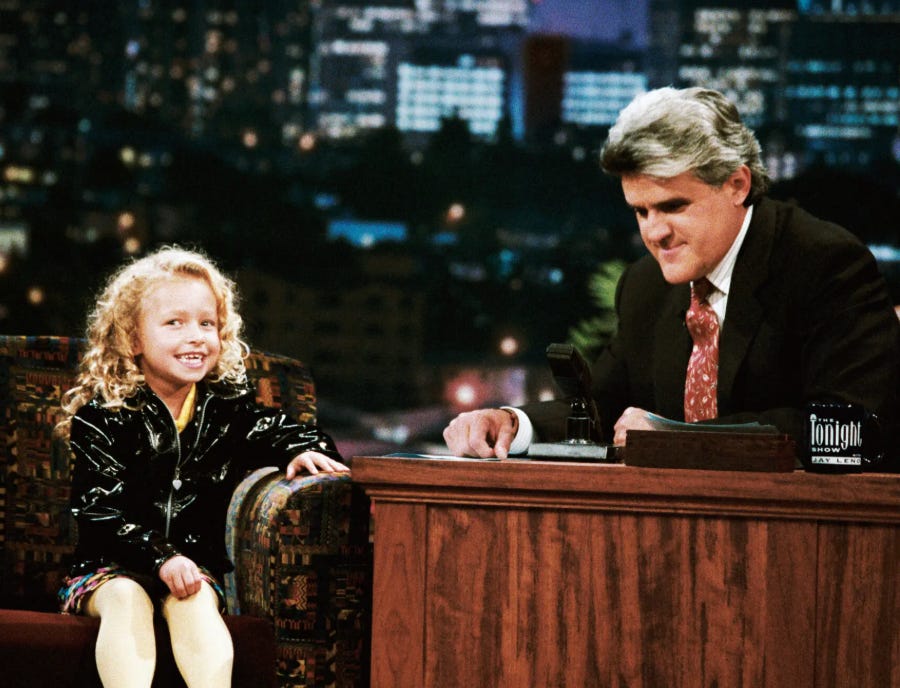
At 11 months old, Hayden Panettiere appeared in a Playskool toy train commercial. By age 4, she was a recurring character on the soap opera “One Life to Live.” In the decades that followed, she starred in movies and television shows. Rarely was she out of a job.
But like many wunderkinds, Panettiere, who died on Sunday at 36, frequently seemed burdened by her success. Her well-documented struggles — with alcohol, drugs, body image, her family, her significant others — seem inextricable from the public scrutiny that lit up so much of her life.
“In an era of relentless paparazzi with an appetite for celebrity breakdowns, naysayers were certain this young starlet would crash and burn,” reads one description of “This Is Me: A Reckoning,” the no-holds-barred memoir that Panettiere released this year. “Not one to disappoint, she did.”
What’s my connection between chimps and the former child star?
Paywall here.
