

Hernando de Soto, the economist not the explorer, has been appointed prime minister of Peru today by President Jose Maria Balcazar. I interviewed de Soto in 2002 and here are a couple of UPI articles I published about our talks.
May 8, 2002 / 4:52 PM
Interview: De Soto’s plan for the poor
By STEVE SAILER, UPI National Correspondent
LOS ANGELES, May 6 (UPI) -- Americans are becoming more concerned about the dire poverty afflicting much of the Third World -- Latin America’s faltering economies dispatch millions of illegal aliens to the United States; the Middle East bursts with underemployed and angry young men; and Africa appears too poor to cope with its AIDS epidemic.
At the recent 2002 Global Conference in Beverly Hills, sponsored by the Milken Institute and Forbes Magazine, Peruvian economic reformer Hernando de Soto offered an optimistic but hard-headed plan for how these nations could mobilize the economic energies of their own poor.
Eight Nobel Laureate economists addressed the conference put on by Michael Milken, the much admired and much reviled junk-bond-king-turned-convict-turned-philanthropist. Yet, de Soto, who hasn’t won the Nobel, because he prefers using words to equations, or so it is often said, stood out for his highly different approach to economics.
De Soto’s central point is that the Third World poor tend to possess de facto control over surprisingly large amounts of assets, such as houses, land, and small businesses. Yet, they find it difficult to use their possessions as collateral to borrow money to invest in starting small businesses.
Why? The poor generally lack the airtight legal titles to their holdings that would give lenders the confidence that they could foreclose on the property if they weren’t paid back. In most of the countries that de Soto has studied, registering a property or business can take over a year of full-time work, unless one can afford a well-connected law firm.
An intense yet genial gentleman with Old World manners, de Soto held court the day after being one of the keynote panelists at the Milken Institute conference.
“If you ask Peruvians whether the fact that they own a $20,000 or $30,000 house can help them toward liquidity, they’ll tell you it doesn’t, because they can’t leverage it,” de Soto said. “And leverage -- obtaining mortgages, issuing shares, issuing bonds -- is essentially a legal tool, but if you don’t have a legal home or business, you can’t do it.”
De Soto, head of Lima’s Institute for Liberty & Democracy, estimates that only about one of every eight countries in the world has the kind of secure and straightforward system of defining legal rights to property that Americans take for granted.
De Soto’s perspective doesn’t fit into standard American ideological categories. He has devoted the past two decades to helping the poor, but he does it by advocating the libertarian-sounding vehicles of property rights and entrepreneurialism.
Yet, while American free-marketeers tend to assume that property rights are natural and thus threatened only by government intervention, de Soto emphasizes that only government bureaucracies can create and maintain efficient and reliable mechanisms for defining ownership.
When he first became prominent, de Soto paid a visit to the leading economists in the United States. They wanted to discuss with him the typical issues that interest contemporary economists -- Peru’s budget deficits, money supply, tariffs, privatization plans, and the like. De Soto, however, wanted to find out how to set up a country registrar of deeds office. “Everybody in America who truly understood property rights died 100 years ago,” he ruefully laughed.
“Where the state is not present,” de Soto noted, “the people themselves create their own extra-legal systems, just as you Americans did here in California during the Gold Rush. There was no law here. So, California was divided into 800 extra-legal jurisdictions. And they issued their own mining claim titles, until you brought them together. And that’s where Egypt and Peru and the rest are today.”
The inadequacy of the Egyptian state at protecting property has encouraged Egyptians to turn for this basic social service to Muslim organizations, some of them radical and anti-American, he said. “These fragmentary Islamic organizations are there as an alternative to government,” de Soto observed.
“The Muslim countries look bleak,” he admitted, “but I have a different perspective on it from working in Egypt for four years. We expected Muslim laws to hinder economies, but that turned out to be unimportant.”
Somewhat similarly, de Soto blames inadequate property rights for making Third World businesses excessively nepotistic. Businessmen who can’t rely upon their governments often rely upon their families.
“Because it takes 17 months to form a legal corporation in Mexico, it’s much easier to deal with my retarded brother-in-law than with a high quality outsider,” de Soto half-joked. “So, the result is that the families are the nucleus around which businesses organize. And, of course, it’s a bad combination of assets. How lucky can you be that your cousin and brother and sister would have the talents you need?”
“The tendency of anthropologists is to say, ‘These Latin Americans and these Arabs are much more family-oriented than Anglo-Saxons,’ but that isn’t it. We don’t have a choice. In America, you have the legal tools to trust each other. You have a way to enforce contracts.”
National leaders, such as Vicente Fox of Mexico, Hosni Mubarak of Egypt, and Vladimir Putin of Russia, are increasingly turning to de Soto’s Institute for Liberty & Democracy for evaluations of their economic arrangements.
Yet, de Soto only claims successes so far in two countries, Peru and El Salvador, and only partially. Perhaps tellingly, both Peru and El Salvador were wracked in the ‘80s by civil wars with Marxist guerrillas, which may explain why leaders were more willing to shake up their traditional arrangements to benefit the poor.
In the late-1980s and early-1990s in Peru, de Soto recalls, “The Maoist Shining Path rebels bombed us various times, using over 400 kilos of dynamite. We’ve had people killed in our organizations.”
Nonetheless, he remains highly optimistic. “If you give the message clearly, everybody understands it’s a win-win situation.” He contends that the poor support his plans, and, “The business sector is for it when we show them how much business they lose.”
Still, entrenched interests drag their heels. “Usually the resistance comes from those who have a monopolistic position. In Peru, it’s the notary publics, because there are only 40 of them and they have to check every document.”
In a panel alongside de Soto, Nobel Prize-winning economist Robert Mundell of Columbia University asserted that the typical Latin American country’s maze of regulatory bureaucracies was erected by wealthy whites to keep brown and black people from getting ahead.
The more optimistic de Soto was less inclined to dwell on deep-rooted problems of race, but he did confirm that racial rivalry played a role in the baffling complexity of property rights law in Peru.
“The tools that were used by the elite,” commented de Soto, who looks to be nearly or all white, “were not separate bathrooms, but legal privileges. So, that’s why most of our fight in Peru was to withdraw from the oligarchy all the legal tricks to discriminate and privilege. ...
“If the Peruvian whites decide they don’t want to marry an Indian, you can’t do much about that, but you can take away the legal tools, and that includes even things like how you can introduce a bill into the legislature. The devil is in the details.”
De Soto predicted, “The countries most likely to pull out ahead are Mexico and Chile.” He later noted that there is less racial hostility in those two countries. Chile simply has few full-blooded Indians left.
“The Mexicans have always been more tolerant,” he observed. “You see a white Mexican with freckles saying, ‘We Indians ... ‘ There is a sort of pride in that Indian background than isn’t found down in Peru. The Mexicans are, culturally speaking, much more democratic and nationalistic than Peruvians.”
De Soto was upbeat about the future of his reform plan. “You get one successful country and the others will follow.”
In the United States, we tend to think of private property as being private: often, only you and your family live on your lot. Thomas Jefferson’s system (described below) lowered the transaction costs of selling land so much that a majority of American citizens can own their own home, and often don’t have to share the land with anybody
The Latin system of vast land grants, however, presupposed that the landowner’s servants, peasants, and tenants would also live on the owner’s piece of property. His property was too enormous for them to live elsewhere and commute everyday.
Over time, these underlings developed informal traditional rights to their shack and the the land it stood on. It might (or might not) be considered bad form for the patron to dispossess his peons of their ancestral dwelling. On the other hand, the peons, not having formal legal title to their traditional property, couldn’t sell it or mortgage it, except to the patron, giving the landowner the advantages of monopsony.
So, you can see why the ruling class hasn’t been in any hurry to let their tenants have formal title to their traditional land.
And here’s my second interview with new Prime Minister de Soto:
May 8, 2002 / 5:51 PM
Q&A : Hernando de Soto on Mexico
By STEVE SAILER, UPI National Correspondent
LOS ANGELES, May 6 (UPI) -- At the 2002 Global Conference in Beverly Hills, hosted by the Milken Institute and Forbes Magazine, prominent Peruvian economist Hernando de Soto, head of the Institute for Liberty & Democracy, was interviewed about how Mexico could create enough jobs for its growing population.
His research in numerous Third World countries has led him to advocate reforms to allow poor people to establish clear title to assets, so they can more easily borrow money against them. He believes that bringing the poor into the legal economy would help them start more businesses.
Q. What kind of reforms would you recommend for Mexico that would enable poor Mexicans to make a living at home and live with their families, rather than have to migrate to America?
A. We were called in by Vicente Fox in 1998 when he was still governor of Guanajuato. And he said, “I intend to be president of Mexico, but why don’t we start off by doing the first stage of your program, which is a diagnostic: How much of Mexico is in the ‘gray’ or extra-legal economy?” So we did that, and he announced it as one of his five top programs when he was running for president. And now that he’s won, we are now putting into place the whole organization that will now design the reforms.
We are working with him now. It’s going to be a long haul. We have over 150 people working on it.
The assets which are now over in the gray side of the economy -- what we call the dead capital economy -- are over 11 million houses, 137 million hectares (338.4 acres), and 6 million unregistered micro, small, and medium-sized businesses. About 78 percent of the population is related to that side of the economy. We’ve estimated that all of these assets that I mentioned are worth about $315 billion, which is equivalent to 31 times all foreign direct investment in Mexico for all time now. That’s seven times the size of the Mexican oil reserves. So, the poor are really the largest potential capital that Mexico has.
What we recommend is revamping the whole legal system stage by stage. It’s a long process, you know. When the European Union told Spain that they were willing to bring it into the European Economic Commission, the process of legal reform took 10 to 15 years. We take about five years to do it.
But what do we have to modify? For example, creating a mortgage in Mexico takes 24 months, working eight hours a day. Foreclosing a mortgage takes 43 months. Selling a house if you’re among the 78 percent of Mexicans that are poor takes, if you want to do it legally, 24 months working eight hours a day. Obtaining legal access for a business, that is to say, setting up a limited liability corporation, or whatever allows you to have shareholders, takes you 17 months working eight hours a day and 126 contacts with government.
So basically the whole system -- and if you go from country to country you can see that it’s pretty much the same -- is made for a privileged elite that knows how to navigate within the existing laws, that’s got access to the big-time law firms. But the country isn’t safe for the enterprise of people who have low incomes.
So the recommendations would be varied but, essentially, we have a program. It’ll take about three years from here on to look at just about all the laws, talking to poor people, finding out how they see the law, then proposing a strategy and legislation that helps take away some of the main obstacles and puts all the leverage points that are needed in place.
Q. How would you get rid of the culture of corruption, in which every president of Mexico leaves the office as a billionaire?
A. The first thing to keep in mind, so as to have some degree of hope, is that all countries started by being corrupt. Britain, which is today the epitome of cleanliness, especially its judges, was pretty corrupt in the mercantilist era. Oliver Goldsmith, a British poet of the 18th Century, defined a British judge as a living creature who sold a dozen laws against half a dozen chickens.
You Americans were pretty corrupt all through the 18th and 19th centuries. In other words, corruption is not something that comes with a special ethnic group. It’s just traditionally what happens when big government starts getting organized all over the world -- the French, the Italians, the Swedes, everybody. That’s the nature of things. People get corrupt when big government comes around and you can use the law to privilege yourself.
In the case of the Mexicans, I think they have already begun to reform. The interesting thing about former President Zedillo is that he’s the first president to say: This is the amount of money I came in with; this is the amount of money I’m going out with. It certainly helps to have competition with two political parties capable of criticizing each other, with more or less even access to television and the media. All of that helps.
Now corruption occurs for many reasons. One is when it’s the only way to get something done. During one of my interviews with a large entrepreneur in Egypt working in the extralegal system -- we cultivate them to get their side of the story -- I asked him, “How about baksheesh (payoffs)?”
“Baksheesh, oh, I love baksheesh!” he answered. “It gives me predictability. I have at least five policemen whom I pay half their income. They are poor people and they allow me to know what I can do. I don’t recommend judges, though, because they are unreliable and expensive.”
So, when I was asked by the Egyptian government at the end of our year-long exercise what kind of law they should bring out, I replied, “You’ve got to give a legal system that’s more reliable than the mafia’s.” If 70-80 percent of the economy in Russia, Peru, or Colombia are run by extra-legal organizations it is not because they break your leg -- after awhile you rebel against that -- it’s because they offer alternatives to the law that are more efficient.
The reason your law in America is obeyed, to a great degree, is because your law is more cost-efficient. It makes more sense for you to work inside the law.
So, part of the reason for corruption in Mexico is culture, politics -- the lack of party competition for 70 years -- and the bad examples of leaders, but a lot has to do with the cost efficiency of the law. People pay bribes in Mexico because it’s the only way to get away from an unfair traffic ticket, or an unfair time in jail, or for providing enough business for your family to survive. But I don’t think corruption is something you can’t tackle. You can clean up your act. And a lot of it has to do with good institutions.
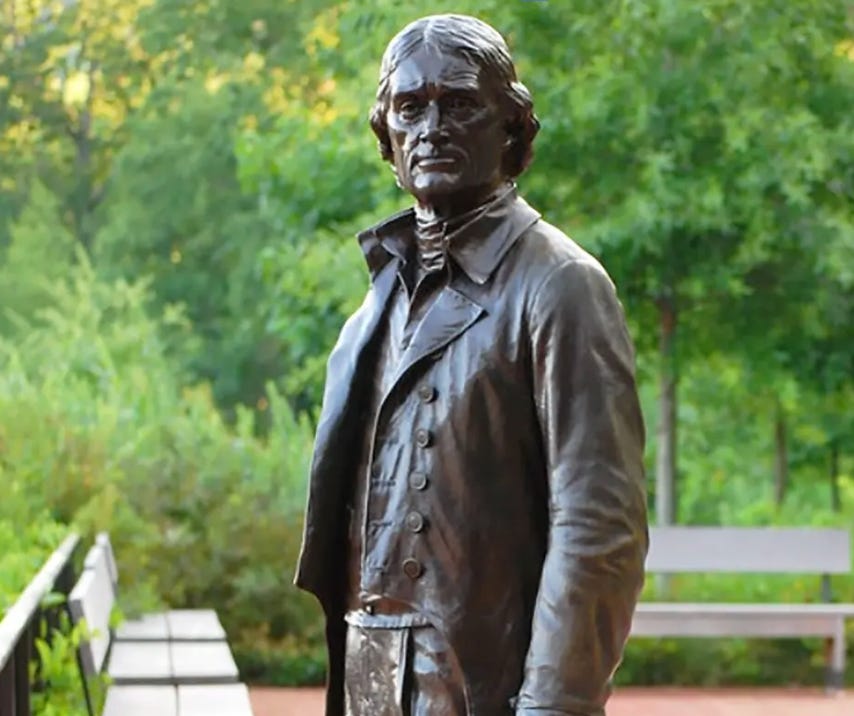
So, in 2015, I wrote an article for Chronicles magazine called “Thomas Jefferson’s GPS” about how Jefferson’s legislation during the Articles of Confederacy era brilliantly got around a problem that besets Latin American countries that are descendants of the old Spanish Empire to this day: How was the King of Spain supposed to determine which of his subjects owned exactly what land on the other side of the world when only the sketchiest of maps existed?
The Spanish solution was to hand out vast land grants to favored individuals that could be delineated with broad terms such as “From the sea to the mountains and from the Rio Verde to the Rio Azul.”
In contrast, Jefferson’s committee in 1785 came up with a science-fiction-like solution to divvying up unseen and unknown land. For example, the width of my home’s lot in California’s San Fernando Valley is 66 feet, one of the standard dimensions for property that Jefferson came up with 241 years ago, when The Valley was legally a Spanish possession.
Paywall here.
Read my otherwise unavailable article on Jefferson’s stroke of genius below.
