

German academic Eugyppius forces himself to read all of Hitler’s Mein Kampf:
Mein Kampf: A Very, Very Long Review
Part 2 of 2.
eugyppius
Oct 11, 2026
Paid
… For all of its purported naughtiness Mein Kampf is a serious snooze of a book, and I had enormous trouble summoning the motivation to make my way through the second volume, which if you can believe it manages to be even more tiresome and boring than the first one. …
The first comes from Chapter 11, on “Nation and Race,” which provides the ideological core of Volume 1 and advances a four-part argument derived from a variety of sources, including Arthur de Gobineau and Houston Stewart Chamberlain.
Teddy Roosevelt’s review of Chamberlain’s Foundations of the 19th Century is witty:
Mr. Chamberlain’s hatreds cover a wide gamut. They include Jews, Darwinists, the Roman Catholic Church, the people of southern Europe, Peruvians, Semites, and an odd variety of literary men and historians. To this sufficiently incongruous collection of antipathies he adds a much smaller selection of violent attachments, ranging from imaginary primitive Teutons and Aryans to Immanuel Kant, and Indian theology, metaphysics, and philosophy….
Eugyppius continues:
Hitler argues in this chapter that Aryans are the sole creators of culture and that Jews constitute an opposite racial type with no culture or state of their own. From there he explains that the German Reich collapsed in 1918 because of a general failure to appreciate the threat of Jewish subversion and the importance of the race question.
He introduces all of this with remarks on what he sees as a “fundamental law” of nature, namely the determination of every animal to mate only with its own kind:
There are truths that are so obvious they are right there in plain sight, yet for that very reason they go unseen – or at least unrecognised – by the ordinary world. People can pass right by such truisms as if blind, and they are utterly astonished when someone suddenly discovers what everyone ought to know anyway. Hundreds of thousands of ‘Columbus’s eggs’ are lying about; it is just that Columbuses are harder to come by.
Thus, without exception, people wander through the garden of nature, imagining that they know and understand almost everything, and yet, with few exceptions, they walk blindly past one of the most striking principles governing it: the internal isolation of the species of all living creatures on this earth.
Even a cursory observation reveals, as an almost ironclad fundamental law underlying all the countless expressions of nature’s will to live, its inherently limited form of reproduction and proliferation. Every animal mates only with a mate of the same species. A tit goes to a tit, a finch to a finch, a stork to a stork, a field mouse to a field mouse, a house mouse to a house mouse, a wolf to a wolf, and so on.
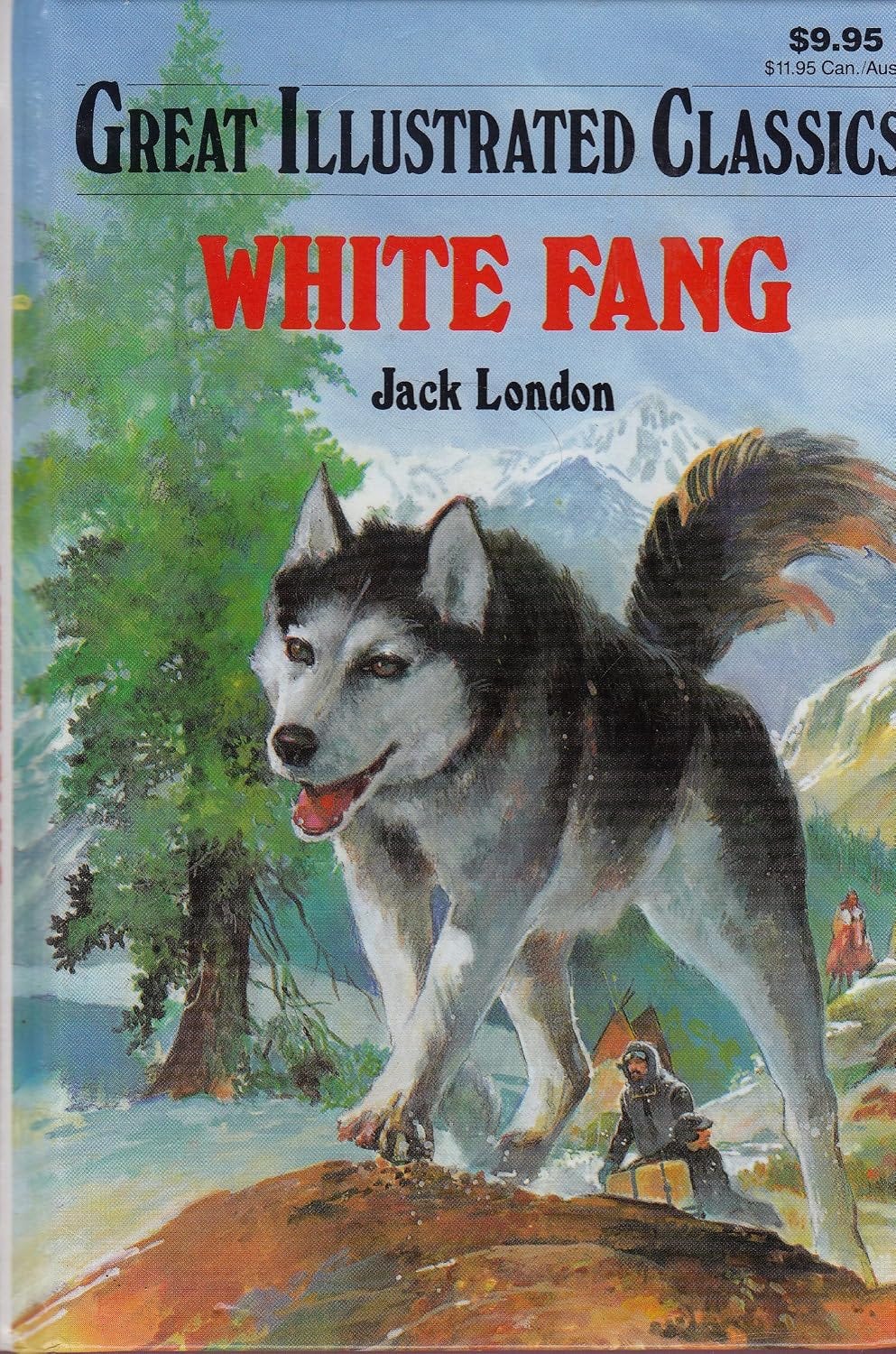
The last example might come as a surprise to Jack London, whose famous novel White Fang is about a wolf-dog that is 3-4ths wolf and 1-4th dog. London’s even more famous Call of the Wild is about a mixed breed dog, Buck, who is half St. Bernard and half Scotch shepherd. By the end, Buck has become the alpha male of a wolf pack whose pups are a new type of wolf, the Yeehat, that looks suspiciously like Buck.
The Nazis banned London’s dystopian novel The Iron Heel, but approved of his dog novels. London was a leftist racial socialist, so Hitler apparently never read either novel, despite their global popularity.
Only exceptional circumstances can alter this, primarily the constraints of captivity or some other impossibility of mating within the same species.
But if nature resists interbreeding, why should nurture?
Paywall here.
