

From Wired:
“How Elizabeth Holmes Tricked WIRED—and Everyone Else
Adam Rogers
October 19, 2026
WIRED was the first magazine to cover Theranos and its enticing billionaire founder. There were warning signs even then.
ELIZABETH HOLMES, THE disgraced founder of the fraud-ridden blood-test company Theranos, made her national press debut in The Wall Street Journal in 2013. The article—“A Drop of Blood, an Instant Diagnosis”—wasn’t a science story, or even a business story. It ran in the Opinion section, by a writer on the Journal’s editorial board named Joseph Rago, winner of a Pulitzer Prize for critiques of the Affordable Care Act.
He wrote that he was impressed by the prospect of individuals having more direct control of their health care; no less an eminence than former secretary of state George Shultz, a Theranos board member, had told Rago that Holmes was the next Steve Jobs or Bill Gates.
By 2014, Holmes was the youngest woman billionaire ever, and the mid-2010s were electric with tech-industry success stories—the iPhone, Tesla, Airbnb, Twitter. I was an editor at WIRED back then, and Theranos-as-presented felt very WIRED. It looked like evidence that a Silicon Valley approach to innovation would work in every industry, including medicine.” …
One of my colleagues, an editor named Caitlin Roper, saw a story in Theranos and in Holmes, but no one was sure what shape it should take. The executive editor suggested Roper just go talk to Holmes and see what was what. The result was an influential long-form Q&A headlined “One Drop, Infinite Data: How Elizabeth Holmes Built a Better Blood Test.” …
Over the next few months, other publications followed. Fortune put Holmes on the cover. The New Yorker did a profile. In October 2015, Inc. put her on the cover, calling her “the next Steve Jobs”—and a couple of weeks later, The Wall Street Journal did another article on Theranos, by the reporter John Carreyrou. The headline was deceptively humble: “Theranos Has Struggled with Blood Tests.”
Uh-oh.
The speedy and accurate blood tests were fake, the innovative tech didn’t exist, and Walgreens, a major partner, terminated its deal with Theranos. It was a grift. A new documentary film, out this week, follows Holmes in the weeks leading up to her incarceration.
Get a bunch of old WIRED editors together these days and it doesn’t take more than one drink before we start asking each other whether we enabled the worst parts of the tech world’s rise to power. Sometimes it seems like every antichrist-lecturing, panopticon-building, machine-god-bothering weirdo with $100 billion and a government contract made his debut in our pages. So, with Theranos and Holmes back in the news, the current administration at WIRED wondered what we were thinking back then.
It was a long time ago. I called Caitlin.
As always, we were looking for good stories. “I was interested in this female founder, but also the idea that her actual goal was disruption of health care, that there could be more transparency and reduced costs,” says Roper, who today is executive producer for scripted film and TV at The New York Times. …
“The conversation I remember with you, which I thought of many years later, was looking at the board of directors, her board, which was just completely batshit. It had military figures and government officials, and just seemed very odd,” Roper says. “You said there was something weird about that. It raised your suspicious hackles.”
It did—a few of us thought we saw hints of red flags. The company hadn’t published any peer-reviewed data. Colleagues had heard unconfirmable rumors of shenanigans inside the company. But that didn’t mean it wasn’t a story. …
Interview done, Roper drove back up to San Francisco, to WIRED. “It didn’t feel like there was a feature to do,” she says. The Walgreens stuff wasn’t happening yet; it was too hard to report out how the technology worked. What was hard, in retrospect, was validation. Roper and the bosses weren’t sure that investment money from bold-faced names made up for an absence of hard scientific evidence.
So Roper wrote it up as an interview—a Q&A. “It seemed more like an interesting founder story,” she says. Roper asked every hard question, and got answers. They just turned out to be lies. But Roper acknowledges some cracks in the story’s origin. “If she had not been a woman, I would have been less motivated. That was part of what compelled me,” she says. “I felt sympathetic to the idea of her outfit and her weirdness, because I related to the idea that she was passing in some way in that environment, needing to assert herself.”
It’s tempting to see in that a DEI-run-amok story. It isn’t.
And then he explains that it was a DEI-run-amok story:
All of us at WIRED were trying to wrestle with sexism in the world we covered, and at our magazine. Holmes’ board was all non–Silicon Valley types—was that because venture investors and scientists had identified her as a bad risk, or was it because Silicon Valley venture capitalists don’t support women founders?
Because Henry Kissinger was famously feminist?
Kissinger put his name to the essay Time magazine about Elizabeth Holmes for Time’s top 100 people of 2015 essay:
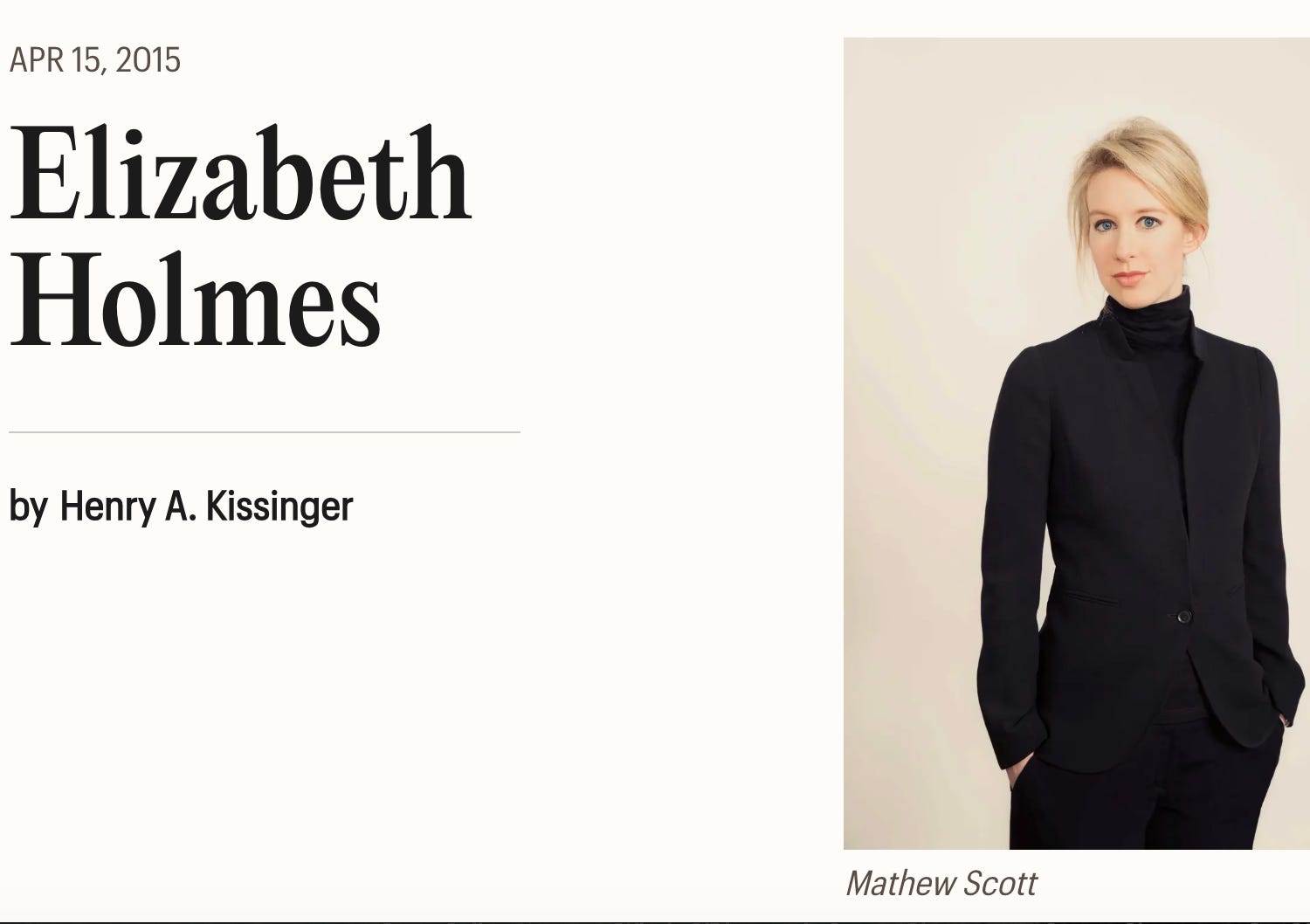
by Henry A. Kissinger
Elizabeth Holmes’ is a story that could happen only in America. After her sophomore year she left Stanford to devote herself to a vision of health care available as a basic human right. When I was introduced to Elizabeth by George Shultz, her plan sounded like an undergraduate’s dream. I told her she had only two prospects: total failure or vast success. There would be no middle ground.
Elizabeth accepted only one option: making a difference. Striking, somewhat ethereal, iron-willed, she is on the verge of achieving her vision—through a new method of blood testing that significantly reduces costs, tests for a whole range of infections and is mobile and can therefore be easily transported to underdeveloped regions.
Striving for prevention and early detection, she is dedicated to transforming health care around the world. She manages an expanding global business by the refusal to be daunted by any obstacle.
Elizabeth is in the process of turning an undergraduate’s vision into a global reality. That she combines fierce and single-minded dedication with great charm makes her a formidable advocate. Others will judge the technical aspects of Theranos, but the social implications are vast.
Kissinger is a former U.S. Secretary of State and a Theranos board member
DEI just made people say the dumbest things. How in the world could you believe that Theranos’s elderly, all-male, not very scientific board of directors was less prejudiced against women than Silicon Valley venture capitalists?
Here’s a …
Paywall here.
