

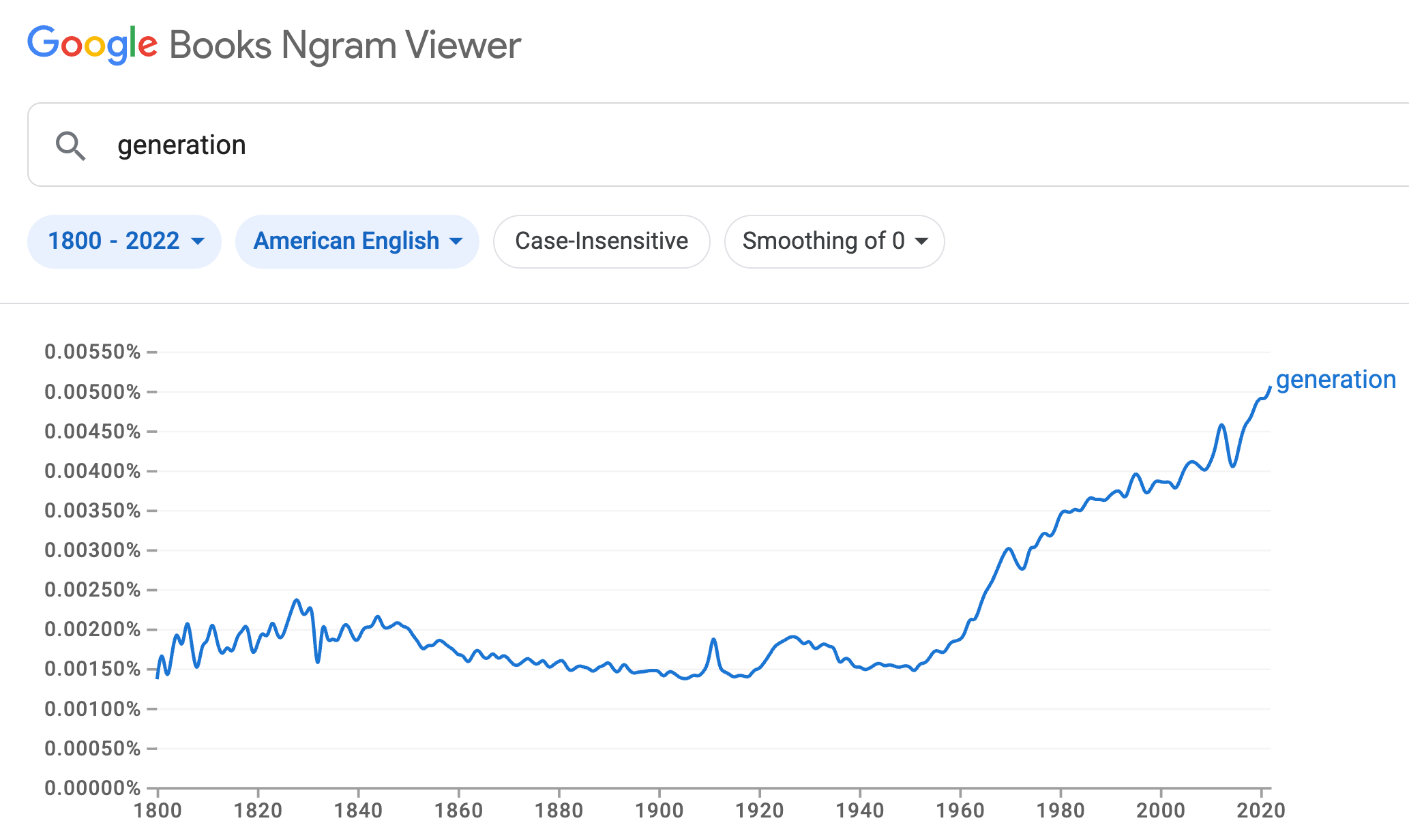
There’s a huge amount of talk about generations lately, although it’s not obvious that there is much of a generation gap in reality. The Generation Gap rose and fell from about 1964 to 1976:
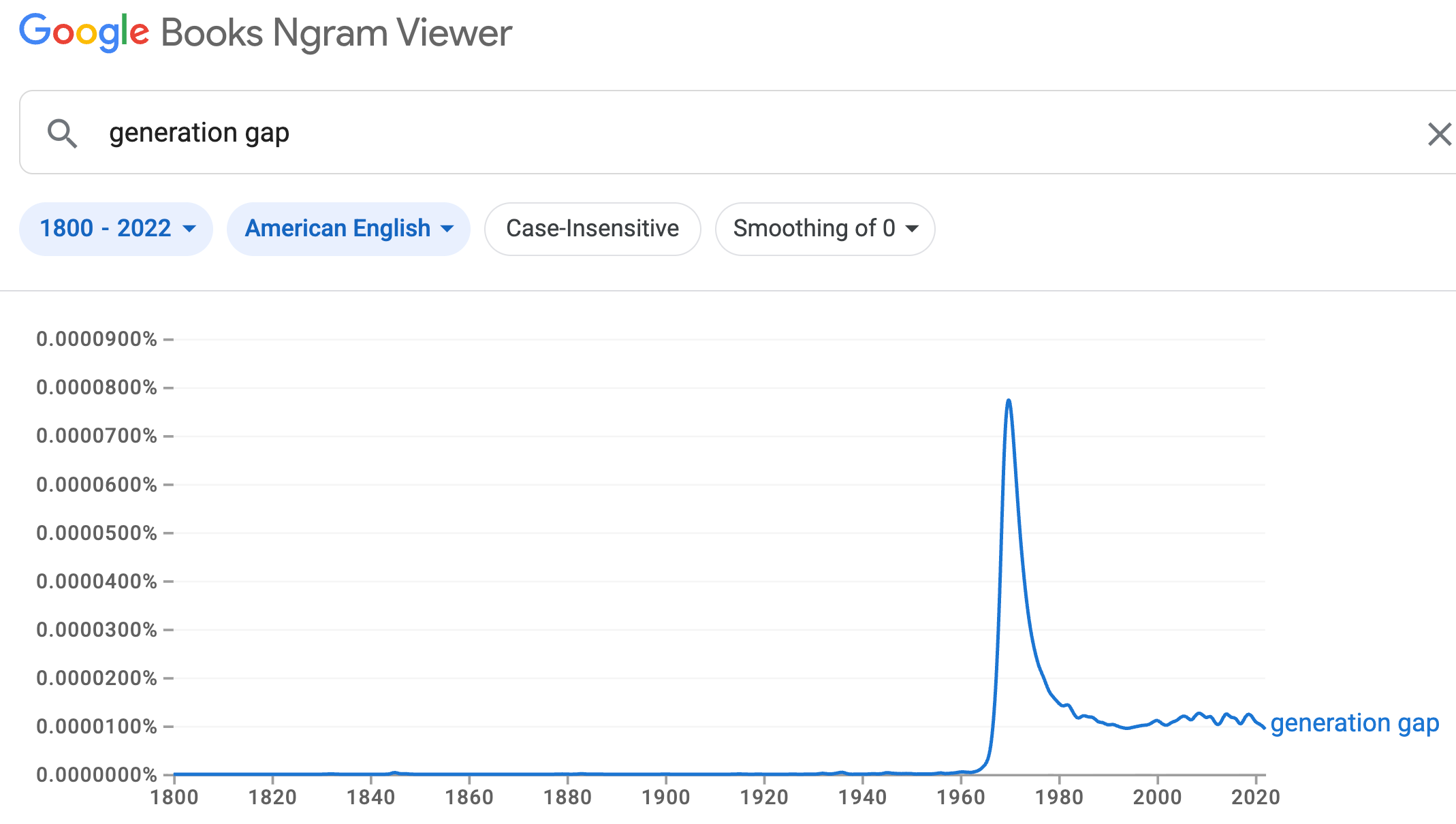
The semi-popular names for age cohorts are practically impossible to remember:
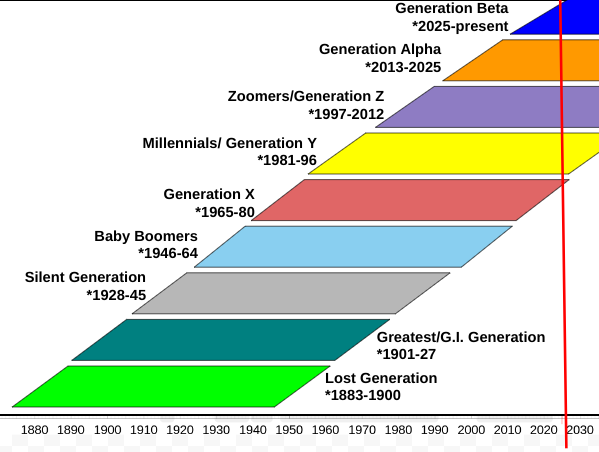
Fortunately, I have a simple plan for reforming what I call Astrology for MBAs.
From the Washington Post opinion section a half decade ago:
Generation labels mean nothing. It’s time to retire them.
July 7, 2021
By Philip N. Cohen
Philip N. Cohen is a sociology professor at the University of Maryland, College Park and author of, most recently, “The Family: Diversity, Inequality, and Social Change.”
Consider these facts: The tennis champion Williams sisters are a generation apart, according to the Pew Research Center. Venus, born 1980, is part of “Gen X”; Serena, born 1981, is a “Millennial.” Meanwhile, Donald Trump and Michelle Obama are both in the same generation. The former was born in 1946 while the latter was born in 1964, making them both “baby boomers.“
Before you start wracking your brain to cram these diverse personalities into generational stereotypes, let me stop you there: Just don’t. That’s the position I and about 150 other demographers and social scientists have taken in an open letter to the Pew Research Center, urging them to stop promoting the use of generation labels (the Silent Generation, baby boomers, Generation X, millennials and now Generation Z).
Generation labels, although widely adopted by the public, have no basis in social reality. In fact, in one of Pew’s own surveys, most people did not identify the correct generation for themselves — even when they were shown a list of options.
This is not surprising since the categories are imposed by survey researchers, journalists or marketing firms before the identities they are supposed to describe even exist. Instead of asking people which group they feel an affinity for and why, purveyors of social “generations” just declare the categories and start making pronouncements about them. That’s not how social identity works.
The practice of naming “generations” based on birth year goes back at least to the supposed “Lost Generation” of the late 19th Century.
More like to Hemingway’s big year of 1926:
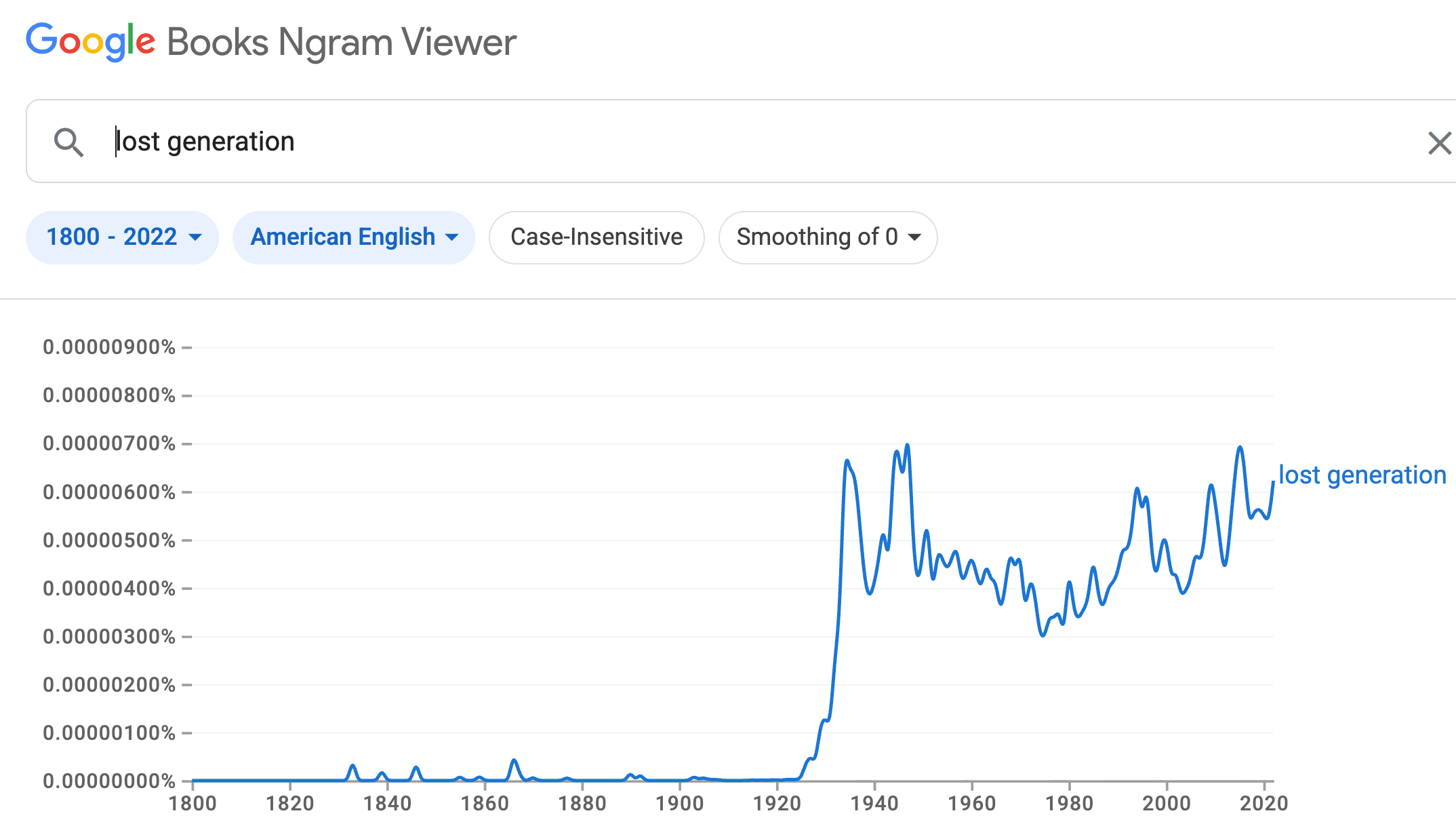
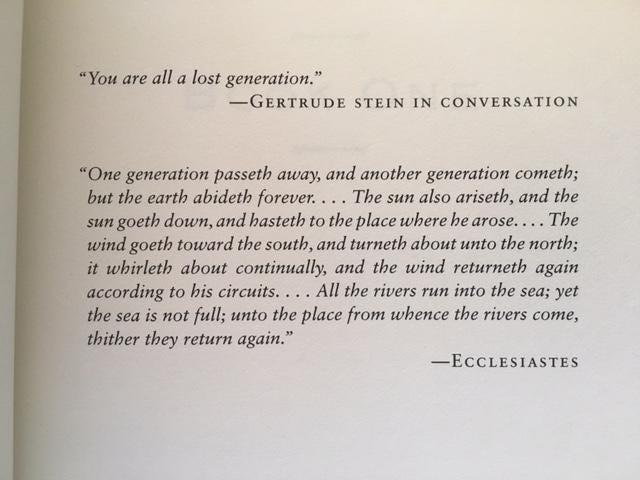
According to Hemingway’s posthumous memoir A Movable Feast, he got it from Gertrude Stein kvetching about the poor quality of postwar auto mechanics.
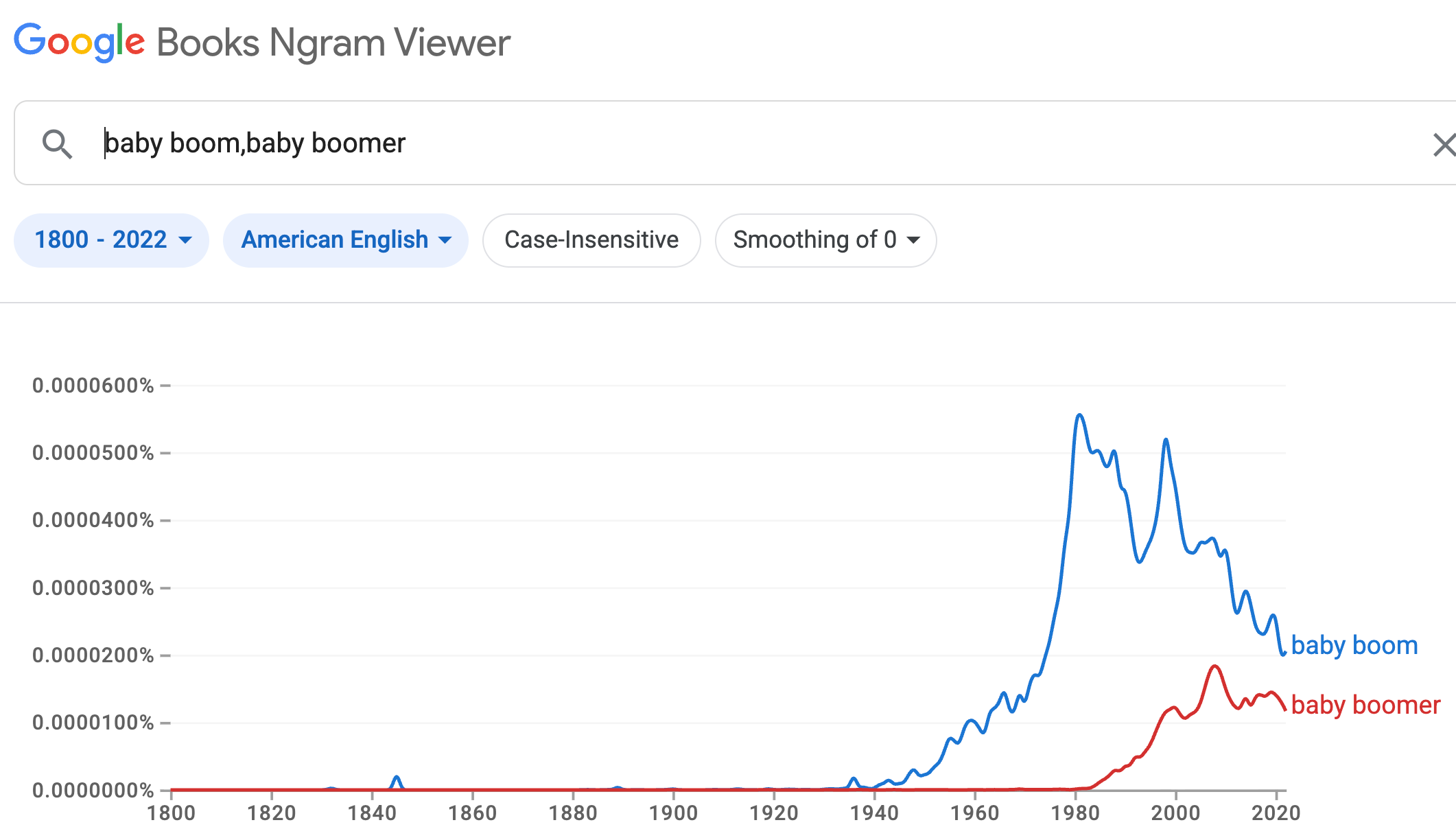
“Baby boom” emerged in the 1940s, and became omnipresent after the baby boom was over in the 1970s. But “baby boomer” only emerged around 1984.
But as the tradition devolved into a never-ending competition to be the first to propose the next name that sticks, it has produced steadily diminishing returns to social science and the public understanding.
The supposed boundaries between generations are no more meaningful than the names they’ve been given. There is no research identifying the appropriate boundaries between generations, and there is no empirical basis for imposing the sweeping character traits that are believed to define them. Generation descriptors are either embarrassing stereotypes or caricatures with astrology-level vagueness. In one article you might read that Millennials are “liberal lions,” “downwardly mobile,” “upbeat,” “pre-Copernican,” “unaffiliated, anti-hierarchical, [and] distrustful” — even though they also “get along well with their parents, respect their elders and work well with colleagues.” …
Millennials will meet a mysterious stranger, then go on a long, challenging, but ultimately rewarding journey.
There are lots of good alternatives to today’s generations. We can simply describe people by the decade they were born. We can define cohorts specifically related to a particular issue — such as 2020 school kids.
Of course, bad as our current generation designations are, we aren’t going to get rid of them. We have to come up with something better to replace them.
So, here’s my suggestion:
Paywall here.
