

The Jason Arday Brouhaha points out a hidden trend that distinguishes the DEI era from the earlier affirmative action era. Rather than simply use racial quotas to boost hiring and admissions of representatives of lower average IQ races, as was traditional from 1969 through, say, 2012, institutions have been self-destructively dismantling their selection systems. This is partly to boost their numbers of The Diverse, but also because they are increasingly ignorant.
Notice how you aren’t supposed to know about supposedly “purported” racial gaps in average IQ. Unsurprisingly, fewer and fewer people these days even know about the gaps’ indisputable existence, much less have thought hard about their implications.
For example, the University of California faculty senate commissioned an expert panel of social science professors to answer whether UC could get by without mandated the SAT and/or ACT admissions test.
The scholars studied UC’s data and responded to the Board of Regents: No, sorry, we absolutely need test scores as well as high school GPA and class rank. Otherwise, we’ll be flying blind and let in a lot of kids whose best hope of higher education is taking remedial classes at community colleges.
UC system president Janet Napolitano, a former cabinet officer in the Obama Administration, replied (in effect): “Ha-ha, I don’t care. Test scores won’t even just be optional, they are now banned! No applicant may submit any test scores. Bwa-ha-ha-ha.”
Not surprisingly, that turned out to be a disaster.
Let me present a graph that sums up America’s white vs. black cognitive ability situation over the last 50 years:
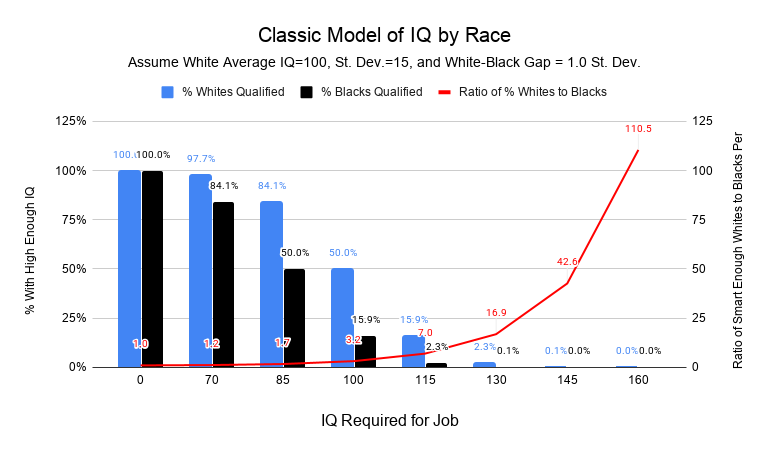
This is fairly stylized and simplified, but not unrealistic:
Ignore the existence of Americans who aren’t white or black.
Assume that the white mean IQ is 100 and that the standard deviation is 15.
Assume that the black average IQ is 85 (one standard deviation lower than the white average).
Don’t worry about possible fat tails or other complexities.
Assume that roughly the following jobs need the following IQs:
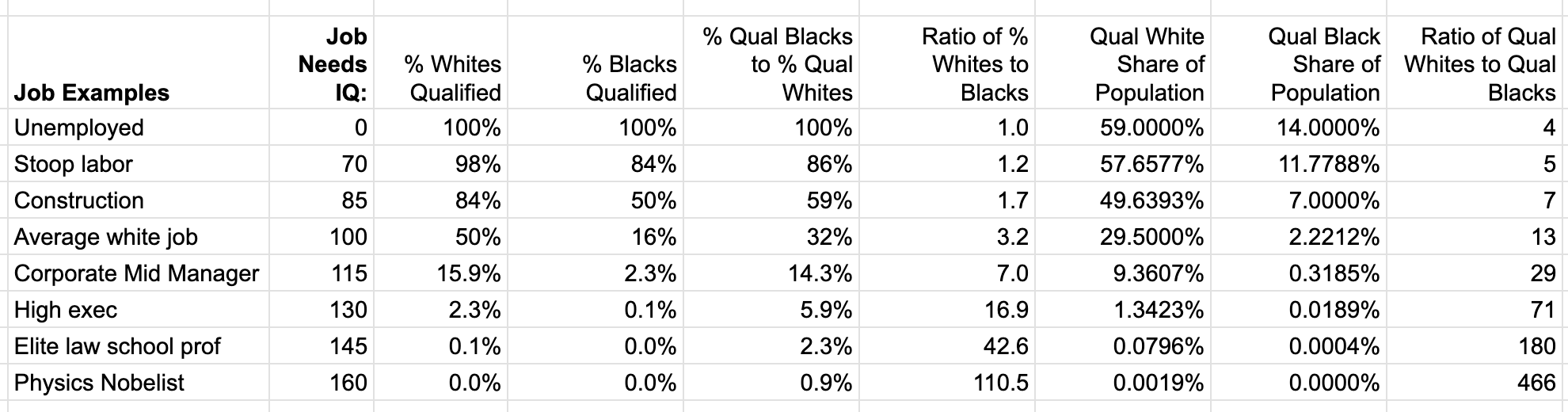
100% of both whites and blacks have a high enough IQ to be unemployed.
But let’s say that it takes a 115 IQ to be a pretty good performer as a pretty higher up middle manager in a big company. 15.9% of whites score that high vs. 2.3% of blacks. A white is 7 times more likely than a black to have an IQ of 115 or higher. And there are about 4.2 times as many working age non-Hispanic whites as blacks in America, so this simple model would predict that 29 times as many whites as blacks would have the IQ needed for this rather good job. So, out of 100 white or black corporate managers (ignoring other races), you’d expect about 3 or 4 to be black.
You can see why smart blacks can find a lot of American institutions to be kind of lonely.
What about at C-suite jobs like CEO and CFO where a 130 IQ is helpful?
The race gaps keep getting wider: per capita, whites are about 17 times as likely to have 130 IQs. For the American population, there are about 71 times as many 130+ whites as blacks. So out of 100 white or black C-level executives, you’d expect, just from IQ, that one or two would be black.
I don’t know what jobs need a 145 IQ: Yale law professor? AI superstar making $10 or $100 million in Silicon Valley? But, whatever, whites are 43 times more likely per capita to score that high and there are 180 times as many American whites as American blacks with 145+ IQs. (This is assuming that the Gaussian normal distribution holds true out at extreme IQs. But it’s hard to get a big enough sample size of these unicorns to test that assumption.)
Here’s the same graph, just for 115 to 160.
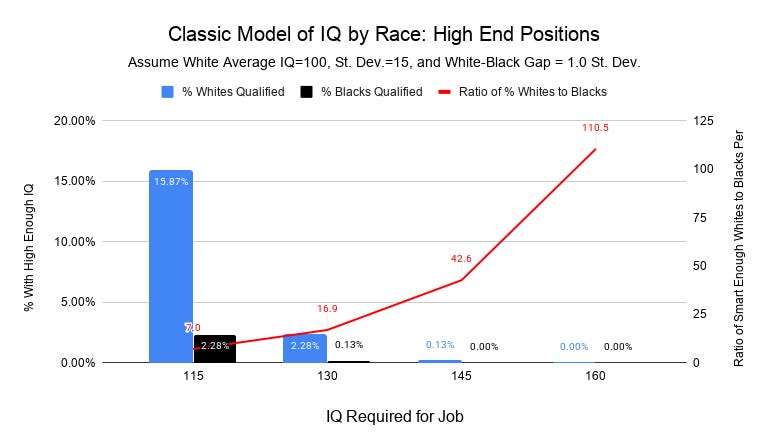
Now you can look at these graphs from two perspectives, both of which can be expressed as: “Wow, the white-black IQ gap is quite big!”
Recall that this is a performance gap as well as a representation gap.
Ideally, we could partially close both at the same time, but we’ve been trying that for a long time without all that much progress.
In some types of jobs (e.g., air traffic controllers), competence matters vastly more than representation. In other types of jobs (e.g., federal judges’ law clerks), perhaps representation really does matter as well as skill.
To close the white-black representation gap fully via affirmative action would require leapfrogging blacks over a huge number of whites, with sizable consequences for competence.
What about a compromise?
If blacks were to get, say, half of the racial gap in average test performance, i.e., 7.5 IQ points, as an affirmative action bonus. For instance, a black scoring 107.5 would get a net score of 115. The following graph shows the impact:
Paywall here.
