Interestingly, this second Trump Era is seeing common sense domestic reforms undoing some of the damage the liberal establishment did during the first Trump Era when it more or less went nuts.
Not all of them are initiated by the Trump Administration.
For instance, this week 751 University of California professors have (so far) signed an open letter to the UC Board of Regents calling for the reinstatement of mandatory SAT / ACT admissions testing for anybody wanting to major in STEM fields.
I’ve been complaining about this policy forever, but now it’s respectable to object:
To the UC Regents, UCOP, Academic Senate leadership, and the people of California:
We write as University of California mathematics faculty, joined by faculty from other STEM disciplines. UC has long served students from every background and has been a powerful engine of social mobility for the people of California. That public trust must be protected for future generations.
Today, UC’s mission is at risk.
To preserve that mission: We call for the reinstatement of the SAT/ACT mathematics requirement for applicants to STEM majors beginning with the 2027 admissions cycle, alongside STEM faculty oversight of readiness standards and admissions practices affecting those majors.
Over the past five years, we have seen a widening divergence in mathematical preparation levels within the same classroom. This trend indicates that current admissions practices do not provide a sufficiently reliable check on mathematical readiness for STEM majors.
The UC San Diego Senate–Administration Workgroup on Admissions report documents this crisis in stark terms: in the last five years, the number of students whose mathematics skills fall below high school level increased nearly thirtyfold; moreover, 70% of those students fall below middle school levels, reaching roughly one in twelve members of the entering cohort.
These findings are corroborated by data across our campuses. For example, for three consecutive years, 20-30% of UC Berkeley first-semester calculus students who participated in mathematical diagnostic testing displayed severe preparation deficits.
Basic mathematical fluency is analogous to literacy; without it, success in university-level STEM becomes structurally unattainable for students. We now observe preparation gaps so severe that instructors must reteach middle-school mathematics while simultaneously teaching the material students need for sciences, engineering, economics, and other quantitatively demanding fields. UC has been a national leader in supporting under-resourced students to do well in mathematics.
However, UC has finite resources and can help only so many students, and only when the preparation deficits they need to overcome are within reach.
Furthermore, the widening spread between underprepared and well-prepared students creates polarized courses, weakening the foundation available to many students and making it harder to teach at the level required for advanced STEM work.
UC is increasingly unable to provide its students with the education needed to become leaders in California’s scientific, technological, and economic future. We are already seeing the warning signs: longer pathways through prerequisite material, reduced readiness for advanced coursework, and growing pressure to dilute quantitative rigor.
Left unaddressed, these trends will lead to declining graduation rates, longer time to degree, and reduced completion of STEM majors, with consequences for California’s highly skilled STEM workforce.
California’s public higher-education system is a coordinated pathway through community college, CSU, and UC that aligns students with the instruction best suited to their preparation. The current admissions system is undermining this structure by admitting students directly into STEM UC programs without a reliable measure of whether they are prepared to succeed. This serves no one well.
The widening abilities gap followed the 2020 elimination of the SAT/ACT, a temporary measure that has now become a permanent vulnerability. This outcome was explicitly predicted by the Academic Senate’s 2020 Standardized Testing Task Force (STTF) report, which warned that removing these tests would eliminate a vital predictor of college success and obscure the impact of severe high-school grade inflation. Unfortunately, the outcomes cautioned against in that report have now materialized in the data across our campuses. All other leading STEM institutions, including the UC’s primary peers, have resumed using SAT/ACT in their admissions to ensure foundational fluency. For the University of California to remain a global leader in STEM, it is essential to restore these objective benchmarks.
This initiative was begun by UC professors of mathematics (although I do not see the name of the most famous mathematician affiliated with the system, UCLA professor Terence Tao).
It has spread to other STEM fields. For example, Berkeley biochemist and Nobel laureate, Jennifer Doudna, the co-inventor of CRISPR gene engineering (whose biography by Walter Isaacson I reviewed in 2021, in part because Isaacson wrote in depth about Doudna’s mentor James D. Watson), has signed.
And there are a few non-STEM signatories, such as one art historian.
Here are some technical suggestions I made behind the paywall for improving college admissions 14 months ago:
Switch the SAT/ACT tests to fully interactive (inflicting harder questions for high scorers and teeing up easier questions for low scorers), which would make it feasible to extend the maximum score another standard deviation from 1600 to 1800 on the SAT or from 36 to 40 on the ACT.
Reduce the GPA bonus for AP classes from 1.0 to 0.5.
Or, better, make the GPA bonus proportional to the score on the actual AP test rather than something you get merely registering for the AP class. A 2 on the AP could get no bonus, a 3 would get 0.33 points for GPA, a 4 0.67 points, and a 5 1.00 points.
Best would be to start using AP tests directly in college admissions. After all, they would appear to combine the best of the SAT/ACT (nationally standardized) and GPA (reward effort as well as talent and you actually learning something test prepping for AP tests). Counting AP scores has been out of fashion on the grounds that not many schools give AP classes, but that is outmoded. The total number of AP tests taken per year increased from 3.7 million in 2012 to 4.8 million in 2022.
Among plausible applicants to thrive in elite colleges, the great majority have sizable opportunities to take AP classes in high school.
There should be Advanced Placement tests given in December for seniors to use on their college applications.
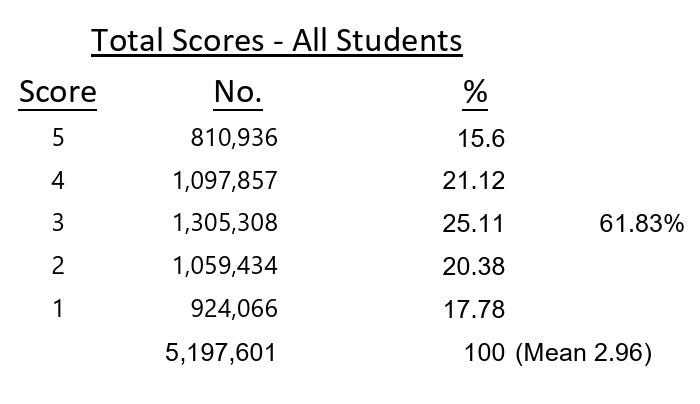
A big problem with using AP test scores for elite college admissions is that they aren’t designed for that, so the maximum score, 5 on a 1 to 5 scale, doesn’t go very high up:
Almost one-sixth of AP test-takes achieve the maximum score. Last I checked, Caltech doesn’t give any credit for AP scores because everybody at Caltech ought to be advanced.
So, boost the ceiling on AP tests from a score of 5 to, say, 8. If the top 16% score a 5 or above, then the top 7% should score a 6, the top 3% a 7, with under one percent scoring a perfect 8
Another problem with AP tests for use in college admissions is that many take most of their AP tests in May of their senior year after admission decisions are already made. So, there should be Advanced Placement tests given in December for seniors to use on their college applications.
Are these improvements all that impossible?
Really?
What other sensible reforms are being undertaken by the unusual suspects?
Paywall here.
Continue reading this post for free, courtesy of Steve Sailer.