

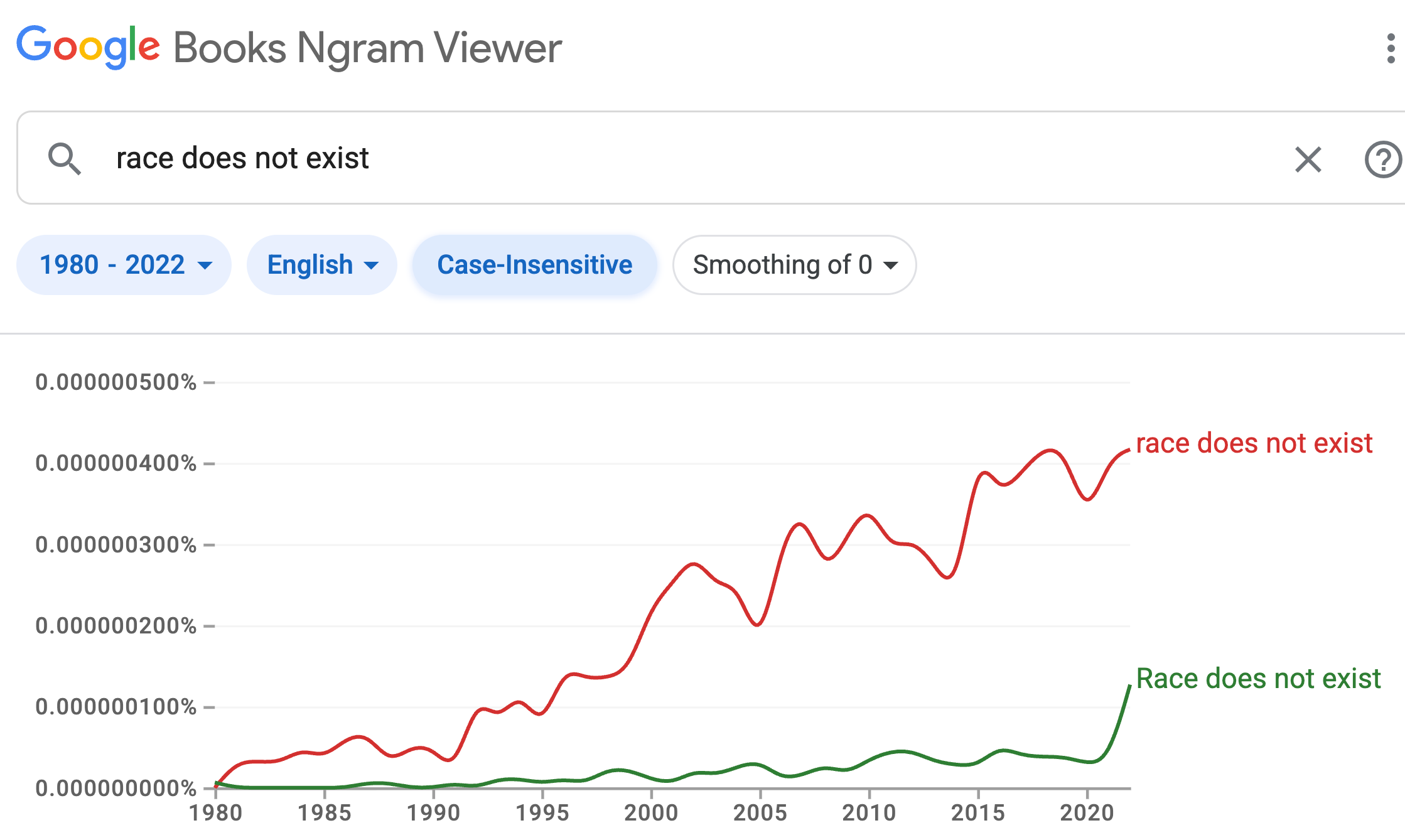
One of the sillier, more intellectually disabling ticks of the 21st Century is that we are constantly told that The Science has proven that Race Does Not Exist. For example, as a Professor of Postcolonial Studies at Cambridge U. explains scientifically:
Yet, despite the dogma that Race Does Not Exist ascending to conventional wisdom since Craig Venter’s vastly influential White House speech in the 2000 ceremony celebrating the Human Genome Project, over the last generation, everybody is increasingly talking about race.
Here’s Ngram showing the increase in the use of of both “race” and “racial” in English language books since 1990:
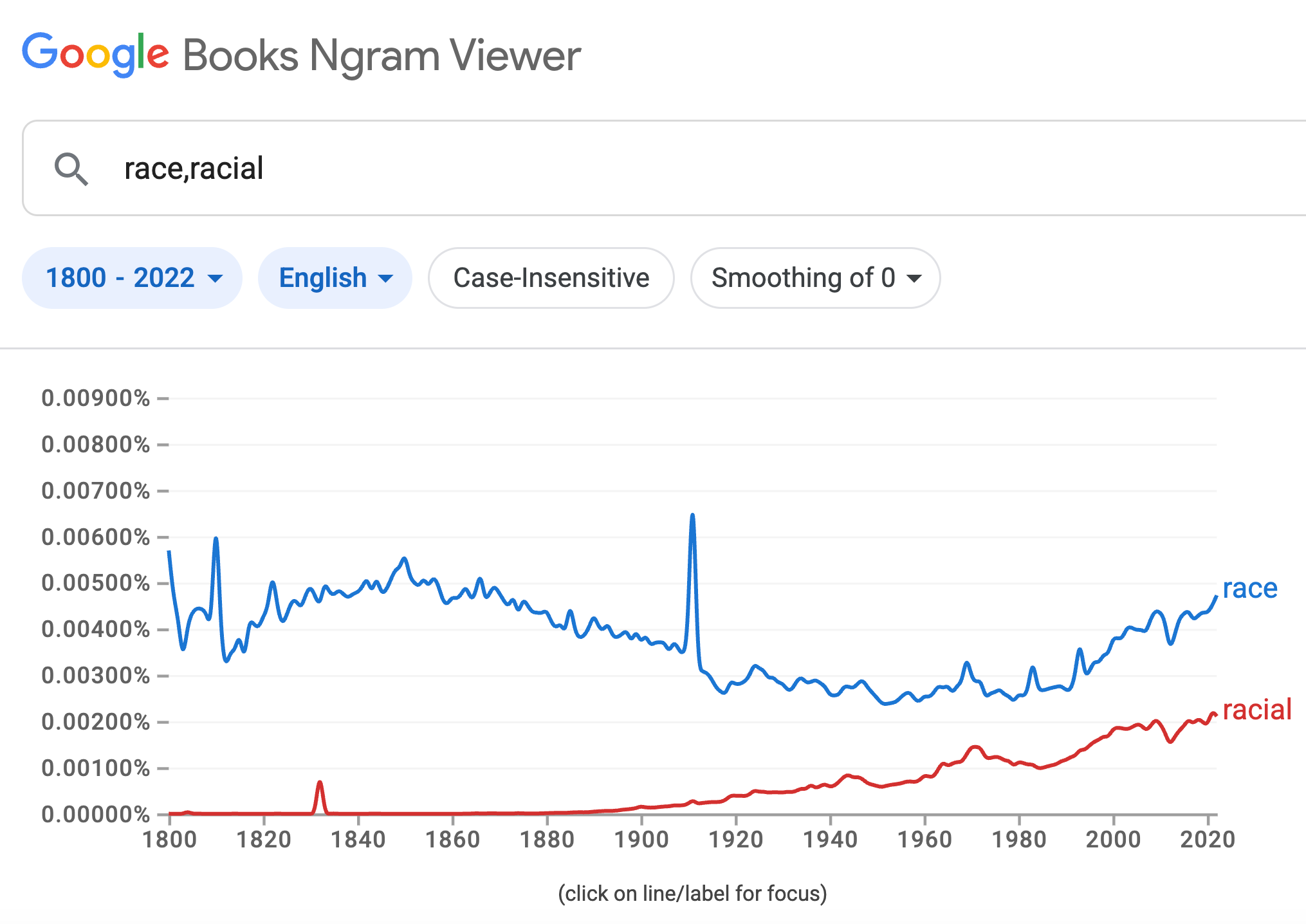
One obvious problem with this methodology is that the word “race” has multiple meanings — athletic race, electoral race, ancestral race. But the word “racial” seldom is used for anything other than talking about topics related to human races. Nobody talks about Secretariat’s supreme racial performance in the 1973 Belmont. So, “racial” is a good proxy for “ancestral race.”
We see, not surprisingly, that “racial” has about doubled in use since 1990, at the beginning of the era of political correctness (and “race” has almost doubled since then).
By the way, it’s not at all a coincidence that the word “race” is used both for a horse race and for an extended family of humans. People used to be obsessed with breeding faster race horses since they were essential in war.
Back in 2021 I looked up all the times Shakespeare used “race” and it’s clear that “race” started out in English in relation to a herd, family, lineage, or breed of horses:
For do but note a wild and wanton herd,
Or race of youthful and unhandled coltsThe Merchant of Venice (V, 1)
But to Shakespeare, “race” also had come to mean a human as well as equine lineage:
Live, and beget a happy race of kings!
Richard III (V, 3),
I wrote in Taki’s Magazine:
This is not to say that Shakespeare was an etymologist. But he inherited from his culture a rich understanding of how sex and race are related, an insight that seems to have largely been lost in modern America—and because America now dominates global thinking about race, the world.
In the Does Race Exist? debates, it’s common for participants to assume that the word “race” can only have its current American meaning of a continental-scale grouping recognizable by surface features.
And yet that clearly is an imposition of the unusual history of the United States (in which people came from the far ends of the earth by ship) onto a word that traditionally often meant something smaller, subtler, and more genealogically based, such as lineage, breed, family, pedigree, or stud. I don’t see why this idiosyncratic recent American development should be wholly privileged in thinking about the concept of race over the older, richer traditions.
Since the 1990s, I’ve argued for a grand unified perspective on biological relatedness, in which both family and race are seen to be products of the same process of sexual reproduction. A racial group would then be a type of extended family, one that has some distinctiveness due to some inbreeding.
Shakespeare might have thought there was something to that idea.
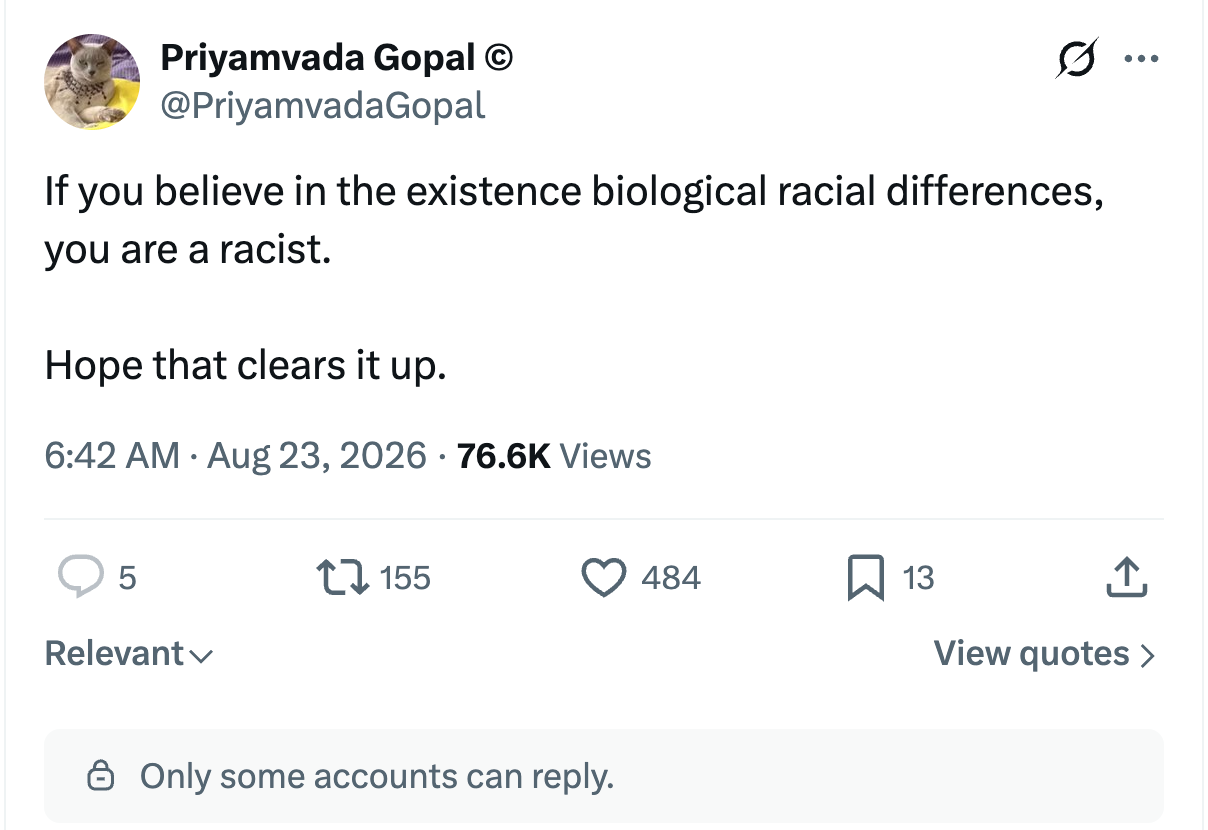
Obviously, Professor Gopal is all wrong.
So a more sophisticated talking point takes the opposite Splitter rather than Lumper extreme: that there are countless races, so you can’t say that, say, sub-Saharans exist in any sense. For example, East Africans are good at distance running and West Africans at sprinting, so how can you talk of “Africans?” (Uh, because they are both good at running?)
In a rare attempt to respond to my definition of race, Kenan Malik wrote in Prospect in 2008:
In the 19th and early 20th centuries, races were viewed as fixed groups, each with its own distinct behaviour patterns and physical characteristics. They could be ranked on an evolutionary hierarchy, with whites at the top and blacks at the bottom. Today, with a few exceptions, race realists reject the idea that there are essential, unbridgeable differences between human populations, or that differences signify inferiority or superiority. So how do they define a race? Usually as “an extended family that is inbred to some degree” in the words of Steve Sailer of the Human Biodiversity Institute. “Roughly defined,” the philosopher Max Hocutt argues, “a member of race R is an individual whose forebears were members of race R.” Just as an “animal is a coyote if it is descended from a coyote,” so “a human being is an Afro-American if she is descended from Americans whose forebears were Africans.” He accepts that “we cannot say with precision how big, how cohesive or how closed a breeding group must be or even how long it must last to count as a distinct race,” but this is immaterial for what he calls the “workaday definition of race.”
A workaday definition might be useful for dinner-table discussions but is hardly the basis of a scientific argument. Hocutt offers no coherent explanation, for instance, why one breeding population, such as the inhabitants of sub-Saharan Africa, constitutes a race, while another, such as Protestants in Ireland, does not. For Steve Sailer, that is no problem: Northern Ireland Protestants, he argues, are a distinct race!
But once everything from the British royal family to the entire human population can be considered a race (because each is an “extended family inbred to some degree”), then the category has little value.
If countries can vary in size as much as Russia and Vatican City, does the concept of “size” have little value?
What strikes me is that …
Paywall here.
