

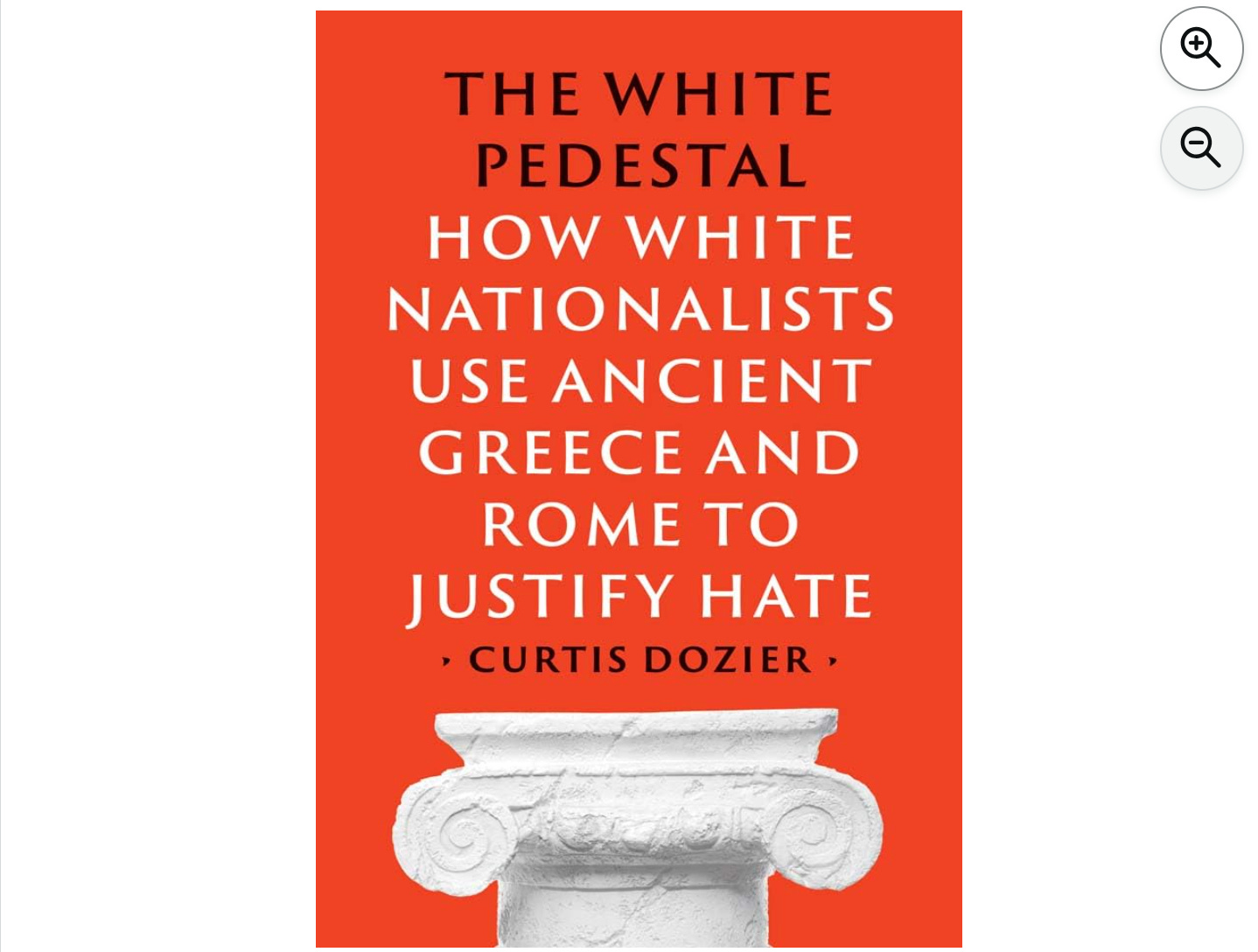
I make a few appearances as a deplorable in a new book by a professor at Vassar:
The White Pedestal: How White Nationalists Use Ancient Greece and Rome to Justify Hate
Hardcover – January 6, 2026
by Curtis Dozier (Author)
3.0 3.0 out of 5 stars (2)
From Commentary:
Review of ‘The White Pedestal’ by Curtis Dozier
Reviewed by Spencer A. Klavan:
How white nationalist thought leaders use ancient Greece and Rome to claim historical precedent for their violent and oppressive politics
It is difficult to ignore the resurgence of white nationalist movements in the United States, many of which employ symbols and slogans from Greco-Roman antiquity. A long-established neo-Nazi website incorporates an image of the Parthenon into its logo, and rioters wore Spartan helmets in the January 6, 2021, attack on the U.S. Capitol. These juxtapositions may appear incongruous to people who associate the ancient world with enlightened political ideals and sophisticated philosophical inquiry. But, as Curtis Dozier points out in this thought-provoking book, it’s hard to imagine a historical period better suited to rhetorical use by white nationalists. Indeed, some of the most widely admired voices from ancient literature and philosophy endorsed ideas
Such as logic, geometry, art, sports, science, historiography, etc.
that modern white supremacists promote, and the social and political realities of the ancient world provide models for political systems that white supremacists would like to establish today.
Part introduction to contemporary white nationalist thought, part exploration of ancient racism and xenophobia, and part intellectual history of the political entanglements of academic study of the past, this book reveals that contemporary white nationalist intellectuals know much more about history than many people assume—and they deploy this knowledge with disturbing success.
Curtis Dozier’s The White Pedestal is a godsend to white nationalists. If ever they needed a book to encourage the false impression that “white nationalism” simply means defending basic virtues and acknowledging obvious facts, this is it. Actual racists, who are indeed gaining alarming traction these days, like to portray their detractors as morally entitled fanatics with nothing but sloppy epithets to offer in lieu of argument. The White Pedestal will help their case. It will do no good for anybody else.
Dozier’s subtitle is How White Nationalists Use Ancient Greece and Rome to Justify Hate. He considers this as much an indictment of Greece and Rome as of white nationalists. “The ancient world was anything but a paradise of tolerance,” he writes in his introduction, which is why evildoers don’t have to misquote or misinterpret classical sources to mine them for retrograde ideas: They are already there.
This is a slight change of strategy from the one Dozier adopted in 2017 when he launched his website Pharos: Doing Justice to the Classics with the support of Vassar College, where he is an associate professor of Greek and Roman studies. Pharos invites contributors to write in if they “learn of a hate group appropriating antiquity,” suggesting that anyone using classical literature to support bad politics must be somehow misusing it. Early posts tried using scholarly rebuttal to respond to alt-right protesters in Spartan helmets and seedy pickup artists quoting Aristotle.
Gradually, though, Dozier became aware of the uncomfortable fact that not every classics expert agrees with him politically, and not everyone who disagrees with him politically is a drooling simpleton. So where he couldn’t fault right-wingers for misunderstanding ancient sources, he instead started blaming ancient sources for being incipiently right-wing. This is the approach he takes in The White Pedestal. “Any surprise that white nationalists take an interest in Greco-Roman antiquity,” he writes, “may give way to surprise at just how frequently ancient sources articulate ideas congruent with white nationalist thought.”
Back in 2018, I reviewed Prof. Arthur Melzer’s work of Straussian political philosophy, Philosophy Between the Lines: The Lost History of Esoteric Writing, documenting that, as Leo Strauss said, the big names like Plato and Aristotle tended to cover up some of their secret beliefs, such as not much believing in Zeus. I noted:
The big secret covered up by ancient philosophers was that they didn’t find the Greek and Roman deities terribly plausible, which isn’t really stop-the-presses news. As Edward Gibbon joked in The History of the Decline and Fall of the Roman Empire, in the most famous example of his periodic prose style:
The various modes of worship, which prevailed in the Roman world, were all considered by the people as equally true; by the philosopher as equally false; and by the magistrate as equally useful.
One finding from Melzer’s chronological list of quotations is that there is little of even Gibbon’s kind of Tory political cynicism on display until Boccaccio in the 14th century points out the ancient alliance between kings and the poets who propagandized for them. (Similarly, nobody in Melzer’s list accuses the writers of the past of sexual hypocrisy until Montaigne in the 16th century.) Instead, virtually all the great minds were what would today be considered extreme conservatives and probably fascists.
While we proclaim our faith in democracy, the condemnation of Socrates by the Athenian democracy was almost universally seen by subsequent philosophers as proving democracy’s malignancy. There’s virtually no evidence in Melzer’s quotes of antiauthoritarianism or egalitarianism in the great philosophers. Hierarchy was seen as a self-evident virtue. The people’s right to know is a relatively recent notion, probably traceable to Martin Luther’s insistence that every man should read the Bible for himself.
Today, the extremism of our culture’s demands for attestations of faith in equality and transparency is a mask for the movement back toward censorship and esotericism. We live in a society in which the fundamental truth’s — such as that talents are distributed unequally by genetics — are increasingly considered unfit for public discussion, and careers as eminent as that of as James D. Watson, co-discoverer of the structure of DNA, are destroyed for letting slip a lack of fidelity to the reigning taboos.
G.K. Chesterton observed:
The Declaration of Independence dogmatically bases all rights on the fact that God created all men equal; and it is right; for if they were not created equal, they were certainly evolved unequal. There is no basis for democracy except in a dogma about the divine origin of man.
A culture that doesn’t believe in God but does insist that He created all persons equally is increasingly going to have to discourage snickering with the lash.
Dozier’s book sounds highly reminiscent of Dr. Donna Zuckerberg’s Not All Dead White Men: Classics and Misogyny in the Digital Age, the fanatically feminist sister of Mark Zuckerberg, our most enthusiastic fan of the Emperor Augustus.
Paywall here.
