

From Reuters:
“We will run the country until such time as we can do a safe, proper and judicious transition,” Trump said during a press conference at his Mar-a-Lago resort in Florida. “We can’t take a chance that someone else takes over Venezuela who doesn’t have the interests of Venezuelans in mind.”
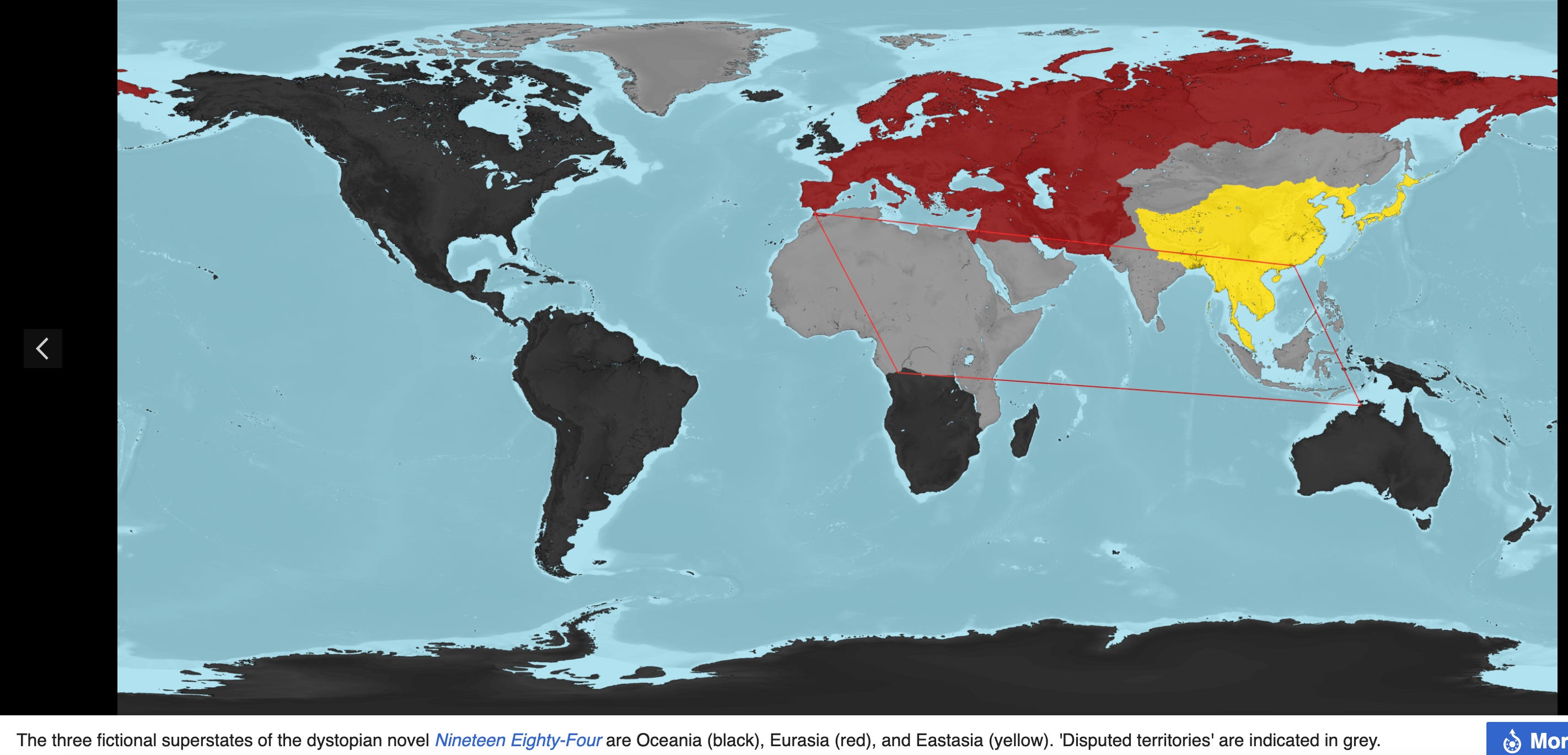
The Trump Administration’s worldview of three spheres of influence — Oceania dominated by Washington, Eastasia by Beijing, and Eurasia by Moscow — seems increasingly similar to that of George Orwell’s Nineteen Eight-Four:
From Theory and Practice of Oligarchical Collectivism as attributed to Emmanuel Goldstein in George Orwell’s Nineteen Eighty-Four:
Each of the three powers which now divide the world is in fact unconquerable, and could only become conquerable through slow demographic changes which a government with wide powers can easily avert. …
In our society, those who have the best knowledge of what is happening are also those who are furthest from seeing the world as it is. In general, the greater the understanding, the greater the delusion: the more intelligent, the less sane. One clear illustration of this is the fact that war hysteria increases in intensity as one rises in the social scale. Those whose attitude toward the war is most nearly rational are the subject peoples of the disputed territories. To these people the war is simply a continuous calamity which sweeps to and fro over their bodies like a tidal wave. Which side is winning is a matter of complete indifference to them. They are aware that a change of overlordship means simply that they will be doing the same work as before for new masters who treat them in the same manner as the old ones. The slightly more favored workers whom we call “the proles” are only intermittently conscious of the war. When it is necessary they can be prodded into frenzies of fear and hatred, but when left to themselves they are capable of forgetting for long periods that the war is happening. It is in the ranks of the Party, and above all of the Inner Party, that the true war enthusiasm is found. World-conquest is believed in most firmly by those who know it to be impossible. This peculiar linking-together of opposites—knowledge with ignorance, cynicism with fanaticism—is one of the chief distinguishing marks of Oceanic society. …
For to change one’s mind, or even one’s policy, is a confession of weakness. If, for example, Eurasia or Eastasia (whichever it may be) is the enemy today, then that country must always have been the enemy. And if the facts say otherwise, then the facts must be altered. Thus history is continuously rewritten. …
Chapter 3. War is Peace
The splitting-up of the world into three great superstates was an event which could be and indeed was foreseen before the middle of the twentieth century. With the absorption of Europe by Russia and of the British Empire by the United States, two of the three existing powers, Eurasia and Oceania, were already effectively in being. The third, Eastasia, only emerged as a distinct unit after another decade of confused fighting. The frontiers between the three superstates are in some places arbitrary, and in others they fluctuate according to the fortunes of war, but in general they follow geographical lines. Eurasia comprises the whole of the northern part of the European and Asiatic land-mass, from Portugal to the Bering Strait. Oceania comprises the Americas, the Atlantic islands including the British Isles, Australasia, and the southern portion of Africa. Eastasia, smaller than the others and with a less definite western frontier, comprises China and the countries to the south of it, the Japanese islands and a large but fluctuating portion of Manchuria, Mongolia, and Tibet.
In one combination or another, these three superstates are permanently at war, and have been so for the past twenty-five years. War, however, is no longer the desperate, annihilating struggle that it was in the early decades of the twentieth century. It is a warfare of limited aims between combatants who are unable to destroy one another, have no material cause for fighting, and are not divided by any genuine ideological difference. This is not to say that either the conduct of war, or the prevailing attitude toward it, has become less bloodthirsty or more chivalrous. On the contrary, war hysteria is continuous and universal in all countries, and such acts as raping, looting, the slaughter of children, the reduction of whole populations to slavery, and reprisals against prisoners which extend even to boiling and burying alive, are looked upon as normal, and, when they are committed by one’s own side and not by the enemy, meritorious. But in a physical sense war involves very small numbers of people, mostly highly trained specialists, and causes comparatively few casualties. The fighting, when there is any, takes place on the vague frontiers whose whereabouts the average man can only guess at, or round the Floating Fortresses which guard strategic spots on the sea lanes. In the centers of civilization war means no more than a continuous shortage of consumption goods, and the occasional crash of a rocket bomb which may cause a few scores of deaths. War has in fact changed its character. More exactly, the reasons for which war is waged have changed in their order of importance. Motives which were already present to some small extent in the great wars of the early twentieth century have now become dominant and are consciously recognized and acted upon.
To understand the nature of the present war—for in spite of the regrouping which occurs every few years, it is always the same war—one must realize in the first place that it is impossible for it to be decisive. None of the three superstates could be definitely conquered even by the other two in combination. They are too evenly matched, and their natural defenses are too formidable. Eurasia is protected by its vast land spaces, Oceania by the width of the Atlantic and the Pacific, Eastasia by the fecundity and industriousness of its inhabitants. Secondly, there is no longer, in a material sense, anything to fight about. With the establishment of self-contained economies, in which production and consumption are geared to one another, the scramble for markets which was a main cause of previous wars has come to an end, while the competition for raw materials is no longer a matter of life and death. In any case, each of the three superstates is so vast that it can obtain almost all the materials that it needs within its own boundaries. In so far as the war has a direct economic purpose, it is a war for labor power. Between the frontiers of the superstates, and not permanently in the possession of any of them, there lies a rough quadrilateral with its corners at Tangier, Brazzaville, Darwin, and Hong Kong, containing within it about a fifth of the population of the earth. It is for the possession of these thickly populated regions, and of the northern ice cap, that the three powers are constantly struggling. In practice no one power ever controls the whole of the disputed area. Portions of it are constantly changing hands, and it is the chance of seizing this or that fragment by a sudden stroke of treachery that dictates the endless changes of alignment.
All of the disputed territories contain valuable minerals, and some of them yield important vegetable products such as rubber which in colder climates it is necessary to synthesize by comparatively expensive methods. But above all they contain a bottomless reserve of cheap labor. Whichever power controls equatorial Africa, or the countries of the Middle East, or Southern India, or the Indonesian Archipelago, disposes also of the bodies of scores or hundreds of millions of ill-paid and hard-working coolies. The inhabitants of these areas, reduced more or less openly to the status of slaves, pass continually from conqueror to conqueror, and are expended like so much coal or oil in the race to turn out more armaments, to capture more territory, to control more labor power, to turn out more armaments, to capture more territory, and so on indefinitely. It should be noted that the fighting never really moves beyond the edges of the disputed areas. The frontiers of Eurasia flow back and forth between the basin of the Congo and the northern shore of the Mediterranean; the islands of the Indian Ocean and the Pacific are constantly being captured and recaptured by Oceania or by Eastasia; in Mongolia the dividing line between Eurasia and Eastasia is never stable; round the Pole all three powers lay claim to enormous territories which in fact are largely uninhabited and unexplored; but the balance of power always remains roughly even, and the territory which forms the heartland of each superstate always remains inviolate. Moreover, the labor of the exploited peoples round the Equator is not really necessary to the world’s economy. They add nothing to the wealth of the world, since whatever they produce is used for purposes of war, and the object of waging a war is always to be in a better position in which to wage another war. By their labor the slave populations allow the tempo of continuous warfare to be speeded up. But if they did not exist, the structure of world society, and the process by which it maintains itself, would not be essentially different. …
And in spite of the endless slaughters reported in the press and on the telescreens, the desperate battles of earlier wars, in which hundreds of thousands or even millions of men were often killed in a few weeks, have never been repeated.
None of the three superstates ever attempts any maneuver which involves the risk of serious defeat. When any large operation is undertaken, it is usually a surprise attack against an ally. The strategy that all three powers are following, or pretend to themselves that they are following, is the same. The plan is, by a combination of fighting, bargaining, and well-timed strokes of treachery, to acquire a ring of bases completely encircling one or other of the rival states, and then to sign a pact of friendship with that rival and remain on peaceful terms for so many years as to lull suspicion to sleep. During this time rockets loaded with atomic bombs can be assembled at all the strategic spots; finally they will all be fired simultaneously, with effects so devastating as to make retaliation impossible. It will then be time to sign a pact of friendship with the remaining world power, in preparation for another attack. This scheme, it is hardly necessary to say, is a mere daydream, impossible of realization. Moreover, no fighting ever occurs except in the disputed areas round the Equator and the Pole; no invasion of enemy territory is ever undertaken. This explains the fact that in some places the frontiers between the superstates are arbitrary. Eurasia, for example, could easily conquer the British Isles, which are geographically part of Europe, or on the other hand it would be possible for Oceania to push its frontiers to the Rhine or even to the Vistula. But this would violate the principle, followed on all sides though never formulated, of cultural integrity. If Oceania were to conquer the areas that used once to be known as France and Germany, it would be necessary either to exterminate the inhabitants, a task of great physical difficulty, or to assimilate a population of about a hundred million people, who, so far as technical development goes, are roughly on the Oceanic level. The problem is the same for all three superstates. It is absolutely necessary to their structure that there should be no contact with foreigners except, to a limited extent, with war prisoners and colored slaves. Even the official ally of the moment is always regarded with the darkest suspicion. War prisoners apart, the average citizen of Oceania never sets eyes on a citizen of either Eurasia or Eastasia, and he is forbidden the knowledge of foreign languages. If he were allowed contact with foreigners he would discover that they are creatures similar to himself and that most of what he has been told about them is lies. The sealed world in which he lives would be broken, and the fear, hatred, and self-righteousness on which his morale depends might evaporate. It is therefore realized on all sides that however often Persia, or Egypt, or Java, or Ceylon may change hands, the main frontiers must never be crossed by anything except bombs.
Under this lies a fact never mentioned aloud, but tacitly understood and acted upon: namely, that the conditions of life in all three superstates are very much the same. In Oceania the prevailing philosophy is called Ingsoc, in Eurasia it is called Neo-Bolshevism, and in Eastasia it is called by a Chinese name usually translated as Death-worship, but perhaps better rendered as Obliteration of the Self. The citizen of Oceania is not allowed to know anything of the tenets of the other two philosophies, but he is taught to execrate them as barbarous outrages upon morality and common sense. Actually the three philosophies are barely distinguishable, and the social systems which they support are not distinguishable at all. Everywhere there is the same pyramidal structure, the same worship of a semi-divine leader, the same economy existing by and for continuous warfare. It follows that the three superstates not only cannot conquer one another, but would gain no advantage by doing so. On the contrary, so long as they remain in conflict they prop one another up, like three sheaves of corn. And, as usual, the ruling groups of all three powers are simultaneously aware and unaware of what they are doing. Their lives are dedicated to world conquest, but they also know that it is necessary that the war should continue everlastingly and without victory. Meanwhile the fact that there is no danger of conquest makes possible the denial of reality which is the special feature of Ingsoc and its rival systems of thought. Here it is necessary to repeat what has been said earlier, that by becoming continuous war has fundamentally changed its character.
In past ages, a war, almost by definition, was something that sooner or later came to an end, usually in unmistakable victory or defeat. In the past, also, war was one of the main instruments by which human societies were kept in touch with physical reality. All rulers in all ages have tried to impose a false view of the world upon their followers, but they could not afford to encourage any illusion that tended to impair military efficiency. So long as defeat meant the loss of independence, or some other result generally held to be undesirable, the precautions against defeat had to be serious. Physical facts could not be ignored. In philosophy, or religion, or ethics, or politics, two and two might make five, but when one was designing a gun or an airplane they had to make four. Inefficient nations were always conquered sooner or later, and the struggle for efficiency was inimical to illusions. Moreover, to be efficient it was necessary to be able to learn from the past, which meant having a fairly accurate idea of what had happened in the past. Newspapers and history books were, of course, always colored and biased, but falsification of the kind that is practiced today would have been impossible. War was a sure safeguard of sanity, and so far as the ruling classes were concerned it was probably the most important of all safeguards. While wars could be won or lost, no ruling class could be completely irresponsible.
But when war becomes literally continuous, it also ceases to be dangerous. When war is continuous there is no such thing as military necessity. Technical progress can cease and the most palpable facts can be denied or disregarded. As we have seen, researches that could be called scientific are still carried out for the purposes of war, but they are essentially a kind of daydreaming, and their failure to show results is not important. Efficiency, even military efficiency, is no longer needed. Nothing is efficient in Oceania except the Thought Police. Since each of the three superstates is unconquerable, each is in effect a separate universe within which almost any perversion of thought can be safely practiced. Reality only exerts its pressure through the needs of everyday life—the need to eat and drink, to get shelter and clothing, to avoid swallowing poison or stepping out of top-story windows, and the like. Between life and death, and between physical pleasure and physical pain, there is still a distinction, but that is all. Cut off from contact with the outer world, and with the past, the citizen of Oceania is like a man in interstellar space, who has no way of knowing which direction is up and which is down. The rulers of such a state are absolute, as the Pharaohs or the Caesars could not be. They are obliged to prevent their followers from starving to death in numbers large enough to be inconvenient, and they are obliged to remain at the same low level of military technique as their rivals; but once that minimum is achieved, they can twist reality into whatever shape they choose.
The war, therefore, if we judge it by the standards of previous wars, is merely an imposture. It is like the battles between certain ruminant animals whose horns are set at such an angle that they are incapable of hurting one another. But though it is unreal it is not meaningless. It eats up the surplus of consumable goods, and it helps to preserve the special mental atmosphere that a hierarchical society needs. War, it will be seen, is now a purely internal affair. In the past, the ruling groups of all countries, although they might recognize their common interest and therefore limit the destructiveness of war, did fight against one another, and the victor always plundered the vanquished. In our own day they are not fighting against one another at all. The war is waged by each ruling group against its own subjects, and the object of the war is not to make or prevent conquests of territory, but to keep the structure of society intact. The very word “war,” therefore, has become misleading. It would probably be accurate to say that by becoming continuous war has ceased to exist. The peculiar pressure that it exerted on human beings between the Neolithic Age and the early twentieth century has disappeared and been replaced by something quite different. The effect would be much the same if the three superstates, instead of fighting one another, should agree to live in perpetual peace, each inviolate within its own boundaries. For in that case each would still be a self-contained universe, freed forever from the sobering influence of external danger. A peace that was truly permanent would be the same as a permanent war. This—although the vast majority of Party members understand it only in a shallower sense—is the inner meaning of the Party slogan: WAR IS PEACE.
In 2026, the Trump Administration’s apparent ideas of the United States as the core of Oceania and China as the core of Eastasia seem …
Paywall here.
