

Is artificial intelligence going to progress so rapidly that the world is destroyed by anarchic attacks on cybersecurity?
Or will the robots take over the world and enslave us all?
Or will it prove a wet firecracker like the 1980s superconductivity 9-days-wonder?
Or will it crash the economy like the Housing Bubble did in 2008?
Or will it usher in an age of prosperity?
Or some combination of all of the above?
From the New York Times oped page:
This Boom Looks a Lot Like the Housing Bubble
Opinion
Guest Essay
Oct. 25, 2026
By Jen Harris
Ms. Harris was an economic official in the Biden White House.
Artificial intelligence is fast becoming the largest investment in U.S. history. As the money pours in, the companies involved are resurrecting bad old habits eerily reminiscent of the shenanigans deployed in the run-up to the financial crisis.
There are already signs that much of this investment may go bad. If it does, the consequences could rival what happened in 2008.
We know far too little about the financial plumbing propping up this surge. What little we do know looks remarkably like the tactics once employed by Wall Street firms like Lehman Brothers, the storied 158-year-old bank that collapsed in 2008, setting off a panic that ultimately cost taxpayers nearly $700 billion in bailouts in today’s dollars and nearly nine million Americans their jobs. Now as then, companies are hiding large amounts of debt off public balance sheets. Firms responsible for protecting our pensions and our insurance are again risking our money by snapping up complicated financial products backstopped by assets of uncertain value. A small group of companies are buying and selling large amounts of a hot product to one another, inflating demand for the product and obscuring the risks of the system in a web of complexity. The accountants and credit-rating firms that analyze the situation — and that are financially beholden to the debtors — are deploying shaky excuses to declare it all fine.
There are a few differences. With more U.S. funds in A.I.-heavy stocks than in homes, a crash could destroy more wealth than the 2008 financial crisis did. And the Trump administration, reportedly eager to prevent a bust, is making changes that inject new opacity and more risk into the situation.
There are already signs the nascent A.I. industry may not soon generate the trillions of dollars required to pay off all the huge debts it is incurring. Earlier this month, The Financial Times reported that the projected annual revenue at A.I. lab OpenAI was about $50 billion at the end of September, 28 percent lower than had previously been believed. Figures reported by The Wall Street Journal this month suggested that revenue growth at Anthropic, OpenAI’s chief rival, was softening. Markets are getting nervous, with the tech-laden Nasdaq falling over 5 percent over the last two weeks.
Anthropic and OpenAI are already so entangled in our economy (and in our national security) that if they sink, Washington will need a plan. Done right, any rescue would come with real safety guardrails, real insurance that we won’t cede control of the technology to China and real service to the public interest.
All three at once? Really?
Lehman Brothers was born in 1850 as a cotton brokerage in antebellum Alabama. The A.I. chipmaker Nvidia was born in 1993 in a booth at a Denny’s in San Jose, Calif., and Meta in a Harvard dorm in 2004. And yet the financial circumstances surrounding those companies share an uncanny resemblance.
Start with hidden loans. A Wall Street Journal analysis in August concluded that the nine largest tech firms, Nvidia and Meta included, have managed to accrue $3 trillion of debt, or roughly 10 percent of the entire U.S. economy, off their balance sheets. Keeping the debt off the books (and away from the figures investors and regulators watch most closely) makes it easier for those companies to spend enormous sums constructing the data centers that drive A.I. — centers they believe will both improve the technology and satisfy an expected takeoff in demand.
Back in 2008, Lehman, too, accumulated lots of debt, primarily from buying subprime mortgages; those loans, which were targeted to home buyers with thin or imperfect credit histories, were the hot product of its day.
OK, but if the hot product of the day in 2008 was sub-prime mortgages in rapidly Hispanicizing Sand State exurbs, while the hot product in 2026 is AI, a colossal technological breakthrough that science fiction writers have been extolling for us/alarming us about for 60 years, is this analogy perfect?
It’s 18 years later and very few people are yet aware of the central mechanism behind the Housing Bubble/Bust, which doesn’t seem at all like our current situation involving AI. As I wrote on the 10th anniversary in 2008:
… Republicans don’t like blaming businessmen or Republican politicians. Democrats don’t like blaming pro-diversity initiatives. Thus, the whole sorry history has gone down the memory hole.
The GOP was in the White House when the Housing Bubble was brewed up in 2002–2005. President George W. Bush strongly pushed the finance industry to lend more to nonwhites at his Oct. 15, 2002, White House Conference on Increasing Minority Homeownership. There he told his federal regulators not to worry so much about traditional credit standards regarding down payments and documentation of income because he wanted to see 5.5 million more minority homeowners by 2010.
Republicans often do a pretty good job of keeping an eye on Democrats trying to hand out rewards to their supporters. But GOP skepticism breaks down when it’s a GOP president calling for easier money for blacks and Hispanics, especially when it’s not tax dollars but mortgages handed out by profit-seeking businesses.
Republican-allied economists have been largely stumped in figuring out how to blame the Bubble and Bust on Democrats.
They focused for a while on the Democratic-sponsored Community Reinvestment Act that was intended to encourage lending in minority neighborhoods. But it was implausible that the government had forced lenders to give out hundreds of billions in what they knew were bad mortgages, especially since most of the lenders had seemed wildly enthusiastic during the Bubble. Moreover, bankers who realized how bad the loans would be could simply have sat out the craziness.
But there is a way that the Community Reinvestment Act groomed the culture of lending over the decades to be overoptimistic about minority borrowers. The CRA acted as a Darwinian filter on which banks got to buy other banks. Banks that didn’t promise to play ball with lending activists could get their acquisitions held up by regulators. Over time, the optimists about minority lending were encouraged to grow bigger while the pessimists were not, so banking came to be dominated by unrealistic enthusiasm.
Consider Washington Mutual of Seattle, which became, via 29 acquisitions, the sixth-biggest bank in the country before it went under in 2008.
CEO Kerry Killinger liked to outbid rival banks for mergers not just in cash but also in CRA pledges. For example, when WaMu competed with Home Savings in 1997 to buy Great Western, Killinger topped Home’s CRA pledge of lending $70 billion to minority and lower-income borrowers by offering $75 billion.
The next year WaMu bought Home Savings itself, and won regulatory approval in part by signing a $120 billion CRA pledge with various leftist front organizations such as the Greenlining Institute.
In 2001 WaMu bought Dime Bank and pledged $375 billion in CRA mortgages.
The informative 2011 book The Lost Bank by Kirsten Grind shows no evidence that Killinger ever thought the government was holding a gun to his head to make these pledges. He felt that WaMu was going to come into Southern California and make a fortune lending to Hispanics. Those local lenders he’d outbid hadn’t been as optimistic about their neighbors’ prospects of repaying their loans as he was because they were prejudiced. They just didn’t understand that diversity is our strength.
Similarly, another central figure in the mortgage meltdown, Angelo Mozilo, CEO of Countrywide Financial, was another diversity enthusiast.
Mozilo wanted to boost Countrywide’s share of the national mortgage market from 10 percent to 30 percent. He believed he could safely do that by increasing lending to marginal customers, especially Hispanics. As an Italian-American who had felt himself the object of WASP disdain, Mozilo believed that lenders traditionally underestimated Latinos’ ability to pay back mortgages due to their bigotry.
In 2003, Mozilo, citing Bush’s push for minority home ownership, pledged to a Harvard audience that Countrywide would lend $600 billion to minority and lower-income borrowers by 2010. In 2005, he boosted that promise to one trillion dollars.
But a trillion here, a trillion there, pretty soon you are talking about real money. Countrywide went under in 2008.
Bush had a not-implausible political plan in mind behind his “ownership society”: By giving the green light to lenders to take more risks with nontraditional borrowers, he hoped to attract Hispanics to vote Republican.
And indeed, the 2004 economic boom among Hispanics in construction and Spanish-language mortgage lending jobs probably helped Bush up his share of the Latino vote from about 35 percent in 2000 to about 40 percent in 2004.
If Bush had cynically put the brakes on immediately after winning reelection, the housing bubble wouldn’t have metastasized the way it did in 2005–2007. Unfortunately, the president actually believed diversity is our strength.
One reason Bush failed to see what was going so disastrously wrong with the housing market in the “Sand States” of California, Arizona, Nevada, and Florida was that in his home state of Texas, where local regulators rapidly approve new home construction, increases in demand are quickly met by increases in supply, so prices don’t rise for very long. The Bush Bubble barely inflated in Texas.
But in California, unexpected demand sets off a regulatory endurance struggle, causing prices to rise through the roof in the meantime. (The other three Sand States are in-between California and Texas in time to construction.)
Eventually by 2007–2008, massive new subdivisions were on the horizon in the Sand States, just as the lending industry discovered that there had actually been perfectly rational reasons why those evil old racist bankers had been reluctant to lend to blacks and, especially, Hispanics.
But ten years later, right- (and left-) thinking Americans remain in thrall to the dogma of diversity. Hence, it’s been difficult for people to grasp the mounting academic research showing the various ways diversity helped set off the landslide that began with the U.S. mortgage market.
For example, a 2015 paper by Lin, Liu, and Xie found that in a sample of 18,000 households:
The difference in the mortgage delinquency rates between immigrants (15.7%) and natives (4.4%) is significant.
That’s more than 3.5 times the native rate.
Similarly, a 2013 paper by Luea, Reichenberger, and Turner revealed 2009 default rates for whites of 3.4 percent, blacks 11.3 percent (3.3 times the white rate), and Hispanics 16 percent (4.7 times the white rate). When the economists adjusted for every available personal statistic, blacks still defaulted at 1.44 times the white rate and Hispanics at 1.88, suggesting that some ethnic prejudice was justified.
A 2013 paper by Reid featuring data from the fifty largest metro areas for mortgages originated just in 2005 shows that foreclosure rates by 2009 were twice as bad for blacks as whites and almost three times as bad for Hispanics as whites. By 2010, 10.5 percent of Hispanics were in foreclosure versus 4 percent of whites.
Blacks weren’t much to blame for 2008 because their mortgages tended to be small because black neighborhoods have low housing prices. Not many immigrants were clamoring to move to Detroit.
But Hispanics tend to live in expensive states such as California, where immigration drives up prices.
According to Zillow, Hispanic neighborhoods nationally exploded in price by 280 percent from 2000 to 2006 versus about 160 percent for white neighborhoods. Remarkably, by the peak of the Bubble, the median home in a Hispanic neighborhood was worth almost a hundred thousand dollars more than the median home in a white neighborhood.
Not surprisingly, the decline in home value from peak to trough was almost twice as severe in Hispanic neighborhoods as in white neighborhoods.
In summary, immigration was seen as a vast boon to the housing market until it turned out that Hispanics tended not to be able to afford the huge mortgages they had been given. At that point in 2008, housing prices in several high-priced Hispanic-heavy states, such as California and Florida, plummeted, taking down financial institutions like Lehman Brothers, Washington Mutual, and Countrywide Financial. This carnage set off a national recession even in places without a Housing Bubble.
Santayana famously said, “Those who cannot remember the past are condemned to repeat it.” But what if you haven’t forgotten it because you never had a clue in the first place?
Instead, the more obvious analogy for the risks we are running with betting so heavily on AI is the Pets.com/9-11 recession of the early 2000s that followed the good times of the first Internet Bubble. The Internet really was a big deal, but investors got carried away, as is only human nature. Here’s what happened to the NASDAQ composite index:
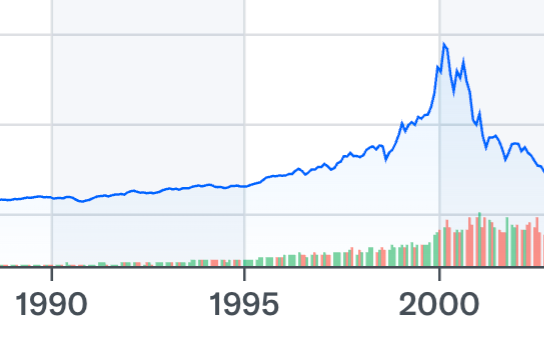
On the other hand, here’s the entire NASDAQ chart:
Paywall here.
