

From the Chicago Tribune:
The Black Caucus is the ‘conscience of Congress.’ Supreme Court ruling has it bracing for a big hit.
By Terry Tang
PUBLISHED: April 30, 2026 at 8:06 AM CDT
Black members of Congress are bracing for a crippling shake-up of their ranks after a Supreme Court ruling gutted a key section of the Voting Rights Act that had protected minority communities in political redistricting and helped boost their representation.
Wednesday’s decision clears the way for Republican-led states to redraw U.S. House districts without regard to race, potentially creating many more GOP-friendly seats.
Maybe.
The New York Times editorial board is similarly worked up:
The Justices Acted as Partisans in the Voting Rights Ruling
April 29, 2026
By The Editorial Board
… The effects will be significant. The ruling, in Louisiana v. Callais, makes it easier for states to draw districts for Congress, state legislatures and local councils that elect the candidates favored by white voting blocs. The officials who make the maps no longer need to worry much about whether they are sprinkling Black voters across many districts and eliminating majority-Black districts.
The reality is that in the name of disentangling race from politics, the Supreme Court has given white voters more power at the expense of racial minorities.
But perhaps Republicans have tended to benefit from the Voting Rights Act mandating lumping blacks, the most steadfast Democrats, into a few districts that are so Democratic-tilted that even black candidates can easily get elected?
This requirement to shovel large numbers of black voters into a few districts allows Republicans to spread out white voters into a lot more districts giving Republicans the upper hand in most elections.
The Votings Rights Act Amendments of 1982 first came into effect in creating guaranteed black districts after the redistricting after the 1990 Census. This got a lot more black elected to the House in 1992, as this NYT graph shows:
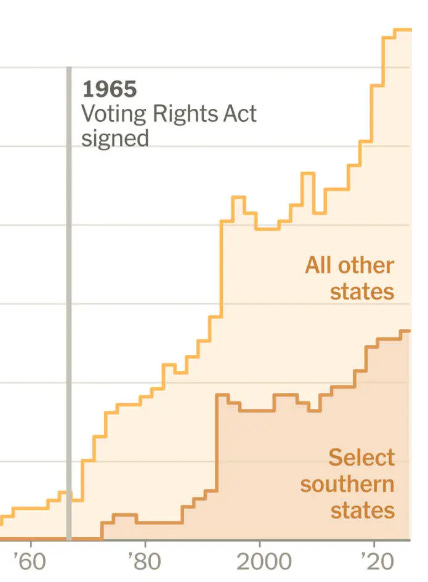
But … in 1994, the GOP won control of the House of Representatives for the first time since the 1952 midterms.
The New York Times itself reported in 1994:
THE 1994 ELECTION: VOTERS; Did Racial Redistricting Undermine Democrats?
By Steven A. Holmes
Nov. 13, 1994
As politicians and academics analyze the forces that created this year’s Republican tidal wave, another factor is taking its place alongside voter anger and President Clinton’s unpopularity: the creation of majority black Congressional districts.
In 1982 Congress amended the Voting Rights Act to require that blacks and other minorities be given an enhanced opportunity to elect one of their own to Congress and to state legislatures. To do that, Congressional and state legislative maps were redrawn after the 1990 Census, a process in which blacks and Republicans came together in an odd alliance to assure that minorities would constitute a majority in some districts.
Reapportionment produced a bumper crop of black elected officials in 1992, with Congress adding 16 black lawmakers. But at the same time, some scholars say, it sowed some of the seeds of the Democrats’ political misfortune this year.
Consolidating black voters, staunch Democrats for decades, into a few districts removed them from other districts, many of which had been held, with their help, by white Democrats. As a result, the white-majority districts that remained had a more Republican cast.
“The process of aggregating blacks into sometimes peculiar-looking districts meant leeching or bleeding blacks out of other districts,” said Richard Scher, a political scientist at the University of Florida. “That left Florida, for example, with a number of white suburban districts that were ripe for plucking, and that’s exactly what happened.”
Some scholars and political analysts say that the creation of majority black districts in 1990 may have played an important role in costing the Democrats control of the House of Representatives. They estimate that the Democrats may have lost 10 seats this year, mainly in the South, because of redistricting, on top of the 5 seats they feel were lost in 1992.
They argue that reapportionment not only siphoned solid Democratic votes from white districts, but also helped Republicans attract higher-caliber candidates and raise more money by giving them a better shot at winning those districts. In addition, when black voters were removed from marginally Republican districts, the Democrats’ chances of winning such seats became that much slimmer.
“There is absolutely no secret that the South on a Congressional-district-by-Congressional-district basis got more Republicans in total because of minority districts,” said an official with the Democratic Congressional Campaign Committee who would speak only on the condition of not being identified.
For example, consider a made-up state with 10 seats in the House of Representatives. Imagine, for the sake of simplicity, that in a typical election, whites makes up 90% of voters and blacks 10%.
Blacks vote 90% Democrat and 10% Republican. Whites vote 54.4% Republican and 45.6% Democratic. So, statewide, Republicans and Democrats each get 50% of the votes.
Thus, in the state as a whole, 18% of Democrats are black and 2% of Republicans are black.
So, if districts are drawn wholly at random to each perfectly represent the racial and partisan breakdown of the entire state, then 82% of the voters in each Democratic primary would be white.
In the average election, what are the odds that at least one black gets one of the 10 seats in the House?
Paywall here.
