

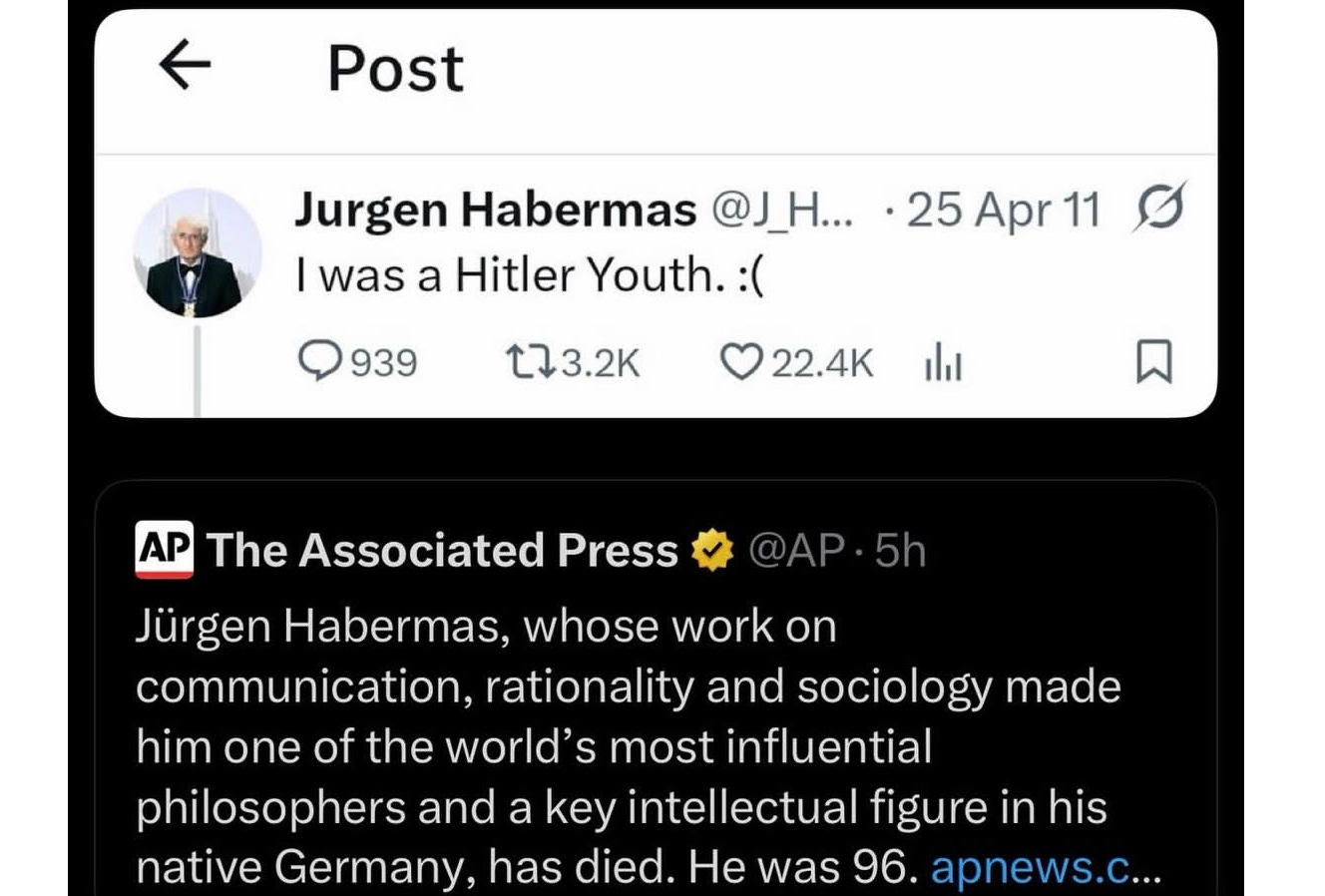
From the New York Times obituary section:
Jürgen Habermas Dies at 96; One of Postwar Germany’s Most Influential Thinkers
In dozens of books, he rejected postmodern cynicism about truth and reason, arguing that rational communication was the best way to redeem democratic society.
By Gal Beckerman
March 14, 2026
Jürgen Habermas, a philosopher and public intellectual who was one of the most influential and cited thinkers in postwar Germany, died on Saturday in Starnberg, Germany, southwest of Munich. He was 96. …
For over half a century and in dozens of books, Dr. Habermas bucked the prevailing trend of postmodern cynicism about truth and reason, offering a staunch defense of Enlightenment ideals and the possibility of individual and societal freedom.
He was best known for introducing in the early 1960s the notion of a “public sphere.” He theorized that democracy emerged and could only continue to exist in a healthy form if there was a space that was outside the control of the state, where deliberation and the exchange of ideas could freely occur. …
But in his old age, he took his immense prestige on the warpath against European voters deliberating and freely exchanging ideas about immigration.
Though a disciple and eventual leader of the famed Frankfurt School of critical social theory, Dr. Habermas had more faith in the promise of modernity than mentors like Theodor Adorno and Max Horkheimer, believing that the Enlightenment was an “unfinished project” that could be corrected through a focus on improved communication.
Starting in the 1970s, he wrote about the “ideal speech situation,” one in which people would come together on equal footing and through a process of rational dialogue arrive at the truth — an idea he expanded on in his major work, “The Theory of Communicative Action” (1981). This sort of consensus-building through conversation — subjecting ideas to, as he frequently put it, an “acid bath of relentless public discourse” — would allow citizens to “exercise collective influence over their social destiny,” he wrote….
Though reading his philosophic writing, often impenetrable in its density, was likened by at least one American intellectual to chewing glass, Dr. Habermas also worked in another register, responding to issues of the moment with countless opinion essays that appeared in German newspapers with great frequency. His abiding concern was the state of democracy and the fear of backsliding into the exclusionary and violent social order he experienced in his youth.
He warned against the rise of nationalism and any attempt to forget or relativize the Holocaust. …
Dr. Habermas also turned his attention to the place of religion in the public sphere. Prompted in part by the hostility toward Muslims in Europe, he wrote in a number of books about what he called a “post-secular” society in which he sought to reconcile the atheistic tradition of the Enlightenment with modern religion, and reflexive faith with the institutions of democracy.
You see, Habermas felt that Europeans, such as Thilo Sarrazin, engaging in communicative action over how many Muslims it was prudent to let into Europe if Enlightenment values were to be preserved was MORALLY WRONG.
Admittedly, Muslims at present tended not to be big fans of Enlightenment values, but all that the heavily Muslim “post-secular” Europe of the the future needed to do was explain to Muslims that they ought to state their demands using Habermas-approved secular arguments.
What could go wrong?
It was part of a lifelong ideal that imagined the greatest number of citizens deliberating together about the state of their society. As he wrote in a 2010 guest essay in The New York Times, in which he deplored the renewal of nationalistic tendencies in European politics: “Democracy depends on the belief of the people that there is some scope left for collectively shaping a challenging future.”
I responded to Habermas’s NYT essay in VDARE:
Paywall here.
