

Which one was Milli and which one was Vanilli?
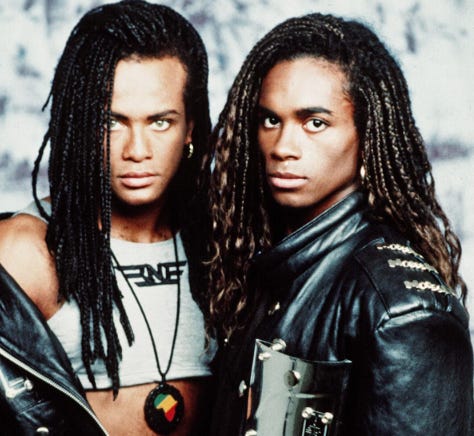
I still can’t tell them apart.
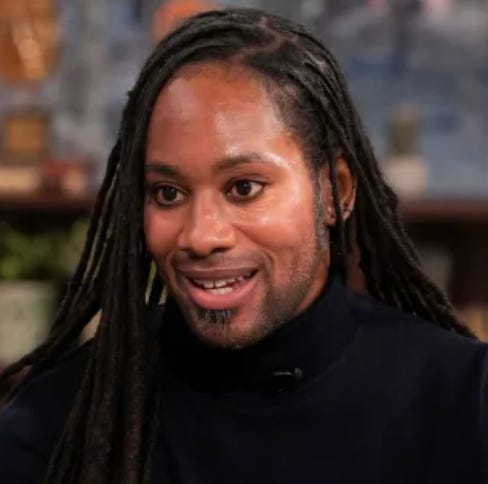
Pretty soon, all three will be one big blur.
From the Guardian last February:
Garth Cartwright
Three decades after having his Grammy rescinded as part of the notorious duo, he is a nominee once more, for the audiobook of his unflinching memoir. ‘I had to tell my story,’ he says
Sun 1 Feb 2026 05.00 EST
It may not be the most auspicious way to start an interview, but I have to ask: Fab, is it you reading your audiobook? Please confirm you aren’t just a pretty face hired to front it?
Fabrice Maxime Sylvain Morvan considers my question, then laughs. I’m teasing: it definitely is Morvan narrating You Know It’s True: The Real Story of Milli Vanilli. But as the recording of his book has been nominated for best audiobook, narration and storytelling recording at the 2026 Grammy awards – and Milli Vanilli are the only winners to have had their Grammy (given in 1990 for best new artist) rescinded, due to the revelation that the duo didn’t sing on their records – I do need confirmation.
“It’s all me,” a smiling Morvan says. “I co-wrote the book with Parisa Rose, a journalist with the Los Angeles Tribune, and throughout I have been as truthful as I can possibly be.”
Truth and lies feature through Morvan’s memoir: as half of Milli Vanilli he enjoyed pop stardom while living a lie, before being skewered by those demanding the truth. Almost everyone aged over 45 will probably have some memory of Milli Vanilli, so popular were they between October 1988 and November 1990: with three US No 1s, and more than 37m singles and albums sold in 1989 alone, they were positioned alongside Michael Jackson, George Michael and Madonna as pop’s most popular performers.
If 1989 was Milli Vanilli’s annus mirabilis then 1990 proved their annus horribilis: after their producer/svengali Frank Farian admitted they were “non-singing performers”. The duo were “cancelled” in today’s terms – Grammy rescinded, recording contract denuded, intense media and public opprobrium. Class action lawsuits under US fraud protection laws were served, while TV comedians ridiculed the photogenic performers.
Of the millions of American record-buyers eligible for rebates, only about 50 ever asked for their money back.
“It was an awful experience,” says Morvan, a youthful 59, speaking from his home in Amsterdam. “People hated us. And when we gave our press conference [in November 1990] after Frank had told the world our secret it felt like we were met by a media lynch mob.”
Footage of the press conference makes for uncomfortable viewing: a baying crowd of predominantly white journalists shout questions and accusations at the duo, treating them like criminals. Morvan remains largely silent during the interrogation, seemingly shellshocked. His Milli partner, Rob Pilatus, tries to defend their position, stating: “We were poor, living in the projects – have you ever lived in the projects?”
No mercy was shown, and Pilatus and Morvan were left to suffer outrageous fortune’s slings and arrows. Pilatus never recovered, dying of an overdose, aged 33, in 1998, his post-stardom life being marked by addiction and a short spell in prison. His death might have signalled the end of one of pop’s most notorious stories, but instead, in recent years there has been a reconsideration of Milli Vanilli: both the exuberant Europop of the recordings, and the duo’s high-energy performances (“We choreographed everything,” says Morvan, “and danced until our shoes were full of blood”). Alongside this new appreciation, plenty have asked the question: did two young Black performers, ruthlessly exploited by white record executives, deserve such public humiliation?
Q. Who was racist:
The European white record producer who signed them to a contract despite their not being able to sing?
or
The American white journalists who were amazed and amused by the famous black pop singers who couldn’t sing?
A. They are all white so all were guilty of racism.
Anyway, I never saw what the big deal was that neither Milli nor Vanilli could sing their hits. Didn’t Jean Kerr in The King and I, Natalie Wood in West Side Story, and Audrey Hepburn in My Fair Lady all have their singing supplied by ghost singer Marni Nixon?
Frank Sinatra definitely sang “I’ve Got You Under My Skin,” but the song was composed by Cole Porter, arranged by Nelson Riddle, and the trombone solo was played by Milt Bernhart. As Adam Smith pointed out, there’s a lot to be said for division of labor.
It was only with the Beatles and, especially, Bob Dylan that the auteur theory became big in pop music.
In this century, musical auteurism has been fading as young men have wandered off from music to video games, while young women have become the face of pop music.
American comedians loved the Milli Vanilli scandal less due to Milli and Vanilli being black, and more due to their being …
Paywall here.
