

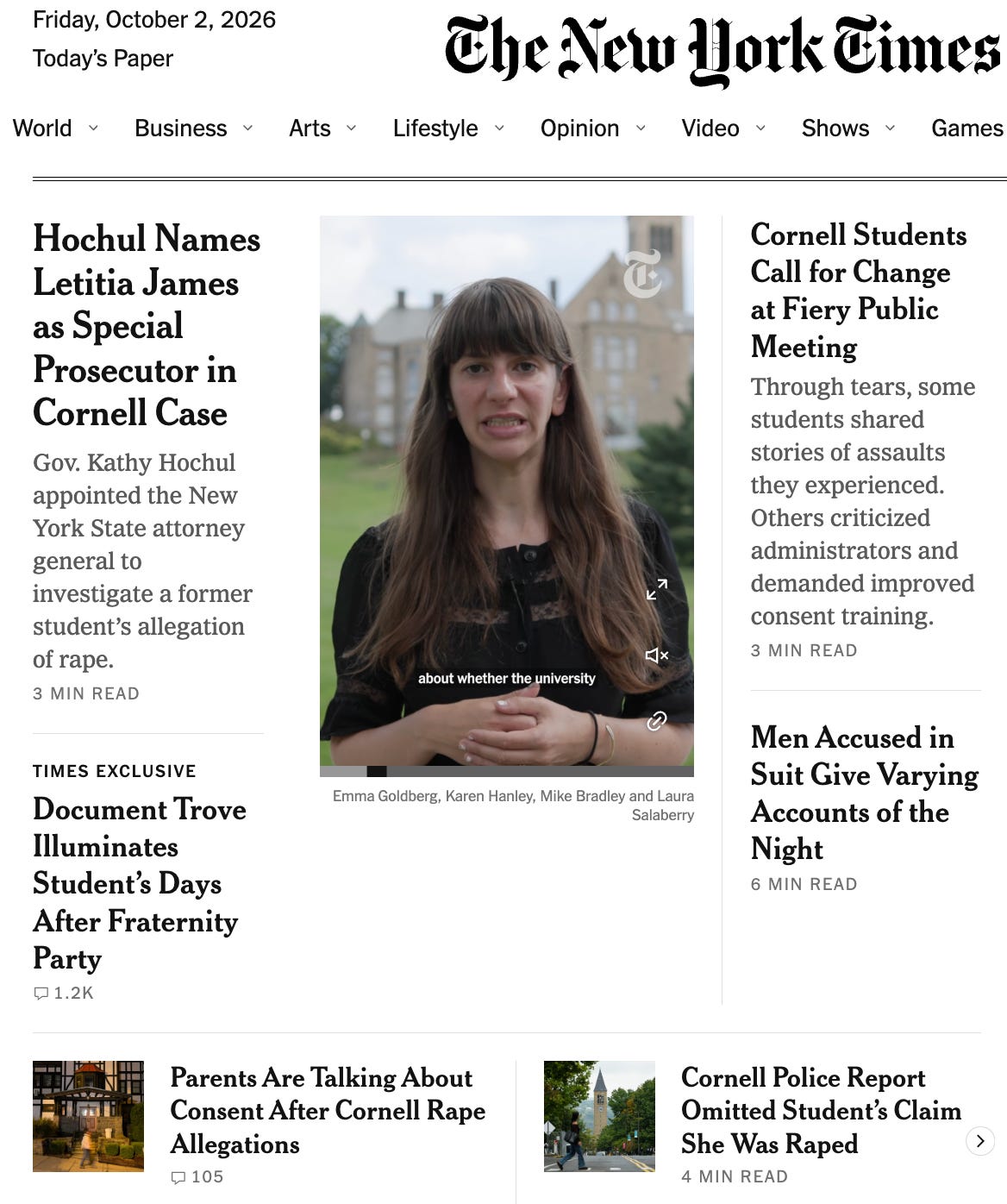
Unlike the Duke lacrosse team rape hoax of 2007 in which no sex happened and the Haven Monahan Rolling Stone rape hoax of 2014 in which Haven Monahan never existed, at least actual sex happened this time, although it sounds like most of the participants appear disappointed it didn’t live up to their favorite porn.
And then there’s the fact that the accused frat boys are fairly diverse, although, as usual, nobody is too sure how to categorize the guy with a Portuguese name.
Apparently, Jane Doe at Cornell was not angry at the four men she had sex with after consenting. Instead, she got angry afterwards at all the women calling her a slut for consenting. Most normal women, not unreasonably, don’t like sluts like Jane Doe for lowering the price of sex. But feminist ideology is incapable of dealing intelligently with most examples of these kinds of women vs. women animus.
The funny thing is that at least one of the New York Times’ articles is devastating to the Narrative:
How a Cornell Student Went From Shame to Action
The woman known as “Jane Doe” was initially embarrassed about what happened at a fraternity party in 2024, but soon concluded: “I was assaulted.”
By Debra Kamin, Matt Flegenheimer, Amy Julia Harris, and Sharon Otterman
Oct. 1, 2026
In October 2024, about a week after a Chi Phi fraternity party at Cornell University, the sophomore who would come to be known as Jane Doe was milling around an online forum about Greek life when she encountered a post that stopped her cold.
“Are Chi Phi brothers Crips or Bloods because I hear they have been doing hell Gang Banging?” someone had written.
“They do drugs and gang r*ped a sophomore,” another user said. “Report them.”
Since the evening that began on Oct. 19, 2024, Jane Doe had recounted the night’s events to her roommates without identifying herself as a rape victim. She had exchanged friendly text messages with men she would later accuse of assault. She had heard uncharitable appraisals of herself from undergraduate gossips.
Then she read the words.
“That’s the first time I had ever heard the narrative change that I wasn’t a whore and that I was assaulted,” Jane Doe told investigators, according to documents from a university review of the accusations obtained by The New York Times.
Those records, which have not been previously reported, help illuminate a case that has horrified the nation and plunged one of its elite institutions into crisis. They shed light on the crucial three-week period between the fraternity party and Jane Doe’s decision to take her story to the campus police, accusing multiple fraternity brothers of sexual assault and alleging that she was coerced into taking ketamine.
The bare facts of what happened after she made her accusations are by now well known: The Tompkins County, N.Y., district attorney, Matthew Van Houten, reviewed her complaint and declined to bring criminal charges, saying there was not sufficient evidence to do so. Jane Doe filed a complaint that prompted at least a dozen hearings by the school’s Title IX committee, which is supposed to ensure compliance with federal civil rights laws.
On Sept. 16, Jane Doe also filed a lawsuit against seven men, accusing them of sexual assault. Lawyers for at least three of the accused men have broadly denied criminal wrongdoing; others have not yet made public statements.
What had not been known publicly, until now, were the detailed filings collected during the private Title IX proceedings — hundreds of pages of emails, text messages, photographs and interviews with Jane Doe, her friends and those she accused.
Taken together, the raw materials sketch Jane Doe’s journey from an unknown sophomore to the embodiment of another searing national dialogue about sexual assault and consent. (Although Jane Doe is identified in the documents, The Times is withholding her name.)
Some women around her, the documents show, were quick to say they viewed the events of the evening of Oct. 19 as sexual assault. But Jane Doe, the interviews and text messages reveal, first appeared to grapple with shame, humiliation and concerns about her reputation before she began to consider herself an assault victim.
In other words, her lived experience was that she was a …
Paywall here.
