

During the recent Great Awokening, amateur historian Nikole “1619” Hannah-Jones was one of the most influential public intellectuals in America. Unlike her fellow MacArthur Genius award-winners, Ta-Nehisi Coates and Ibram X. Kendi, she is even reasonably intelligent, if extremely racially bigoted and, compared to Kendi, whom I’ve always admired for diligently piling up money for his estate while the getting was good in case his cancer comes back, rather lazy. Here are the grand total of three articles Hannah-Jones has published in the New York Times so far in 2026:
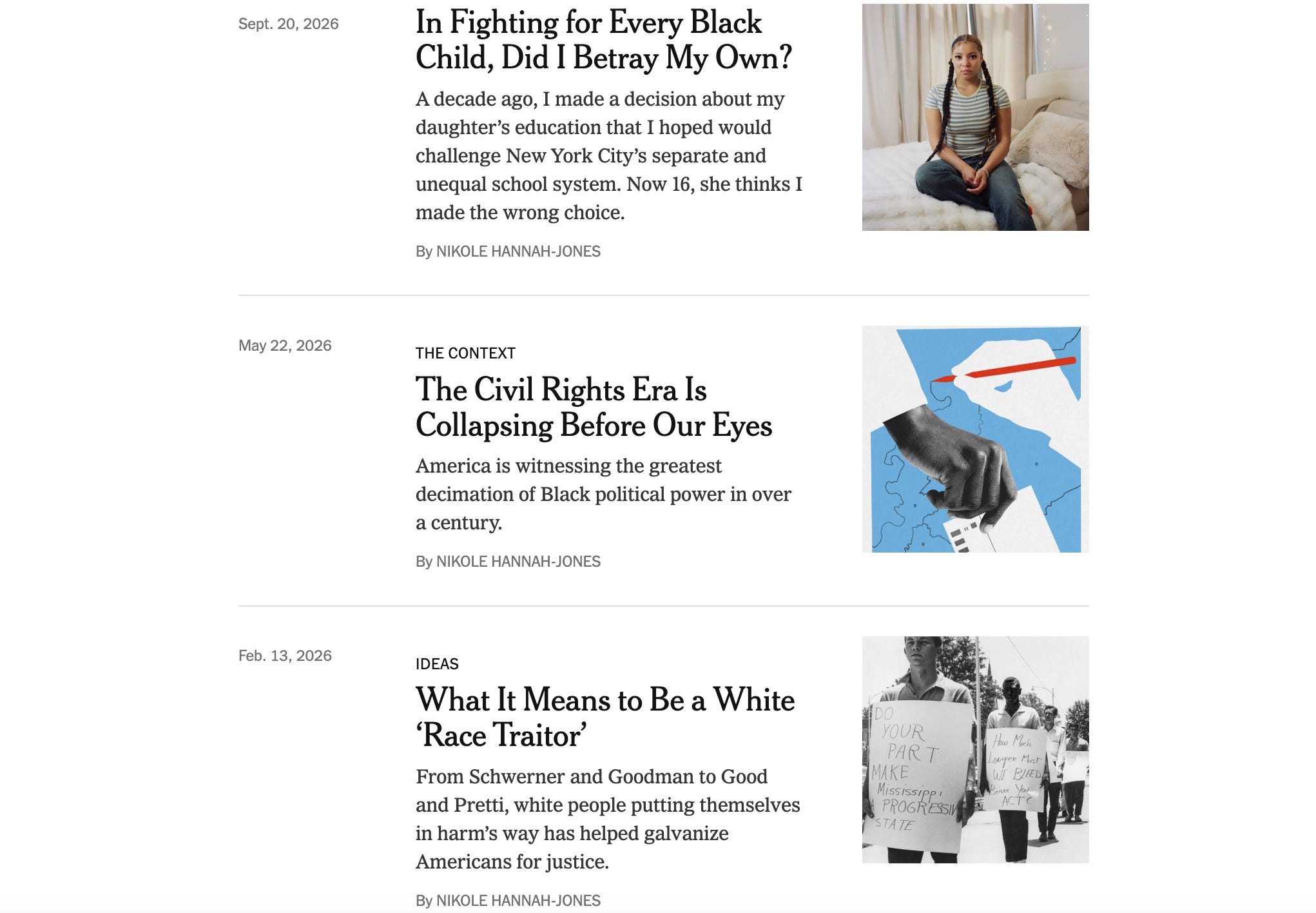
The daughter of a white woman and a black man, Hannah-Jones, was a leading spokesman during the 2010s for the popular panacea that all it would take to solve the problems of African-Americans would be to send America’s vast surplus of white children to school with underclass blacks.
One obvious problem with that is that we are running out of white kids to solve the problems of other people.
Back in 2016, she decided her upper middle class 3/4ths black 4-year-old daughter was going to help solve the problems of underclass blacks by sending her to a public school next to housing projects in Bedford-Stuyvesant, as she wrote in the New York Times Magazine:
Choosing a School for My Daughter in a Segregated City
How one school became a battleground over which children benefit from a separate and unequal system.
By Nikole Hannah-Jones
June 9, 2016
In the spring of 2014, when our daughter, Najya, was turning 4, my husband and I found ourselves facing our toughest decision since becoming parents. We live in Bedford-Stuyvesant, a low-income, heavily black, rapidly gentrifying neighborhood of brownstones in central Brooklyn.
Bedford-Stuyvesant is a 15 minute subway ride from Wall Street, so it has long been in the sights of gentrifiers. Comedian Colin Quinn wrote in 2015 about all the affable young WASPs from across suburban America moving in to Bed-Stuy:
These new white people hate the white man, too. They’ve been to liberal arts colleges where they learned about oppression and condemn it. And so there they are, these people who look like they stepped out of a Norman Rockwell painting, on the sidewalks of Bed-Stuy, singing along with Notorious B.I.G.’s “Ten Crack Commandments,” sanding chairs.
Back to Hannah-Jones:
The nearby public schools are named after people intended to evoke black uplift, like Marcus Garvey, a prominent black nationalist in the 1920s, and Carter G. Woodson, the father of Black History Month, but the schools are a disturbing reflection of New York City’s stark racial and socioeconomic divisions. In one of the most diverse cities in the world, the children who attend these schools learn in classrooms where all of their classmates — and I mean, in most cases, every single one — are black and Latino, and nearly every student is poor.
But the point of trying to make a lot of money by living in a gentrifying neighborhood is that you aren’t going to have children who will attend neighborhood schools … at least not until after they’ve gentrified.
New York actually has some pretty decent largely black neighborhoods in Queens and Harlem. But they aren’t particularly gentrifying because there wasn’t such an obvious differential between the location’s value and the human capital.
Not surprisingly, the test scores of most of Bed-Stuy’s schools reflect the marginalization of their students.
Alternatively, the marginalization of their students reflects their test scores.
This alternative was considered unthinkable in the 1960s until the impact of the shocking 1966 Coleman Report began to sink in in a seminar led by Daniel Patrick Moynihan at Harvard. Education Weekly reported on the Coleman Report’s 40th anniversary in 1966:
Race Report’s Influence Felt 40 Years Later
By Debra Viadero — June 20, 2006
Just before the Fourth of July weekend in 1966, the U.S. Office of Education quietly released a report that would shake the beliefs upon which many educators and social reformers had staked their work.
Titled “Equality of Educational Opportunity,” the mammoth, 737-page study reached the unsettling conclusion that school might not be society’s great equalizer after all.
On the eve of the 40th anniversary of that study, now better known as the Coleman Report, researchers continue to grapple with many of the same questions about how family background contributes to disparities in children’s school performance.
The report found that black children started out school trailing behind their white counterparts and essentially never caught up—even when their schools were as well equipped as those with predominantly white enrollments.
What mattered more in determining children’s academic success, concluded the authors, was their family backgrounds.
“This was the 1960s,” the policy expert Marc S. Tucker recalled. “The idea that who one’s parents were and what happened in the home is a far greater determinant of one’s future than what schools could do was a pretty grim commentary and one that was very hard for people to accept.”
Mr. Tucker, today the president of the Washington-based National Center on Education and the Economy, was among a group of scholars convened by Harvard University later the same year to make sense of the findings.
Four decades later, scholars say that much has changed in American education and much has not. While social science has found more sophisticated ways to chart disparities in children’s schooling and achievement, it has failed to make them go away.
“The Coleman Report basically opened up that question, and nobody’s been able to answer it satisfactorily since,” said David J. Armor, a researcher who worked on the original study and subsequent reanalysis. “No one has found a way, on a large-scale basis, to overcome the influence of family,” added Mr. Armor, currently a professor of public policy at George Mason University in Fairfax, Va.
The project was historic for more than its provocative conclusions, though, says David K. Cohen, a professor of education and public policy at the University of Michigan in Ann Arbor.
“I think it really marked the beginning of a new era for both research on education and a more general understanding of schooling and how schools work,” he said.
The study was ordered by Congress as part of the Civil Rights Act of 1964. In Section 402 of the legislation, federal lawmakers directed the U.S. commissioner of education to “conduct a survey … within two years of the enactment of this title, concerning the lack of availability of equal educational opportunities for individuals by reason of race, color, religion, or national origin.”
Following the release of “Equality of Educational Opportunity” in July 1966, Harvard University convened a yearlong seminar on that controversial federal study from a research team led by James S. Coleman. The Harvard University Faculty Seminar on the Coleman Report drew some 75 participants from along the Eastern Seaboard and helped shape a generation of education policy experts whose influence continues to be felt. …
To carry out that task, Alex M. Mood, then assistant commissioner for educational statistics, chose two researchers: James S. Coleman, the Johns Hopkins University sociologist whose name has become indelibly associated with the study, and Ernest Q. Campbell, a sociology researcher from Vanderbilt University.
The report they produced was, and some say, remains, among the most extensive and best-known studies of American education. At a cost of $1.5 million in 1966 dollars, the project drew on data for 570,000 students, 60,000 teachers, and 4,000 elementary and secondary schools across the country. When completed, it weighed as much as the Manhattan telephone directory and was only slightly more readable.
What was revolutionary about the report, though, was its use of testing data to measure educational disparities, which was an innovation that went beyond the project’s congressional mandate. Rather than provide a checklist of physical resources, Mr. Coleman and Mr. Mood wanted the study to find out what children actually learned.
“Up until that time, very little attention was paid to student outcomes,” said Eric A. Hanushek, a Stanford University economist who participated in the post-report analyses at Harvard. “It was all about inputs—whether the schools had books, libraries, or computer labs. The importance of the Coleman Report was that it changed the perspective to concentrating on student performance, and that has endured.”
When I started reading social science in 1972 because the national debate topic that year was about education funding (“Resolved: That governmental financial support for all public and secondary education in the United States be provided exclusively by the federal government”), the Coleman Report was a very big deal. It famously used computers. Using computers to analyze data about people seemed like a fun thing to 13-year-old me.
But I haven’t found any evidence of Ms. Hannah-Jones ever mentioning the 60-year-old Coleman Report in the New York Times.
She wrote in the NYT in 2016:
I didn’t know any of our middle-class neighbors, black or white, who sent their children to one of these schools. They had managed to secure seats in the more diverse and economically advantaged magnet schools or gifted-and-talented programs outside our area, or opted to pay hefty tuition to progressive but largely white private institutions. I knew this because from the moment we arrived in New York with our 1-year-old, we had many conversations about where we would, should and definitely should not send our daughter to school when the time came.
But all these people were not New York Times writers and future MacArthur Geniuses on the topic of education, so what could they possibly know?
My husband, Faraji, and I wanted to send our daughter to public school. Faraji, the oldest child in a military family, went to public schools that served Army bases both in America and abroad. As a result, he had a highly unusual experience for a black American child: He never attended a segregated public school a day of his life. He can now walk into any room and instantly start a conversation with the people there, whether they are young mothers gathered at a housing-project tenants’ meeting or executives eating from small plates at a ritzy cocktail reception.
Department of Defense schools for the children of military personnel do well in test scores, often ranking with Massachusetts, New Jersey, and Minnesota near the top of public school average scores.
One reason is because the military is Congressionally banned from taking applicants who score in the bottom decile of the enlistment cognitive exam. Most of the time, when it can help it, it tries not to take would-be enlistees who score below the 30th percentile. After the big crash of 2008, the Air Force and Navy set the 50th percentile as the cut-off. The Pentagon has a whole bunch of data.
Plus, military schools have tended to traditionally be more disciplined. And their students’ parents are used to following and giving orders.
And, Hannah-Jones might be right that being integrated helps. Or, you could say that military culture (e.g., the Marines’ “The right way, the wrong way, and the Marine Corps’ way”) is better than African-American culture.
But you aren’t supposed to say that.
I grew up in Waterloo, Iowa, on the wrong side of the river that divided white from black, opportunity from struggle, and started my education in a low-income school that my mother says was distressingly chaotic. I don’t recall it being bad, but I do remember just one white child in my first-grade class, though there may have been more. That summer, my mom and dad enrolled my older sister and me in the school district’s voluntary desegregation program, which allowed some black kids to leave their neighborhood schools for whiter, more well off ones on the west side of town. …
I remember those years as emotionally and socially fraught, but also as academically stimulating and world-expanding. Aside from the rigorous classes and quality instruction I received, this was the first time I’d shared dinners in the homes of kids whose parents were doctors and lawyers and scientists. … But this exposure helped me imagine possibilities, a course for myself that I had not considered before.
I suspect schooling is important for ambtion. The brilliant education blogger Ed Real tweets today:
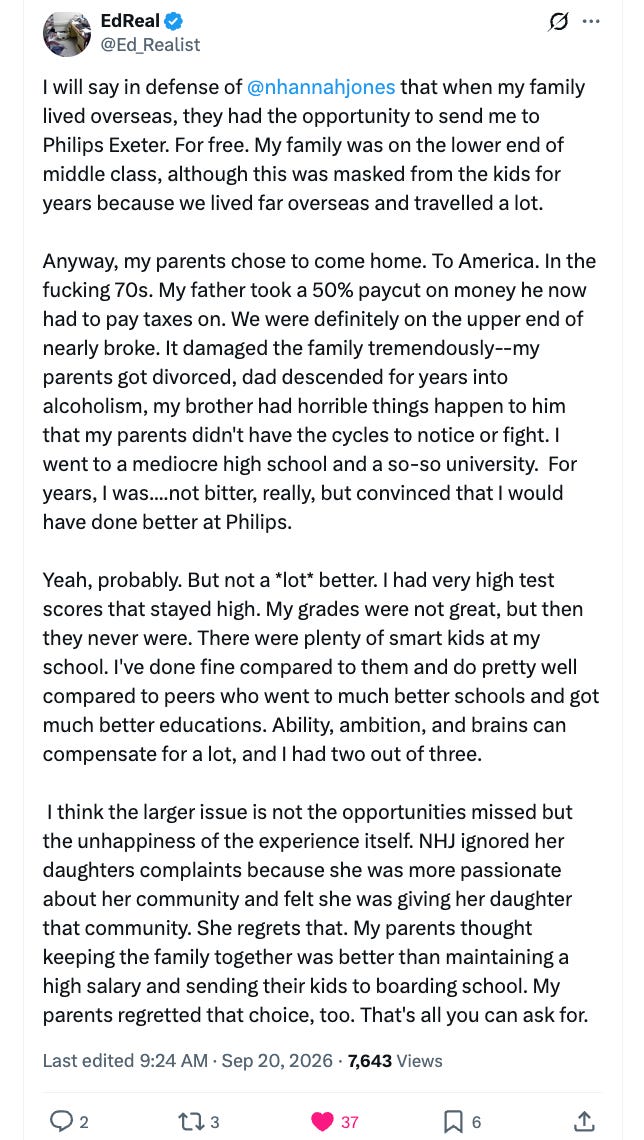
Personally, I enjoyed a fine private school education. But on the other hand, if I’d gone to nearby Harvard-Westlake School in the Hollywood Hills, the top prep school in Los Angeles, I perhaps would have become more focused on worldly ambition to garner the glittering prizes.
It’s hard to say where any one person would have ended up if a single circumstance were different; our life trajectories are shaped by so many external and internal factors. But I have no doubt my parents’ decision to pull me out of my segregated neighborhood school made the possibility of my getting from there to here — staff writer for The New York Times Magazine — more likely. …
Integration was transformative for my husband and me. Yet the idea of placing our daughter in one of the small number of integrated schools troubled me. These schools are disproportionately white and serve the middle and upper middle classes, with a smattering of poor black and Latino students to create “diversity.”
In a city where white children are only 15 percent of the more than one million public-school students, half of them are clustered in just 11 percent of the schools, which not coincidentally include many of the city’s top performers. Part of what makes those schools desirable to white parents, aside from the academics, is that they have some students of color, but not too many. This carefully curated integration, the kind that allows many white parents to boast that their children’s public schools look like the United Nations, comes at a steep cost for the rest of the city’s black and Latino children. …
I told Faraji that I wanted to enroll Najya in a segregated, low-income school. Faraji’s eyes widened as I explained that if we removed Najya, whose name we chose because it means “liberated” and “free” in Swahili, from the experience of most black and Latino children, we would be part of the problem. Saying my child deserved access to “good” public schools felt like implying that children in “bad” schools deserved the schools they got, too. …
As I told Faraji my plan, he slowly shook his head no. He wanted to look into parochial schools, or one of the “good” public schools, or even private schools. … He worried that we would be hurting Najya if we put her in a high-poverty, all-black school. “Are we experimenting with our child based on our idealism about public schools?” he asked. “Are we putting her at a disadvantage?”
(Faraji is an IT support guy, which is honest work.)
So, how did the MacArthur Genius mom’s big plan work out for little Najya?
Paywall here.
