

The Racial Reckoning and the accompanying higher murder rates may be heading back:


Rikers Island is a huge 413 acre prison Island in the Hudson River out near La Guardia airport where almost all the jail facilities for New York City are centralized. This has advantages — civilians don’t have to live near prisoners and their homies coming to visit them. But it also has disadvantages because transporting prisoners to the various courtrooms spread across the five boroughs takes hours.
But nobody wants to build immense enough jails in their own boroughs to accommodate their fair share of the prisoners, so New York has been stuck with Rikers.
Until now, in the wake of the Blue Tsunami when Mayor Mandami announces he’s closing it down.
How will New York City finally build enough jail capacity to replace Rikers?
It won’t!
Mamdani will just let half the jailbirds go free on the streets.
You might think it would be a good idea to try to remember all the way back to how catastrophic Black Lives Matter was for black lives. But who can remember racist stuff like that?
For example, in the New York Times, columnist David Wallace-Wells asserts that it’s a GIANT MYSTERY why murders have been dropping since 2021:
Crime Rates in American Cities Have Never Been Lower. Why?
Nov. 18, 2026
By David Wallace-Wells
Opinion Writer
… In the wake of a big blue wave nationwide, one of the country’s most popular politicians feels secure enough in his standing to tackle police reforms that just a year ago seemed radioactive. But it is also a sign that we are all living in a very different world when it comes to crime than we were just a few years ago, at the peak of the pandemic crime surge.
Terms mentioned and not mentioned in this lengthy essay about why crime was higher in 2020-2021 than today:
Pandemic — 5 times
Covid — 2 times
Black Lives Matter or BLM — 0 times
George Floyd — Zip
Racial Reckoning — Nada
Back then, you heard a lot about social chaos and urban doom loops, the bad old days of the 1970s and the possibility that flight to the suburbs could wreck American cities once again. Instead, what followed was historic drops in violent crime almost across the board.
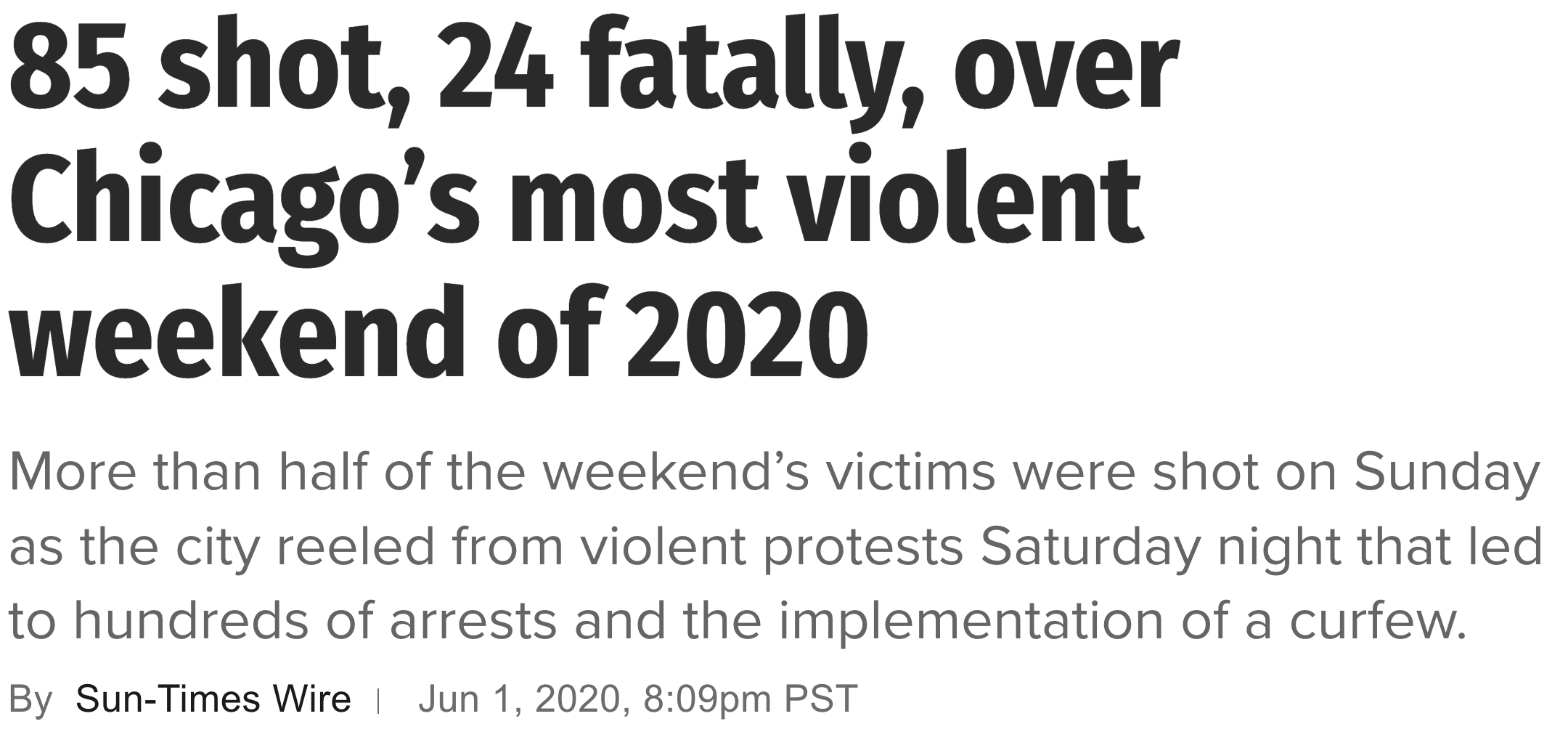
After historic increases in violent crime between May 25, 2020 and May 31, 2020. For example, from the Chicago Sun-Times on the most murderous single day, Sunday May 31, 2020, in Chicago’s storied history of murder when 18 killings were recorded in 24 hours as the cops dug in downtown to defend the Loop and the Magnificent Mile from more looting, allowing locals on the West and South Sides to run amok and take vengeance upon their neighbors over disses:
Wallace-Wells expounds:
By some measures, American cities are actually safer now than their European counterparts, which many Americans have long envied as walkable, high-trust utopias.
Between 2021 and 2025, the number of murders in New York City fell by more than 36 percent. Though this is miraculous,
It’s not actually all that miraculous for the number of homicides in New York City to have been 307 in 2018, 309 in 2019, and 308 in 2025. If you ignore the carnage of the George Floyd Era in-between, that’s one of the most boring social science stats I’ve seen.
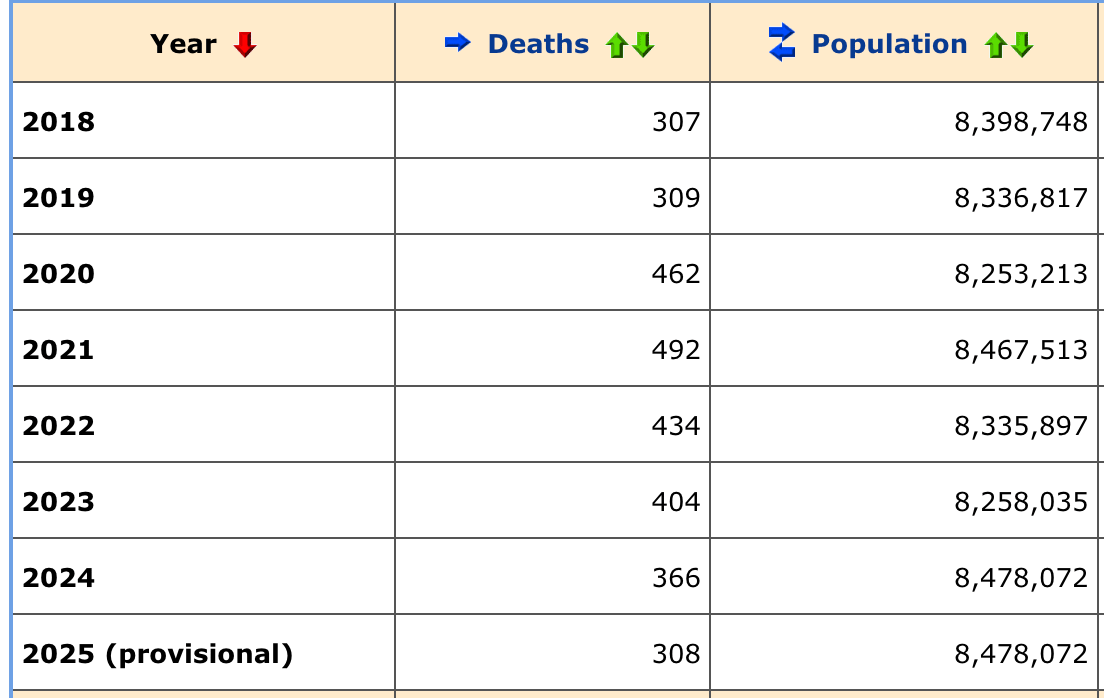
it isn’t exceptional: In those same years, the national murder rate fell by 40 percent.
It’s almost as if American elites went nuts in late May 2020 and demanded cops stop arresting so many blacks. After a few years, they realized was a really bad idea and quietly shut down their Racial Reckoning. Now, they hope nobody remembers what they did.
The CDC makes available homicide mortality rates going back to 1968, unfortunately leaving out the sharp rise in murders in 1964-1967 during the peak of liberalism: LBJ’s Great Society and the Warren Court.
Contrary to Wallace-Wells, according to the CDC, the national homicide death rate was slightly worse in 2025 (5.1 per 100,000) than in 2014 (5.0), at the very beginning of the Ferguson Effect.
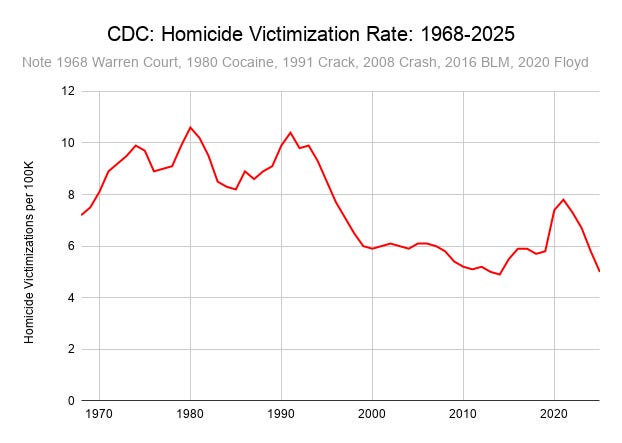
In looking at 1968-2025, you can see various events that drove homicides up or down, such as
the later years of the liberal era,
the brief powder cocaine boom around 1980 (e.g., the Miami Vice era),
the Reagan-Cosby era of racial good feelings that was, sadly, terminated by
The rise of crack cocaine in the later 1980s,
The post-crack 1990s crackdown on crime
The good effects of the 2008 Crash on the murder rate
The emergence of Black Lives Matter at Ferguson in later 2014
George Floyd (d. May 25, 2020)
The Vibe Shift as the BLM Racial Reckoning got memoryholed.
Of course, blacks get themselves killed by homicide at vastly higher rates than anybody else except American Indians:
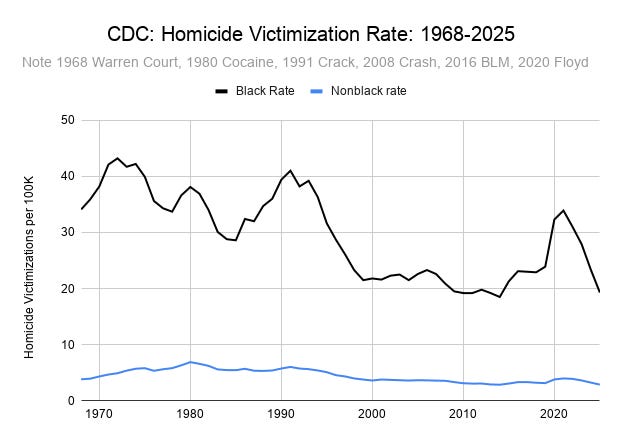
The role of the Floyd Effect in getting black lives murdered is absolutely spectacular in the CDC’s weekly data (by total homicide victimizations, not by rate per capita):
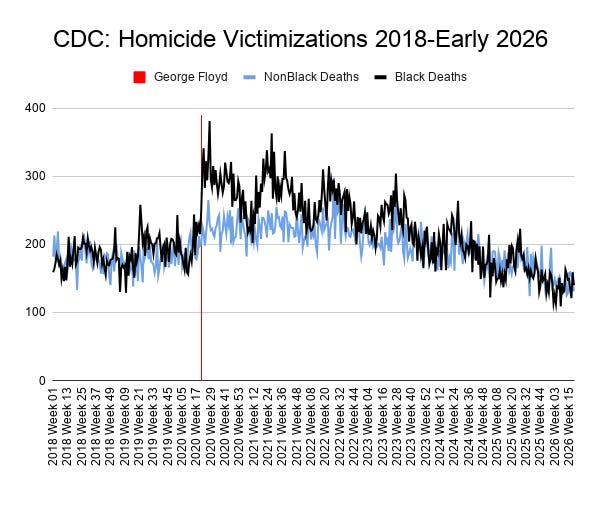
And it has continued to decline, according to estimates, by between 15 percent and 20 percent this year alone. Half of the number of people who would have been killed given crime rates in 2021 are now likely to survive given the rates of 2026.
The CDC puts a 6 month lag on homicide stats to give coroners time to make sure, so CDC data only goes through April 2026. But, yes, early 2026 looked less lethal than early 2025.
When murder declined this much over the course of the 1990s, it was as if the clouds had opened and a new age of urban possibility dawned, with decades of white flight reversing and a future of information economy gentrification coming into view. We stopped talking about superpredators and the crack epidemic and started talking about police violence and eventually the new Jim Crow.
And how did that obsession with police violence and the New Jim Crow work out in 2015 to 2024?
We stopped worrying about child abduction and started worrying about excessive safetyism. We began hearing a lot less about burning neighborhoods and cities going bankrupt and a lot more about housing shortages and the unmanageable cost of rent.
That drop in crime was momentous, marking the end of the 20th century in American life and the beginning of the 21st, perhaps as decisively as the arrival of the internet or the end of the Cold War. In percentage terms, this drop already appears to be larger. It has also come faster.
Some large shares of these declines are returns to prepandemic trends, after a horrific Covid-era surge.
It’s like how American combat deaths returned to pre-Big Band trends when swing music suddenly went out of fashion in 1945.
What, you are saying the 291,557 violent deaths of young American men in 1941-1945 weren’t Benny Goodman’s fault? OK, OK, maybe it was Glenn Miller’s fault instead. But, in any case, all those deaths at Guadalcanal and the Bulge definitely happened while swing was on top of the Billboard charts, so how could the cause be anything else?
Although the pattern may seem predictable and intuitive now, it was hardly conventional wisdom five years ago that all would quickly return to normal, or better than normal.
Nobody predicted in March 2020 that mass shootings at black outdoor parties would surge to record levels in the summer of 2020.
Instead, some people predicted, not unreasonably, that domestic murders would go up sharply as people went nuts being stuck indoors with their loved ones.
But …
Paywall here.
