

From the New York Times news section:
What Are ‘Teen Takeovers’ and Why Are Police Struggling to Stop Them?
Across the country, police and city officials are trying to crack down on sometimes violent youth gatherings, but the teens themselves say they need some way to socialize and blow off steam.
By Clyde McGrady, Emma Schartz and Julie Bosman
Clyde McGrady reported from Washington, D.C., Emma Schartz from New York and Julie Bosman from Chicago.
May 7, 2026, 5:01 a.m. ET
As the school year draws to a close, the perennial worry about teenage misbehavior and how to keep youth occupied in the summer has a new name with ominous undertones: “teen takeovers.”
In Detroit, Chicago, Atlanta, the nation’s capital and elsewhere, large, quickly organized gatherings of youths have popped up in downtowns, parks and leafy neighborhoods. They can be noisy, boisterous and at times violent, their impact often amplified on television, especially in conservative media outfits like Fox News.
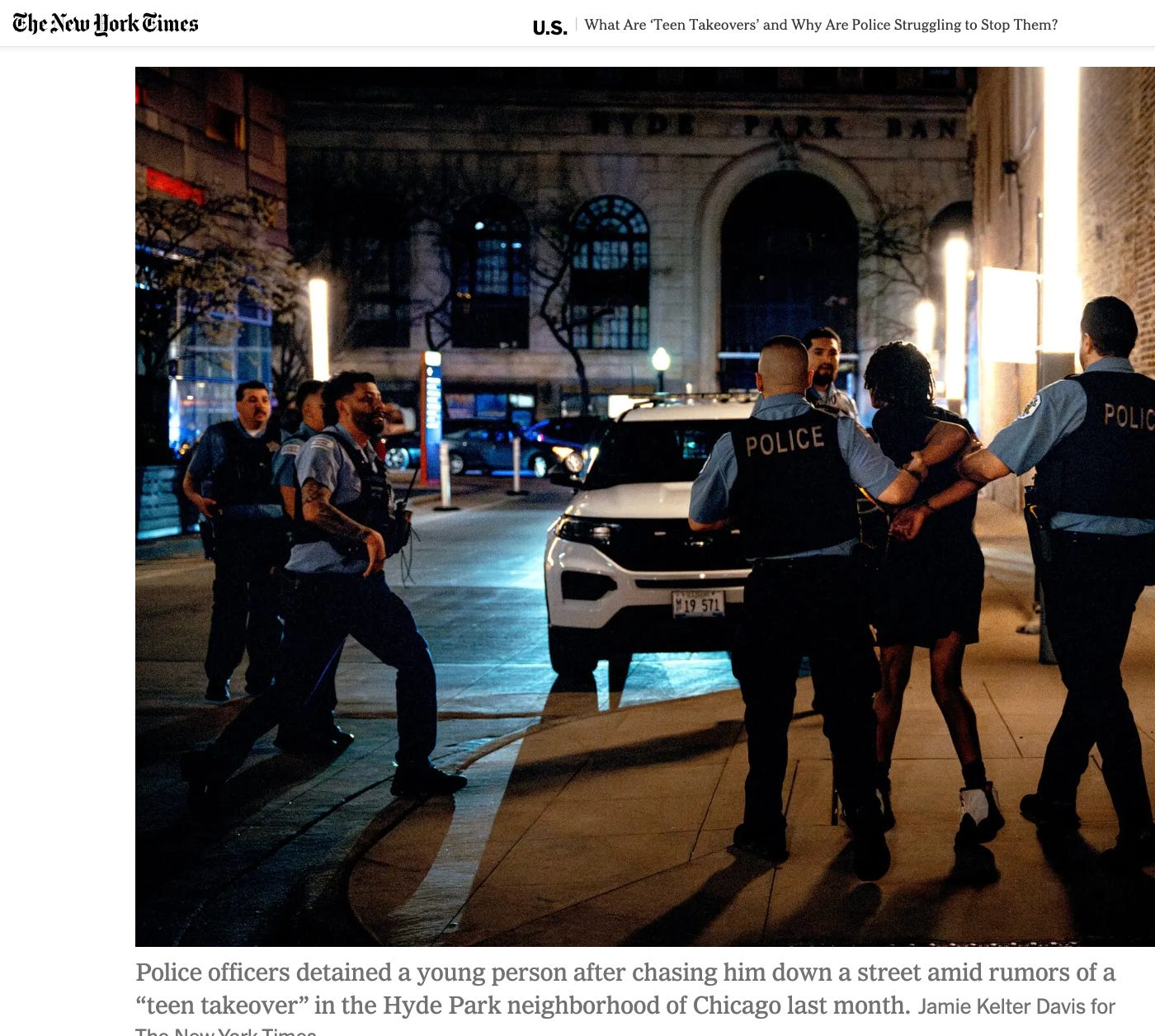
Due to “rumors,” six white (or whitish) cops bully a youth who just wants to have fun.
And city leaders have begun to pay more attention.
“It has gotten worse when it comes to the bad behavior,” Larry Snelling, the superintendent of the Chicago Police Department, said in an interview. “Kids just start to fight, so they get increasingly more violent.”
Societal anxiety over juvenile delinquency is not new. A family court judge told The New York Times in 1952, “The reasons for children getting into trouble are the same yesterday as forever — revolt, rebellion, the need for self-expression, denied to them somehow, in a natural way.” At that time, authorities attributed the “extreme behavior of youth” to the Korean War, national and international insecurity, and a lack of mental health treatment.
Some juvenile delinquents even carried switchblades and zipguns.
Now it’s social media and the long tail of Covid-19, with its resulting Zoom-from-home generation. But what is undeniably new is the role that platforms like Instagram and TikTok play in the speed of organization and the scale of assembly. And the larger the gatherings, the better the chance that something can go wrong.
“Detroit teens do have a thing for pulling out guns while fighting,” said Malaysia McCline, 15, who recalled stumbling into a teen takeover last month after the Tigers’ opening day.
She and friends had noticed a growing crowd at the city’s waterfront that included a former classmate she’d lost touch with. It was fun, but by nightfall, some became rowdier, yelling and running. Police officers moved in.
“I was scared,” she said.
Law enforcement officials around the country are enjoying a period of good news. Crime overall in cities including Columbus, Chicago, Houston and Los Angeles has dropped significantly in recent years. Homicides nationally are poised to hit their lowest rate in more than a century, data shows, a remarkable recovery from pandemic highs.
Not from the George Floyd racial reckoning highs, but from the pandemic highs!
Never forget that you must always forget about the Floyd Effect. We wouldn’t want to learn a lesson as a society about what precisely caused black deaths by homicide and car crash to soar 44% and 39% respectively during the second triumph of Black Lives Matter because that would be embarrassing to the New York Times.
But the pandemic exacerbated a decline in the amount of time that teenagers spend going out and socializing, and socializing is a natural impulse, said Laurence Steinberg, a psychology professor who studies adolescent development. It is bound to burst out.
Just what should be considered a teen takeover is nebulous. On May 3 near Oklahoma City, at least 23 people were injured in a shooting at what police labeled an “unsanctioned” lakeside party. Like classic takeovers, it had been advertised on social media and drew a large crowd of teens and people in their early 20s.
The Lake Arcadia mass shooting that left 1 dead and 22 wounded was a classic example of Sailer’s Law of Mass Shootings:
From KFOR News in Oklahoma
EDMOND, Okla. (KFOR) — An 18-year-old gang member is now behind bars, charged with felony murder in the death of Avianna Smith-Gray and the injury of 22 others in Sunday night’s mass shooting at Arcadia Lake—as police say at least one more shooter remains at large.
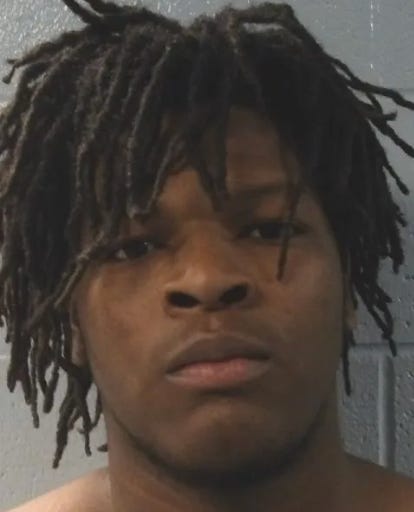
Edmond police announced Jaylan Davis turned himself in Wednesday morning after police secured a warrant for his arrest Tuesday night.
Multiple witnesses identified Davis as one of the shooters, police said.
“Six of those victims are juveniles as young as 15 years of age,” Edmond Police Chief J.D. Younger said.
Arrest documents say as the party went on, two women began fighting.
During that fight, police say Davis began arguing with a member of a rival gang and began shooting.
Police say Davis used a pistol equipped with a device known as a “switch,” allowing it to fire multiple shots with one single pull of the trigger.
Investigators also found spent shell casings from a rifle.
Police believe there is at least one other shooter they still need to catch.
Back to the New York Times article:
Politics might be amplifying how adults are perceiving the threat. In a year when midterms loom and Republicans are facing stiff headwinds on the war in Iran, the economy, inflation and the cost of living, the issue of crime might be a bright spot for the party. A Pew Research poll last week found that by 17 percentage points, more Americans said they agreed with Republicans than Democrats on crime policy, a bigger edge than the party had two years ago.
Any bets on how many paragraphs it will take the NYT before it mentions the word “black?” Excuse me, I meant, before the NYT mentions the word “Black.”
Paywall here.
