

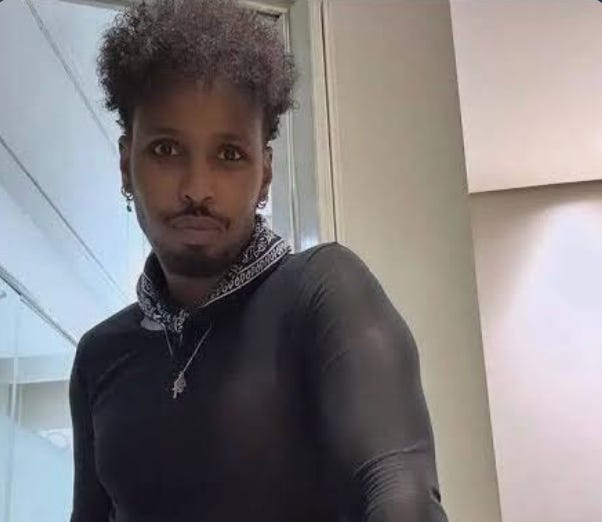
Rep. Ilhan Omar (D-MN) has gotten (more or less) married four times:
Most recently to white political consultant Tim Mynett
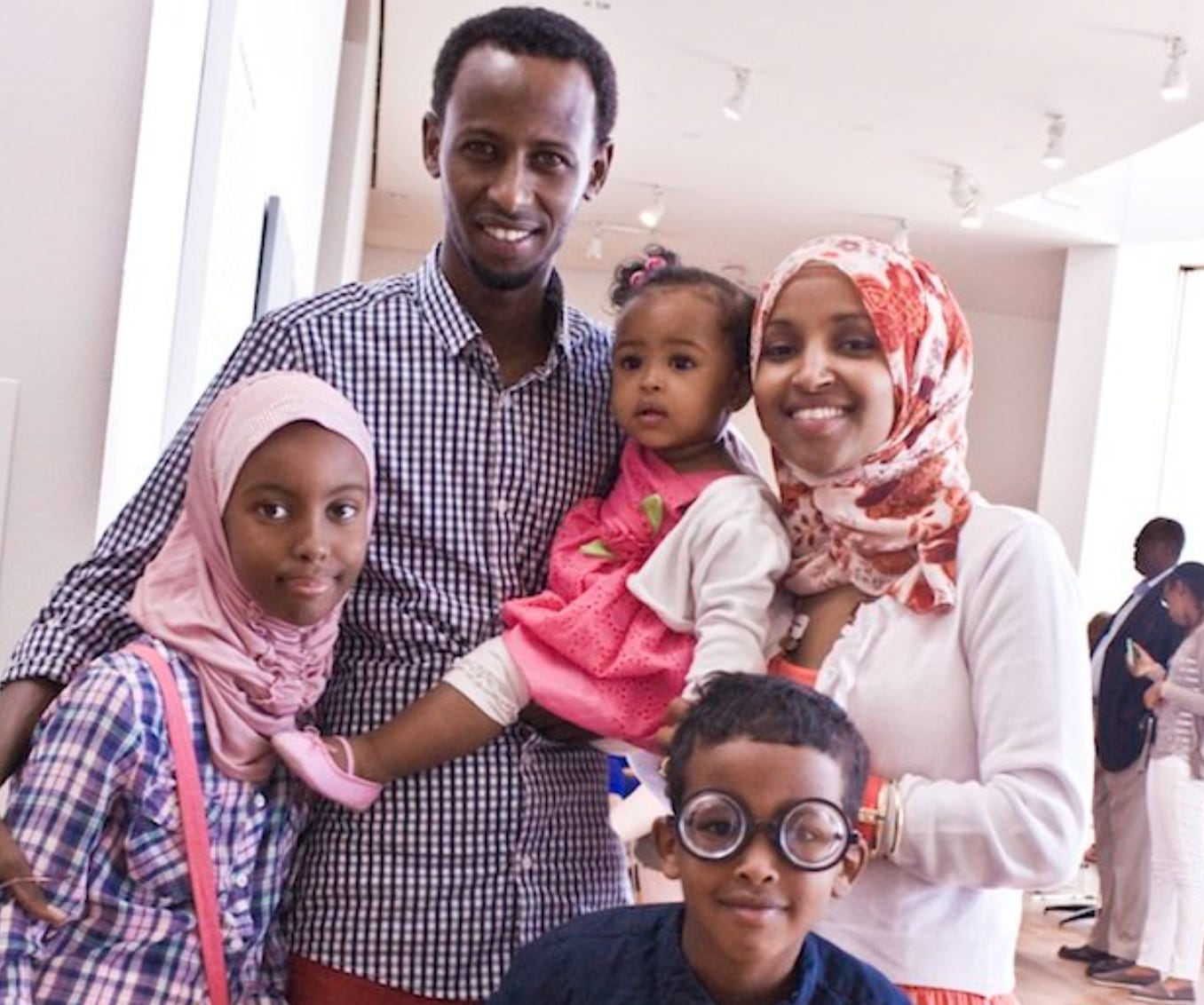
The third and first times to Ahmed Hirsi, the Somali father of her three children … although Rep. Omar claims the first time she married Hirsi in an Islamic ceremony in Minnesota when she was 18, they didn’t complete getting a Minnesota marriage license and Minnesota has not had common law marriage since 1941, so that wasn’t official (and thus her second marriage was not bigamous).
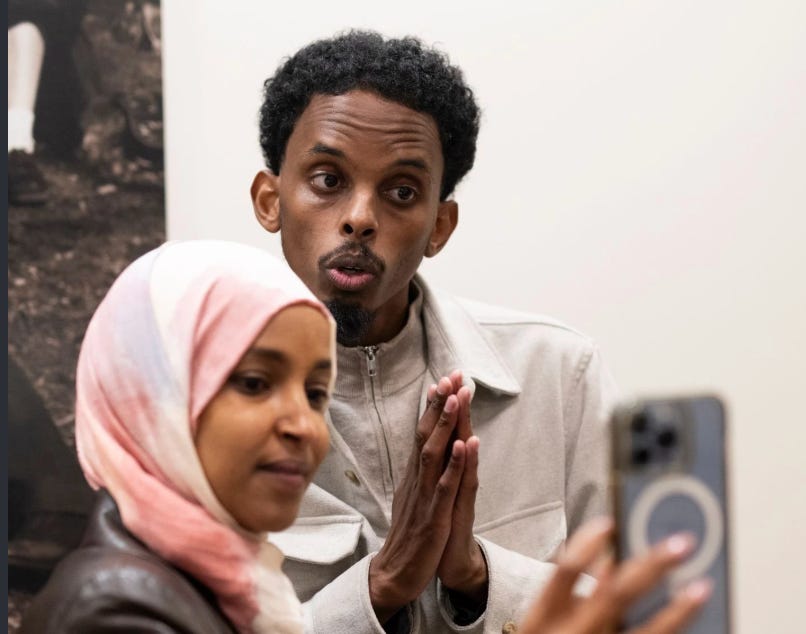
And the second time to the world’s gayest Somali man, Ahmed Nur Said Elmi, who is widely (although vaguely) rumored to be her brother. Everybody who looks into it comes up with them having the same father, Colonel Nur Said Elmi, but whether or not they had the same mother remains unclear. Still, absolutely nobody has ever come up with a plausible explanation of why she might have been so smitten with heterosexual lust for the immensely effeminate Elmi that she would abandon the father of her children, but still live with Hirsi and get pregnant by him a third time while nominally married to Elmi.
The New York Times news section reports this week:
Federal agents in Minnesota opened an investigation [in 2016], according to several people familiar with the matter. They found evidence suggesting that Mr. Elmi and Ms. Omar were siblings, according to the six former and current officials familiar with the case. But, because prosecutors did not pursue the matter, the agents had limited investigative tools, the officials said.
Mr. Elmi had obtained a provisional two-year green card based on the marriage, two former officials said. But when he sought to make that status permanent, immigration officials requested additional evidence about the validity of the marriage. Instead of responding, Mr. Elmi left the United States and abandoned his green card petition, the officials said.
Obviously, engaging in a sham marriage to aid in immigration fraud is against federal law, even in Minnesota. Marrying your sibling or half-sibling is also illegal in Minnesota under Minnesota Statutes § 517.03. You can’t even marry your first cousin there. The closest relatives you can legally marry in Minnesota are first cousins once removed and second cousins.
The Congresswoman and her brother were legally married from 2009-2017, although during these years she had a third child with her first/third husband and those two filed taxes together a couple of times. She appears to have continued living with her first husband, but moved her brother/husband in with them, much to the disgust of her real man.
After trying for a couple of years to persuade U.S. immigration authorities that his marriage to the future Representative was legit, Mr. Elmi gave up his quest for an American green card and went back to Britain, where he advertises himself as a “dirty dandy,” (which sounds like a gay gigolo, but he may just be an amateur enthusiast).
It’s striking how often Somalis get away with fraud despite little evidence that they are terribly adept at it. For example, presumably one reason why government bureaucrats didn’t believe that Elmi and Omar were really man and wife is because Elmi is a massive flamer.
Meanwhile, Elmi is lately looking for a career, so he is attempting to become Jason Argay.
From the Wits Centre for Diversity Studies in South Africa:
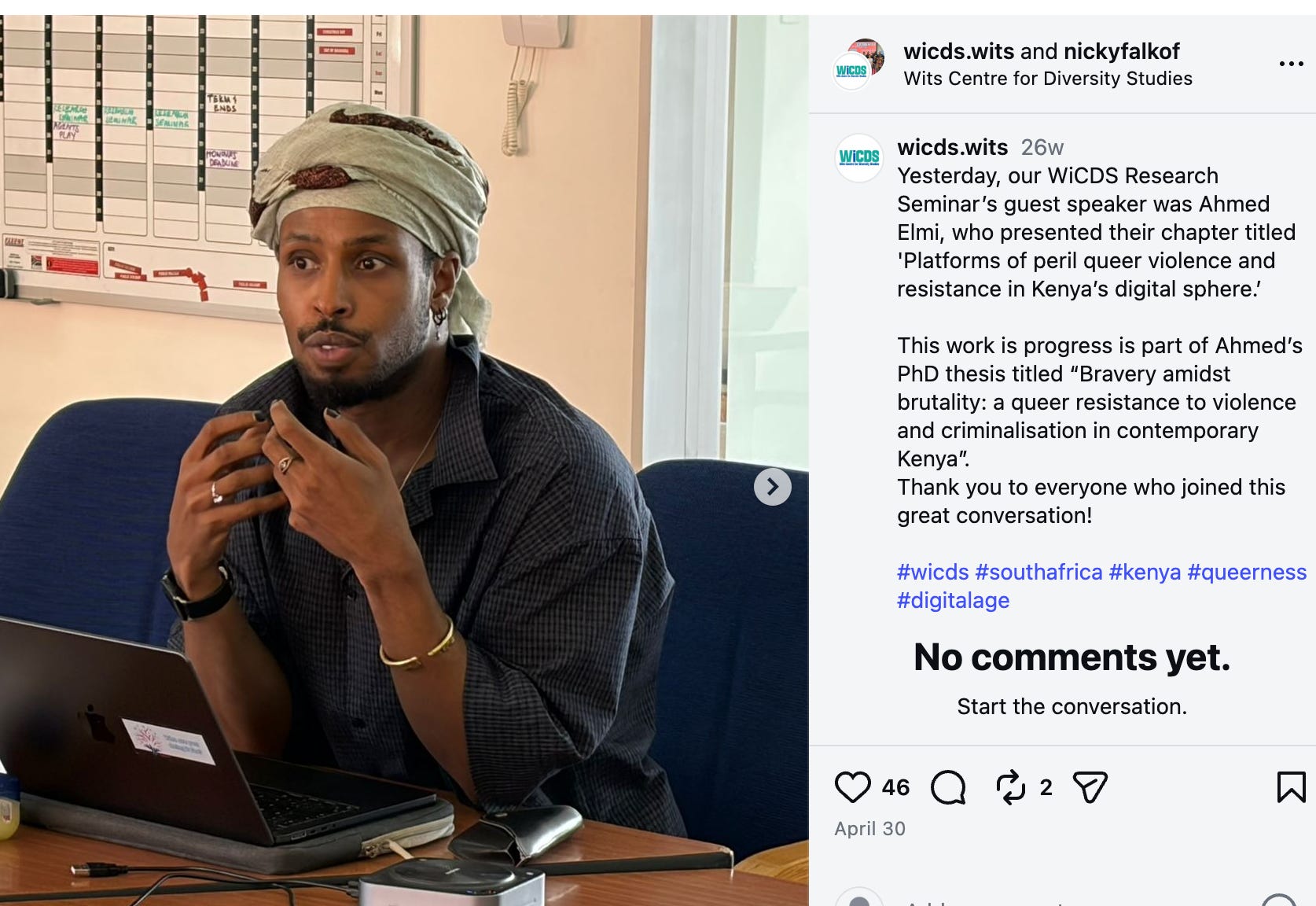
Note that this refers to Mr. Elmi as a “they.”
On the other hand, his webpage at U. of Bristol in the UK refers to him as a “he:”
Doctor of Philosophy, School of Sociology, Politics and International Studies
Member, Bristol Doctoral College …
Research interests
Ahmed Elmi is an ESRC-funded PhD researcher in Political Science at the School of Sociology, Politics, and International Studies (SPAIS), University of Bristol. He was previously a visiting doctoral scholar at the Wits Centre for Diversity Studies (WiCDS), University of the Witwatersrand, in Johannesburg, South Africa; and an affiliate researcher at the British Institute in Eastern Africa (BIEA), in Nairobi, Kenya. In 2025, he served on the programming and curatorial team for GALA Queer Archive’s ‘Margins for Error’ exhibition on queer African art, film, and publishing; also in Johannesburg, South Africa. He is currently completing his doctoral thesis, provisionally titled: ‘Bravery amidst Brutality: A Queer Resistance to Violence and Criminalisation in Contemporary Kenya.’
Grounded in queer African epistemologies and standpoint methodology, his research examines violence against queer people in Kenya, interrogating the intersections of sexuality, politics, and structural marginalisation. Drawing on ethnographic fieldwork conducted in four urban centres: Eldoret, Kisumu, Mombasa and Nairobi, his work analyses vulnerability and resistance within postcolonial queer politics, contributing to debates on anti-LGBTQ+ moral panics, mediated queerphobia, legitimised violence, decolonial praxis, digitality, futurity, and the reimagining of Africa’s social and political landscape for queer communities. Previously, as a Graduate Teacher at the University of Bristol, he led undergraduate seminars on political theory, focusing on contemporary global politics.
Ahmed is also interested in state politics and political party systems across Africa, having conducted research with the Political Parties Database Project (PPDP), and the Political Parties in Africa Project (PPA), at the University of Bristol, as well as the Democratic Accountability and Linkages Project (DALP) at Duke University, in the United States. Through these works, he has collected quantitative data on elections, party organisation, and political leadership in Malawi, Uganda, and Zambia, and produced comparative country-specific dossiers on Angola, Kenya, Malawi, Nigeria, and Zambia.
He holds an MSc in Social Science Research Methods (Politics) from the University of Bristol, and an MA in Global Media and Communication from the University of Leicester. For both programmes, he was the top-ranked student in his cohort, and on both occasions was awarded the Prize for Best Overall Performance, which is conferred upon the graduating student with the highest overall grade-average. In 2022, Ahmed was awarded a full PhD scholarship from the Economic and Social Research Council (ESRC). He is a member of the Royal African Society, the African Studies Association of the United Kingdom, the British International Studies Association, and the Political Studies Association.
Follow Ahmed’s research on his Substack and LinkedIn.
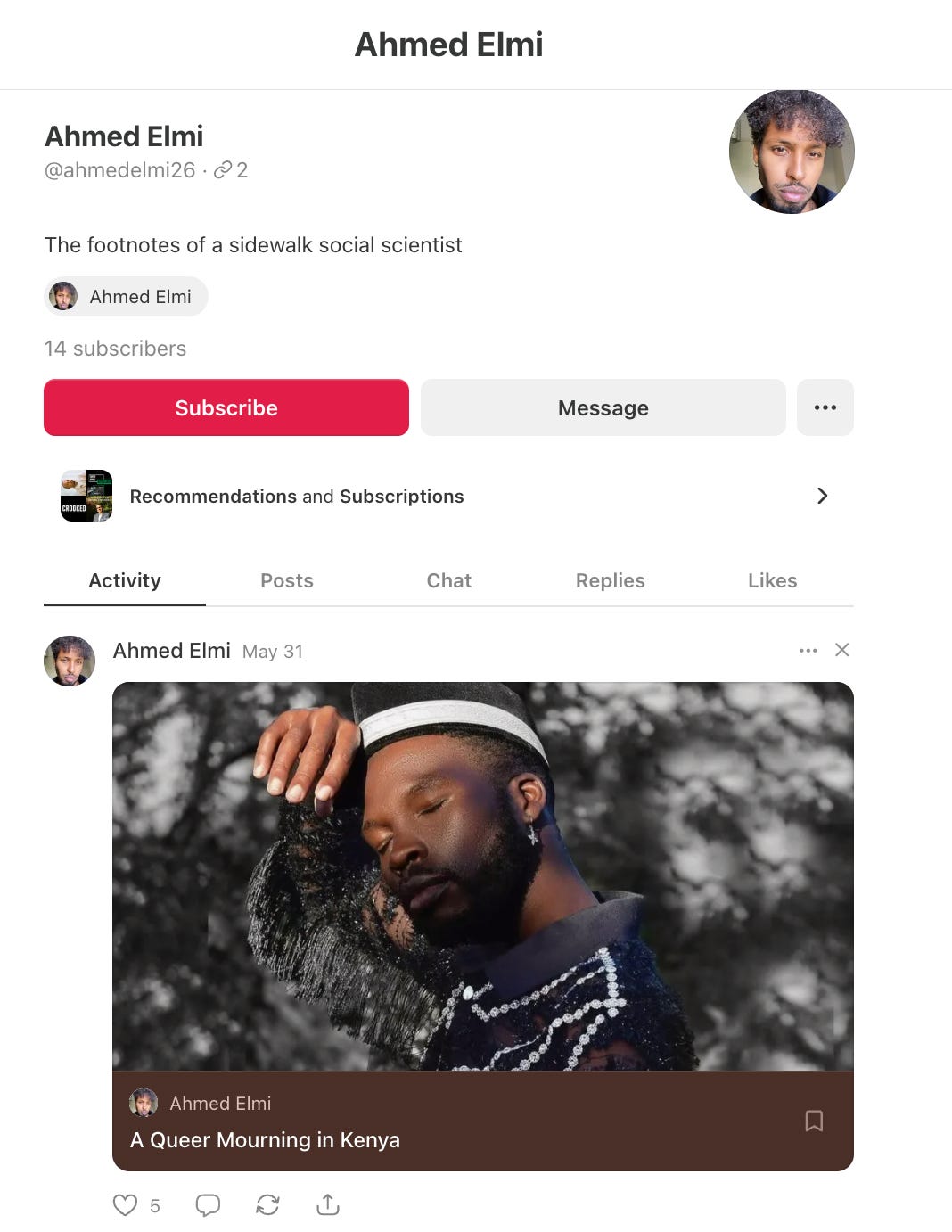
Here’s his one Substack post:
Here’s his one academic journal article:
Out in the Field: Notes on Researching Queer Violence in Kenya
Ahmed Elmi
Abstract
This essay reflects on the ethical, emotional, and methodological complexities of conducting ethnographic research on queerphobic violence in Kenya. Drawing on nine months of fieldwork across urban centres, it argues that research in contexts where queerness is criminalised cannot be adequately understood through institutional ethics alone. Instead, the field is conceptualised as a relational and embodied space shaped by shifting power dynamics, positionality, and emotional labour. Using standpoint theory and queer African epistemological approaches, the essay demonstrates how knowledge is co-produced through ongoing negotiation, care, and accountability. It highlights the researcher’s fluid insider-outsider positioning, the limits of procedural ethics, and the emotional toll of engaging with trauma and risk. By centring lived experiences and community practices, the essay contributes to decolonising methodologies, challenging Euro-American research frameworks. Ultimately, it positions fieldwork as a process grounded in reflexivity, solidarity, and a commitment to resisting the conditions that sustain queer violence in Kenya.
Journal TOR: The Open Review for the Social Sciences
Publication status Published - 27 Aug 2026
Lately, lots of black writers have been caught using AI.
So … Here’s Pangram’s analysis of Elmi’s 154-word abstract:
Paywall here.
