

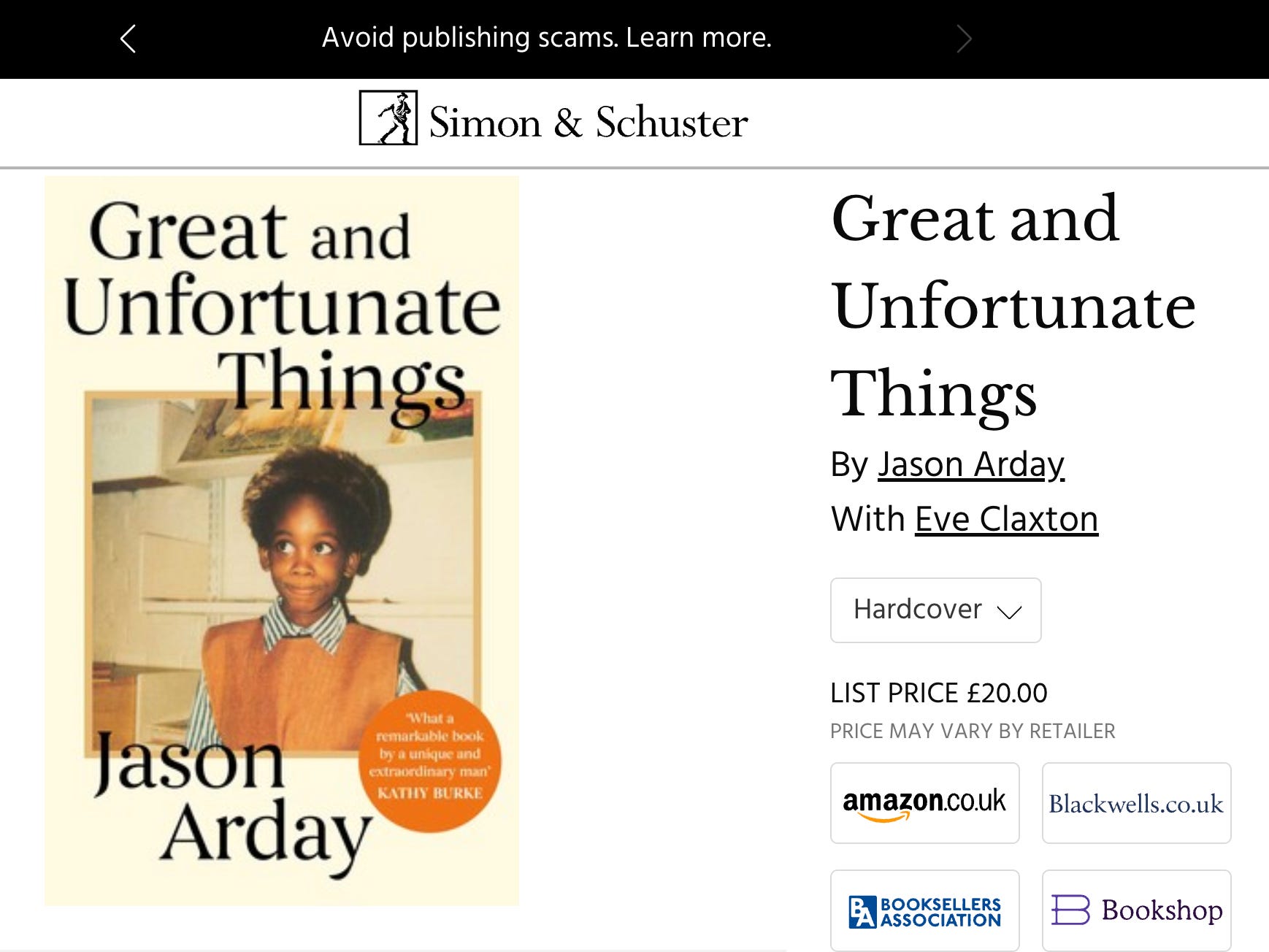
Here’s an op-ed in The Guardian in The Summer of George:
If we want a more equal Britain, we must teach its true black history
Sat 13 Jun 2020 07.00 EDT
This article is more than 6 years old
Jason Arday
Dr Jason Arday is an assistant professor of sociology at Durham University
British curriculums ignore the atrocities of empire and the contributions of black people. These must be acknowledged
Martin Luther King Jr once said: “The arc of the moral universe is long, but it bends toward justice.”
Really? Wow, I’ve never heard anybody quote that line before. This Professor Arday must be a genius scholar to have discovered that MLK “arc of the moral universe” quote deep in the archives.
From The Guardian in 2023:
Diagnosed with autism as a child, Arday found his voice through speech therapy and his mother’s unflagging support. Now he is using it with the same tenacity that saw him run 30 marathons in 35 days
By Charlie Brinkhurst-Cuff
Tue 11 Jul 2023 05.00 EDT
Jason Arday believes in destiny. The University of Cambridge’s youngest Black professor, he joined its faculty of education in March 2023, at 37.
Arday’s official title is “Professor of Sociology of Education,” which does not sound terribly rigorous.
Before then, he had been a professor at Glasgow and Durham universities; published three books of academic work, mainly focusing on race and education; and, most importantly to him, raised more than £5m by doing charity work. All of this he has squeezed into a time period where he was learning to navigate the world with neurodivergence; Arday didn’t speak until he was 11 and couldn’t read or write until the age of 18.
It’s an unlikely story, he concedes, one that has made headlines and changed his life irrevocably. But he believes he was always going to do something great. “I knew I was destined to do something,” he says with a smile. “But I didn’t know it’d be this, admittedly.”
Arday’s story is one of grand heights, but also of profound lows. He has barely slept over the past 15 years, he says, working through most nights – often on his academic and charity work, but sometimes just to make ends meet.
“Barely slept over the past 15 years?”
Until recent years, he struggled to find the balance he needed in the chronically underfunded academic sector, replete with zero-hours contracts. …
Arday grew up on a council estate in Clapham in south London to Ghanaian parents. …
Of course, another major facet of his upbringing was the fact that he couldn’t speak, read or write for much of his childhood. Diagnosed with autism and global developmental delay when he was three, he was taught sign language when he was four. When he was 11, after “thousands of hours” of speech therapy and support from his mother, who used music and lyrics to help him understand how words flowed and fit together, something clicked one day.
“The experts made some pretty bleak diagnoses about how I would have to be in assisted living,” he says. “But on that fateful day, I said hello.” He stopped using sign language shortly after.
… “When you’re cognitively impaired, you make sense of things in different ways.” …
Arday does not view himself as intellectual, necessarily, but as someone who has determination. In 2010, he ran 30 marathons in 35 days to raise money for charity. “If you have the will, it will always supersede skill,” he says, smiling. …
Arday is humbled by the recent attention he has received in the press and from the public since his appointment, he says. He has had more than 200,000 emails from all over the world, many from well-wishers. …
To explain his ideology, he leans on the fighting lessons of Rocky Balboa: “You’re going to be in a very archaic, hostile environment, to some extent, which will be predicated by people outside of that who may not want your existence in that place. But you’ve got to be willing to take the hits, because the greater mission is to achieve equality, and to achieve diversity, and to make that space as big as possible.” …
“We’re talking about thousand-year-old white establishments. And anytime you’re a person of colour that penetrates those legacy spaces, it can be difficult for some people to digest or manage. Our mission, in some respects, is very simple. It goes back to what we’ve always tried to do, which is to democratise education information and redistribute resources as far and wide as possible to those most in need. And those two institutions have a lot of capital.”
Oxford and Cambridge have a staggering £21bn in wealth between them, according to a 2018 report from the Guardian. On a practical level, when it comes to redistributing resources and capital, Arday is engaging in as many schemes and interventions as he can to give education access to marginalised communities.
“A lot of it is about going into schools, across the gambit of intersectionality, not just focused on race, and really giving minoritised groups the opportunity to be in these spaces and not just to absorb these thousand-year-old buildings, but to express themselves,” he says.
Now, an unsurprising revelation:
Paywall here.
