

Robert Trivers, perhaps the most legendarily colorful evolutionary theorist, has died at age 83, according to an X post by Steve Stewart-Williams, although I don’t see his source.
If this report of his death is greatly exaggerated, my apologies to Dr. Trivers.
I haven’t found anybody else reporting this, so I wonder if perhaps Trivers wanted the rare opportunity to read his obituaries.
They will certainly make for entertaining reading.
From John Horgan:
Later, when I was alone with him in his living room, Trivers displayed knowledge of a different kind. If someone pulls a knife on you, he informed me, cross your arms in front of you, like this. Wait for your assailant to make his move, knock his knife hand aside with a forearm and punch him or go for his throat. He showed me a chokehold he learned from his pal Huey Newton.
Trivers’ pal Huey Newton was a founder of the Black Panthers:
Gripping the back of my windpipe between his thumb and fingers, Trivers pinched until I winced. He apologized for hurting me, but did I understand how it would feel if he had squeezed hard? This hold can incapacitate any man, no matter how big and strong, and kill him if you keep squeezing. Massaging my throat, I indicated my appreciation for the lesson by nodding and grinning like a submissive ape.
While waiting around for obituaries, here’s a strong 2005 article about Trivers from The Guardian:
Despite switching disciplines - from maths to law to history then the sciences - Robert Trivers profoundly influenced evolutionary biology with his theory that our sense of justice has Darwinian explanations. But he suffered severe mental breakdowns and his career at Harvard was dogged by controversy. After 15 years in genetics he has now turned to anthropology
Here’s Andrew Brown’s substack. He’s a good writer.
The Guardian, Saturday 27 August 2005
Robert Trivers could have been one of the great romantic heroes of 20th-century science if he’d died in the 70s, as some people supposed he would. …
In the early 70s, as a graduate student at Harvard with no formal training in biology, he wrote five papers that changed forever the way that evolution would be understood. He came up with the first Darwinian explanations for human cooperation, jealousy and our sense of justice that made genetic sense, and he showed how these arose from the same forces as act on all animals, from the pigeons outside his window to the fish of coral reefs. Then he analysed the reasons why, in almost all species, one sex is pickier about who it mates with than the other; then the ways in which children can be genetically programmed to demand more attention than their parents can provide. …
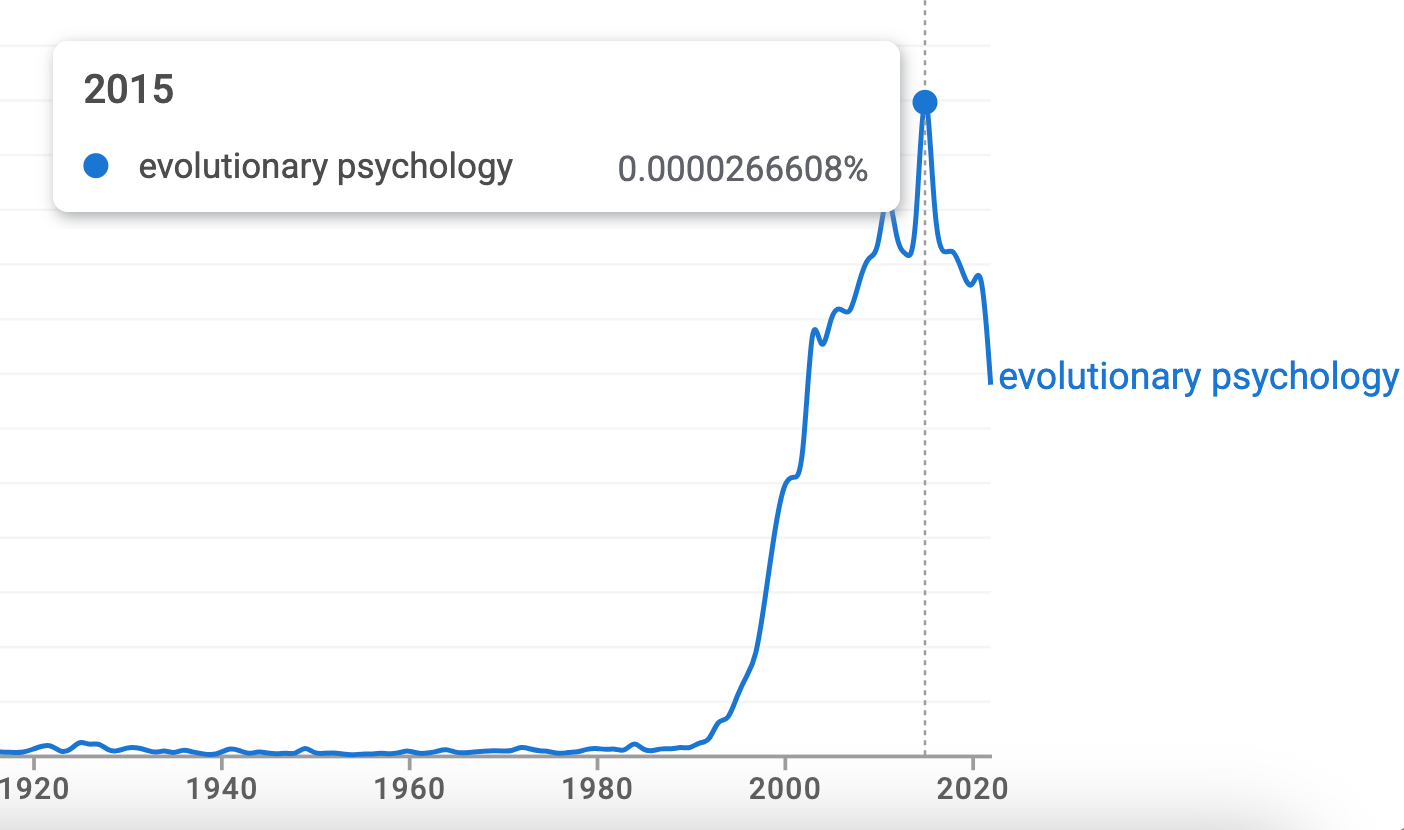
Evolutionary psychology was a big deal in the early 2000s, but lately you don’t hear about it as much.
EO Wilson, who coined the term sociobiology, described him as one of the most influential - and consistently correct - theoretical evolutionary biologists of our time. But he was reckless, aggressive and suffered from bipolar disorder which led him into agonising, debilitating breakdowns. His work was politically controversial. Harvard would not give him a professorship and towards the end of the 70s he seemed to vanish. In fact, he went in 1979 to the University of California in Santa Cruz, then a university with a reputation for drug abuse and slackness. “It was a once-in-a-lifetime mistake,” he says, “in the sense that I can’t afford to make another one like that. I survived, and I helped raise my children for a while; but that was all.”
He also switched his attention from theoretical biology to the detailed and difficult study of stretches of DNA and their conflicts within particular bodies. He says: “Call it arrogance, overconfidence, or ignorance; it was mostly ignorance, I think. I naively thought - this was my phrase - I’ll whip genetics into shape in three to five years. Fifteen years later, genetics has whipped me into shape. You do not whip genetics into shape within three to five years. It took me eight to 10 to understand what I was reading.”
He is bringing out a book, Genes in Conflict, written with a younger colleague, Austin Burt, which summarises everything that is known about conflicts within the genome; but at just the point when the two of them know as much as anyone can about this discipline he has switched back to anthropology. His next project is to show that we have evolved the capacity to deceive ourselves because it makes us better at lying to other people.
This kind of wild leap between disciplines has characterised his life. He was born in 1943, the second of seven children born to Howard and Mildred Trivers, who had met at graduate school in Harvard in the 30s. His father, whom he characterises as clever but ineffectual, had pursued postgraduate studies in German philosophy in Germany, until 1938 when even he noticed it was time for a Jewish student to leave. …
During the second world war, Howard Trivers worked for the army, and produced the regulations for denazification: he was rewarded with a post in the state department, so Robert Trivers grew up in a diplomatic household, a handicap he has triumphantly overcome: his opponents at Harvard are described as fools, and he says Richard Lewontin, the intellectual leader of the campaigns against sociobiology, grossly underestimated the role that selection plays in the makeup of the genome, while sanctioning all sorts of slanders against his opponents. Trivers says of his old enemy Stephen Jay Gould’s theory that the female orgasm was merely a by-product of the fact that the opposite sex has them, “It makes you wonder just how close Steve had ever been to that blessed event if he thought it was a side-effect ...”
He was sent to grand schools - at Phillips Academy Andover, Massachusetts, where the Bushes went, he was regarded as a promising mathematician after he taught himself calculus, in three months, aged 14; and he took two advanced maths courses before he arrived at Harvard. Typically enough, he then lost interest in maths, and decided to be a lawyer instead, fighting injustice, defending people who were minimally criminal. He had grown up in Washington as well as Berlin and Copenhagen, and was keenly aware of injustice and racial discrimination.
In order to become a lawyer, he had to have a humanities degree, so his first studies at Harvard were in American history. They were interrupted by the first, and worst, of his breakdowns, which took the form of spiralling mania - staying up all night, night after night, reading Wittgenstein and then collapsing. He was hospitalised, and treated with the first generation of effective anti-psychotic drugs.
… He fell in love with the logic of evolution. In the flow of genes through generations, and the steady, inexorable shaping of behaviour by natural selection, he saw a geometry of time, as beautiful as the geometry of space that Newton and Galileo had discovered.
His mentor was an ornithologist called Bill Drury, whose memory he venerates. Drury was an expert on herring gulls. Trivers says: “He knew enough that if God had made him a herring gull, he would have known 90% of what he needed to survive.”
Drury became very close to his pupil and his trust was reciprocated: “Bill and I were walking in the woods one day, and I told him that my first breakdown had been so painful that I had resolved that if I ever felt another one coming on, I would kill myself. Lately, however, I had changed my mind, and drawn up a list of 10 people I would kill first in that event. I wanted to know if this was going forwards or backwards. He thought for a while, then he said ‘Can I add three names to that list?’. That was his only comment.” …
Trivers determined to take a doctorate in biology; but university protocol meant that Drury could not be his adviser. Instead, he chose the curator of herpetology, Ernest Williams, who derailed his original plan to study monkeys in favour of going to Jamaica to study lizards. Trivers admits: “I was also quite frankly, interested in the women. When we flew to Jamaica I took one look at the women and one look at the island and decided to become a lizard man if that’s what it took to go back there.” Since that first epiphany, he has lived for about 13 years in Jamaica, off and on; he has married two Jamaican women.
Though he no longer studies lizards, he still has a long-term project going on the island, which studies symmetry in growing children. Symmetry is important in Trivers’ theories because it is a measure of fidelity to the genetic masterplan, and so of health and desirability. More symmetrical children should appear more attractive to their peers, even if the differences are not consciously discernible. …
The asymmetries Trivers is measuring in a very detailed fashion are very small, quite undetectable in normal life, yet we seem to be unconsciously very sensitive to them. Symmetrical children are consistently judged to be the best dancers, which is also a measurement of sexual attractiveness. Theory would predict that women measure attractiveness more closely than men do. Sure enough, the gap between those judged best and worst dancers was greatest among the boys.
Unlike the other founders of sociobiology, Trivers was more interested in human than in animal behaviour.
My theory has long been that …
Paywall here.
