

Here’s a recent book:
Shade: The Promise of a Forgotten Natural Resource
by Sam Bloch (Author) Format: Hardcover
4.6 4.6 out of 5 stars (28) 4.0 on Goodreads 439 ratings
Editors’ pick
Best Nonfiction
An extraordinary investigation into shade, this “compelling . . . conversation-starter draws examples from history, city-planning and social policy” (NPR) to change the way we think about a critical natural resource that should be available to all.
“Thought-provoking . . . Bloch, an environmental journalist, examines how shade is now a privilege, often denied to farmworkers, the homeless, and residents of poor neighborhoods.”—The New Yorker
A NEW YORKER BEST BOOK OF THE YEAR
On a 90-degree day in Los Angeles, bus riders across the city line up behind the shadows cast by street signs and telephone poles, looking for a little relief from the sun’s glaring heat.
I’ve been interested in this topic of shade in Los Angeles for a long time, but I come to different conclusions than the author, as I will explain below:
Every summer such scenes play out in cities across the United States, and as Sam Bloch argues, we ignore the benefits of shade at our own peril. Heatwaves are now the country’s deadliest natural disasters with victims concentrated in poorer, less shady areas. Public health, mental health, and crime statistics are worse in neighborhoods without it. For some, finding shade is a matter of life and death.
Shade was once a staple of human civilization.
A passage excerpted Tyler Cowen at Marginal Revolution:
Shade is not part of L.A.’s modern identity. In the 1930s, the city was rezoned to Federal Housing Administration design standards and banned high-density developments like row houses. Although apartments were once common, city leaders bowed to a prevailing wisdom that L.A. should not resemble a dark and cramped East Coast city.
Uh, the “dark and cramped” conditions of East Coast cities were never blamed by Angelenos on any purported abundance of shade trees. Walkable, densely populated Eastern cities tended to have very few shade trees on their streets because nobody had front lawns for planting trees.
There were a few tree-lined urban neighborhoods back east, but they tended to be famously desirable exceptions, such as Greenwich Village in Manhattan. One problem with 21st Century urbanist discourse is that it is so dominated by Jane Jacobs’ fine 1961 book The Death and Life of Great American Cities about why her neighborhood, Greenwich Village, is better than your neighborhood that mental images of leafy Greenwich Village take up a lot of space in the mind’s eye of discoursers on the Good Old Days Before Cars.
Freestanding single family-homes that were touched by sun on every side became mandatory.
No, Mid-Century Angelenos objected to towering buildings relegating their houses to permanent shadows. Trees were thought of differently. For example, a tree can provide shade in summer and sun in winter after the leaves have fallen off.
In came the cars. L.A.’s curbside trees were removed to accommodate shrinking sidewalks and expanding roads,
Where I live, in the San Fernando Valley of Los Angeles, very few roads have been widened since as far back as I can remember in the mid-1960s.
I’m sure that Mr. Bloch has in mind some neighborhood near downtown L.A. that was laid out before the automobile in the 1890s and that looks more charming in daguerreotypes than it does now in real life. But the vast majority of Los Angeles was laid out in the Automotive Age of the 20th Century … but it used to have more planted trees than it does now
and new rules that require parking minimums dealt another blow to the urban forest.
Parking lots often incorporate trees.
What don’t play nice together are dense multi-story buildings and trees. (Le Corbusier’s ill-fated vision of “a tower in the park” attempted to solve that problem by putting up towering housing projects surrounded by lawns and trees. Unfortunately, that didn’t work out well at Cabrini-Green and Pruitt-Igoe.
Mediterranean-style courtyards became endangered species as the shaded commons were converted to outdoor car storage. For decades, no building could be taller than the twenty-seven-story city hall…
Since the 1970s, an individual right to sunshine has been practically enshrined in state law.
But that’s part of the pro-tree, anti-building environmentalist NIMBY movement. Not In My Back Yard isn’t referring to NIMBY’s hatred of planting trees in their backyards.
His assertion that “Freestanding single family-homes that were touched by sun on every side became mandatory” is silly. Back when Los Angeles was dominated by freestanding single family-homes, it had an enormous number of fast-growing trees.
I am a native of the San Fernando Valley in northwestern Los Angeles, home to close to 40% of the population of America’s second biggest city. I recall being impressed around 1975 while hiking in the Hollywood Hills or driving north over the crest of the 405 freeway at Mulholland Drive how densely forested the Valley was 50 years ago.
This suburban forest was not natural. Before American times, most of the SFV was dry brush with trees only found along the Los Angeles River and a few other waterways. After William Mulholland’s aqueduct brought water from the Sierra Nevada, it was converted into one of America’s most productive farmlands, with some tree planting, such as eucalyptuses for windbreaks and lemon groves (oranges didn’t grow well on the flat San Fernando Valley floor compared to the sloping foothills of the San Gabriel Valley).
Suburbanization of the SFV took place in Mid-Century. The King of Comedy, Mack Sennett, producer of the Keystone Kops, started developing my neighborhood in the late 1920s from farmland to housing. The last beanfield and barn in the area were plowed under around 1963-64.
A big part of Valley post-war real estate development was tree-planting. We’ve all seen tweets of photos of treeless new suburbs with comments about how awful and soulless life must be there. So developers put in vast numbers of fast-growing trees in the postwar Valley.
Trees grows year-round in the Valley, so the ones planted in housing developments around 1950 had grown huge by the 1970s. My parents’ ash tree grew at least 3 feet taller per year and was perhaps 75 feet tall only 25 years after it was planted.
So, the Valley has today some spectacular tree-lined streets, like Stansbury Avenue in Sherman Oaks:
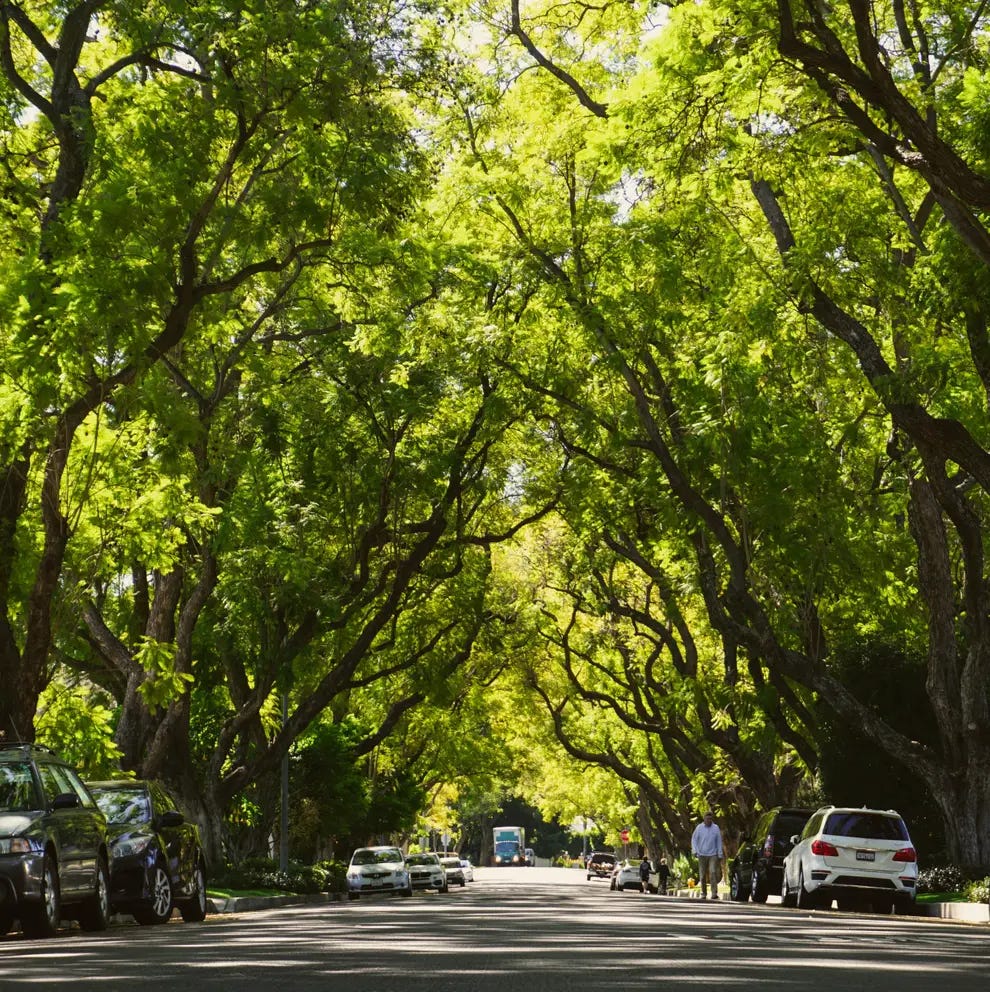
(Thanks to Pernel Quilon’s photoessay “19 Los Angeles Tree Tunnels.”)
Overall today, however, the Valley has many fewer trees than in 1975. The tree coverage is clearly far sparser than 50 years ago.
The population of the Valley in 1975 was around 1.0 million. Today it’s around 1.8 million.
Most of that overall increase is due to more density. By 1975, the Valley was over 95% developed (with mostly single family homes).
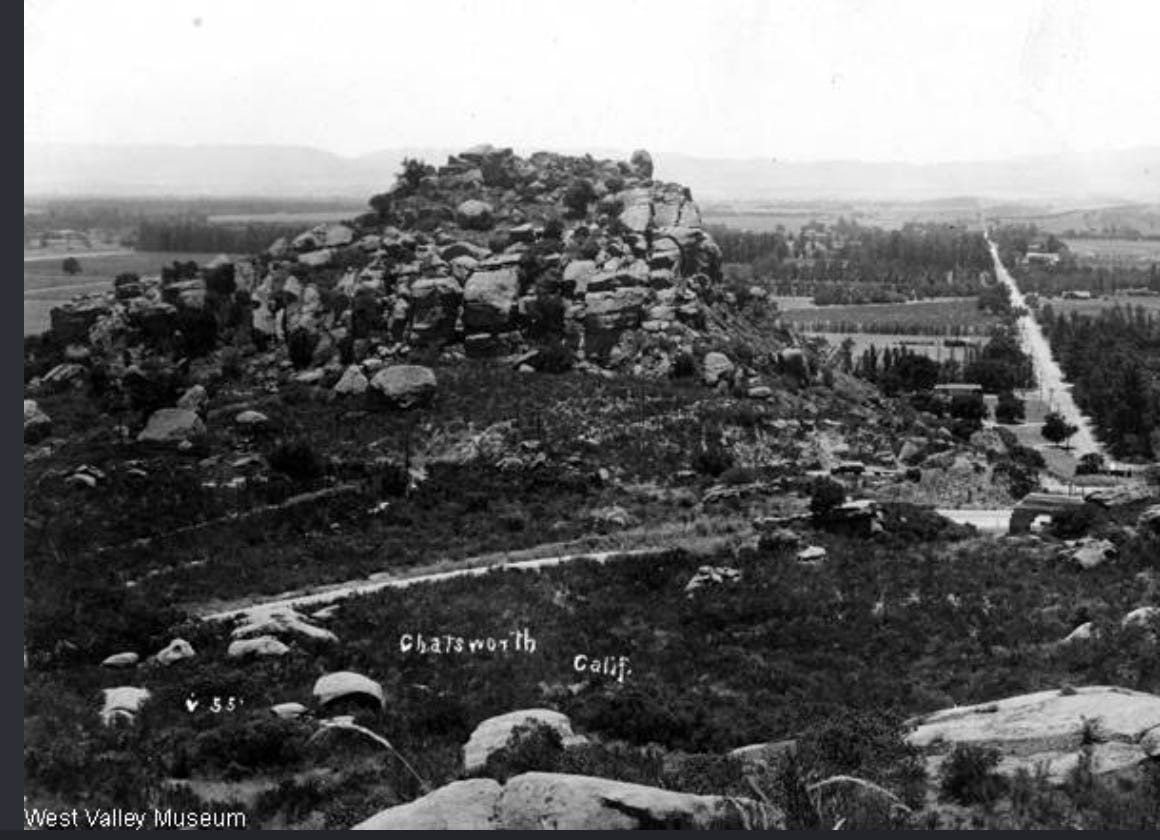
I can recall rock climbing at Stony Point in the extreme northwest of the Valley in 1977 and housing developments were less than a mile away in this last redoubt of Valley agriculture. The alluvial flatlands of the Valley are about 235 square miles, so the one square mile or so of farmlands I observed in 1977 were under 1% of the SFV.
Why are there fewer trees in the SFV than 50 years ago? …
Paywall here.
