

The male sex notoriously thinks about the Roman Empire a lot.
Less famously, but almost as obviously, men frequently dwell in their innermost thoughts upon the subject of war elephants.
Thus, practically every discussion of Jared Diamond’s 1997 book Guns, Germs, and Steel that I’ve ever been involved in, and I’ve been in quite a few, tends to ultimately focus on Diamond’s contention that the failure of sub-Saharans to ride elephants into battle was due to the innate untameability of African elephants.
Thus, a name of everlasting fascination to the male mind is that of Rome’s greatest enemy, Hannibal, the North African general who attacked Rome from the north by marching through the Alps with his war elephants. Artists’ conceptions of Hannibal’s epic crossing of the Alps with his elephants are innumerable:
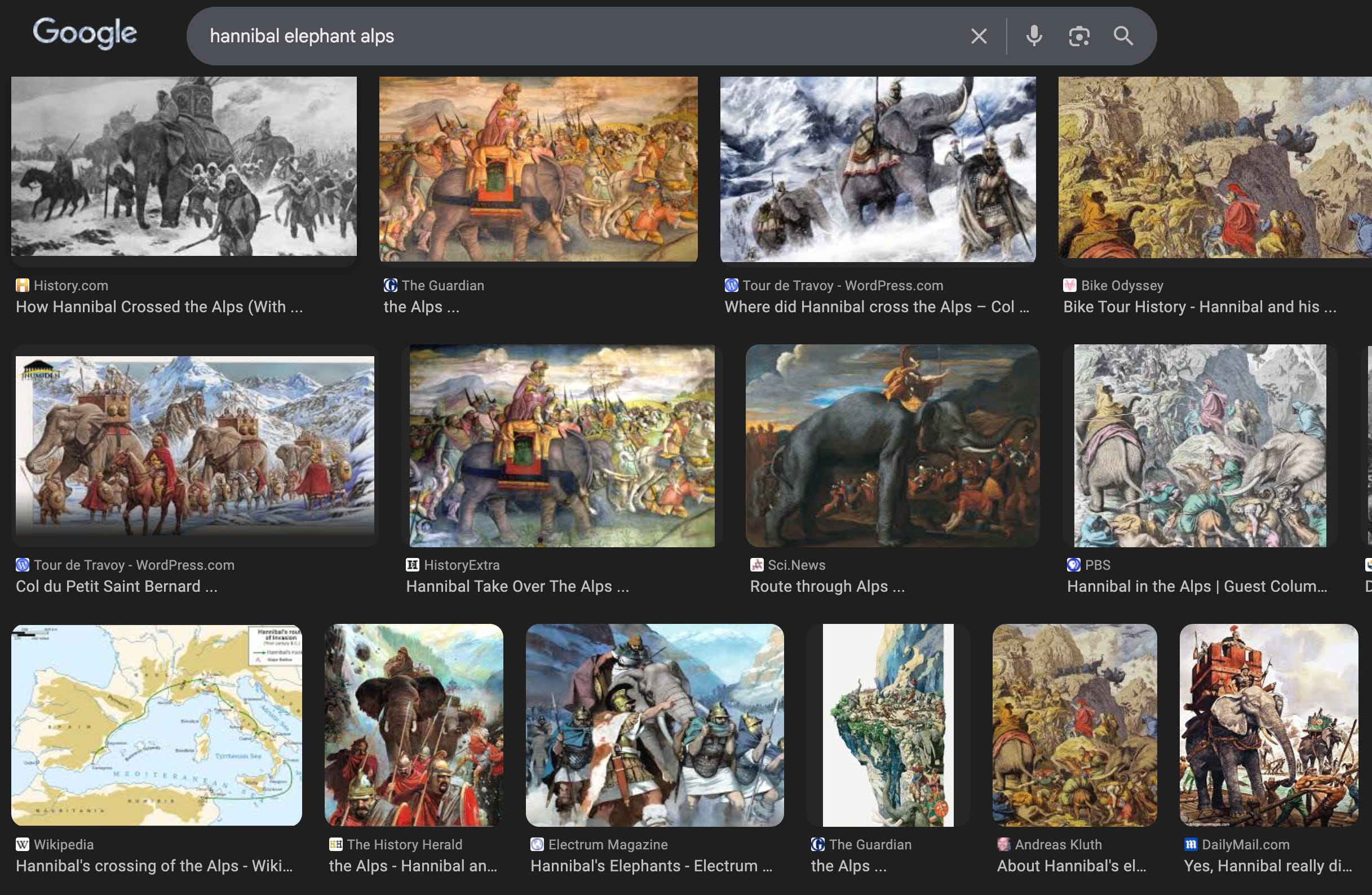
It’s assumed that the Carthaginian elephants were the extinct subspecies or species (who really knows?) of North African forest elephant from the northeast African highlands, such as Eritrea. Hannibal’s personal elephant, however, the last survivor of the three dozen to set out from Spain, was named “The Syrian,” and perhaps was a larger Asiatic elephant, giving Hannibal a better view of the battlefield.
The New York Times reports:
Elephant Bone in Spain May Be Proof of Hannibal’s Tanks With Trunks
Archaeologists say a 2,200-year-old specimen is the first direct evidence of how the Carthaginian war machine used the giant mammals in the Punic Wars.
By Franz Lidz
Feb. 13, 2026
A 2,200-year-old bone unearthed near Córdoba, Spain, may provide the first direct archaeological evidence of the formidable battle elephants employed by the Carthaginian general Hannibal.
Tucked away in a bed of rubble alongside Carthaginian coins from the third century B.C., the baseball-size ankle bone serves as a bridge between colorful historical narratives about the Second Punic War and hardened archaeological fact. The fossil wasn’t from the 37 elephants that famously crossed the Alps in 218 B.C., but it offers what Fernando Quesada Sanz, an archaeologist at the Autonomous University of Madrid, calls a “landmark” connection to Hannibal’s military campaigns, as well as his tactical errors.
Traces of combat — specifically, catapult ammunition found with the specimen — suggest the elephant died in battle, according to Dr. Quesada, an author of a study published last month in The Journal of Archaeological Science: Reports.
During the closing decades of the third century B.C., the Mediterranean was dominated by two superpowers: the emergent Roman Republic and Carthage, a North African city-state in what is now Tunisia. Still reeling from a humiliating defeat in the First Punic War — which cost them the strategic islands of Sardinia and Corsica — the debt-stricken Carthaginians pivoted to Spain, carving out a prosperous new empire from its silver mines.
Leading this expansion was Hannibal of the Barca family, whose brother Mago is credited with bringing elephants to the Iberian peninsula around 228 B.C. Hannibal then revolutionized warfare by deploying armored pachyderms against local tribes. This terrifying shock force broke battle lines and provided elevated, commanding positions for his archers.
“It is quite possible that the bone uncovered around Cordoba belonged to one of the elephants that Hannibal used to crush the Carpetani tribe in central Spain,” Dr. Quesada said.
The Second Punic War was ignited in 219 B.C. by Hannibal’s brutal, eight-month siege of Saguntum, a strategic Spanish stronghold allied with Rome. Believing the siege to be a rogue act, Rome demanded that Hannibal be handed over. When Carthage refused, the two powers declared war, setting the stage for a colossal 17-year conflict.
Before his invasion of Italy, Hannibal left 21 war elephants in Spain under the authority of his brother Hasdrubal. Those so-called tanks of antiquity were distributed among Mago and other generals. Dr. Quesada said the bones in his team’s archaeological find might be linked to those elephants.
… Sealed beneath a collapsed adobe wall, the remnant was found with 12 large stone catapult projectiles, suggesting that a fierce clash had taken place on the grounds of the settlement. …
The fate of the Córdoba elephant was undoubtedly grim, but it was probably a swifter mercy than the marathon of misery endured by Hannibal’s herd. Over five grueling months, the elephants caravaned from Catalonia across the Pyrenees and the Rhone, ultimately scaling the snow-slicked Alps. Their thousand-mile journey was less a military feat and more a slow-motion catastrophe.
While accounts vary, many historians believe a significant number of the elephants — perhaps nearly all 37 — initially survived the passage. But by the spring of 217 B.C., Hannibal’s grand trunk show had been reduced to a lone survivor: a tusk-shorn animal named Surus, meaning the Syrian. The others had died following the Battle of Trebia because of exhaustion, wounds and a severe winter ice storm.
Ever since the success of Gladiator in 2000 revived the sword-and-sandal genre, filmmakers have been trying to get a Hannibal movie made. Directors tend to personally identify with the conquering heroes of the ancient world, such as Alexander, Caesar, and Hannibal.
As I will recount below, I wrote an article in 2002 about who should play Hannibal. But, as I may have mentioned once or twice over the decades, in Hollywood, after all is said and done, more is said than done.
Yet, now, Netflix has all the money in the world. So Denzel Washington as a Hannibal movie or TV series may actually happen. From World of Reel:
March 5, 2026 Jordan Ruimy
Here’s an update on a project that was announced three years ago: Antoine Fuqua’s Netflix-backed biopic of the legendary Carthaginian Hannibal, with Denzel Washington set to portray the general, is set to start production in June.
Antoine Fuqua is a black director whose big achievement was 2001’s Training Day with Denzel as the bad guy.
Furthermore, the DP is Robert Richardson, a three-time Oscar-winning cinematographer, whose work with Quentin Tarantino (“Once Upon a Time in Hollywood,” “Inglourious Basterds,” “Kill Bill”), Martin Scorsese (“The Aviator,” “Casino”), and Oliver Stone (“JFK,” “Platoon”) has made him one of the most visually distinctive DPs in the game.
Set Fuqua aside for a moment — the project at least has a commendable screenwriter in John Logan, whose résumé includes Gladiator, The Aviator, Sweeney Todd, and Skyfall.
That’s a lot of talent but …
Paywall here.
