The Trump Administration has imposed a $100 per person per visit (not per day) surcharge on foreign tourists visiting the top eleven national parks (I’m putting the eight I’ve been to in bold): Acadia, Bryce Canyon, Everglades, Glacier, Grand Canyon, Grand Teton, Rocky Mountain, Sequoia & Kings Canyon, Yellowstone, Yosemite, and Zion.
Not surprisingly, the Washington Post is up in arms over how Trump is hatefully violating the Negative Second Amendment: “Congress shall make no law abridging the freedom of Belgian tourists to visit Yellowstone National Park real cheap.”
Or something.
The Washington Post seems to think the surcharge demeans our sacred immigrants, although it expressly doesn’t apply to legal immigrants and would seem focused instead on well-heeled foreign tourists.
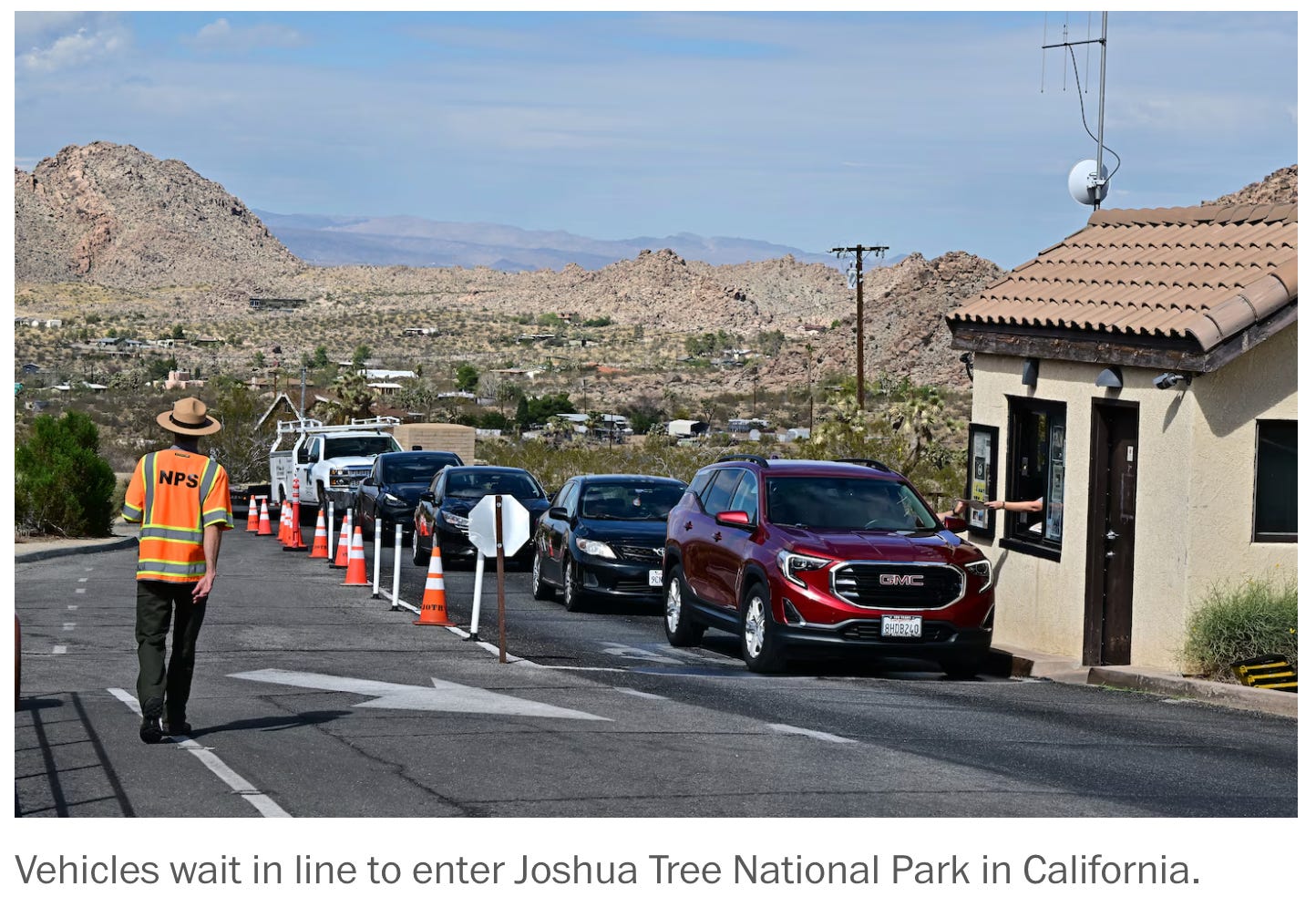
However, Joshua Tree National Park east of Los Angeles, which has become kind of the hipster national park that L.A.’s young people visit, is not one of the eleven superstar national parks where foreign tourists are being charged extra. So, this photo just represents the usual line.
President Donald Trump’s $100 surcharge on foreign tourists is causing long lines and delays at some national parks.
January 9, 2026
By Jake Spring
Visitors traveling to the most popular national parks are facing a new question at the gate: Are you a U.S. resident?
A.: “No, I’m a resident of Monaco. You would be too if you had any sense plus a reasonable trust fund.”
That question is causing longer wait times to enter parks and is leading some foreign tourists to turn away at the gates. Experts describe the “America-first pricing” as another example of the Trump administration’s targeting of immigrants.
A U.S. Resident is defined as a United States citizen or legal resident of the United States.
So legal immigrants don’t have to pay extra, just illegal immigrants (theoretically) and foreign tourists, age 16 and older.
I think the Trump Administration’s reform is mainly targeting the wallets of foreign tourists, who make up around 25% of visitors to Yosemite National Park. I am told that 1 out of 6 visitors to remote Yellowstone National Park in Wyoming are foreign. Another superstar, Grand Canyon National Park, is in dispute: either one out of 6 or one out of 3 or higher in recent travel industry polls.
The more obscure old time national parks like Lassen and Olympic, or the newer ones like Capitol Reef, have overwhelmingly American visitorships. But foreigners can in 2026 visit all but the top eleven for the same fee as Americans.
International tourism has been booming in the post-covid era, so extracting more money from people who fly across an ocean to see America’s most famous sights is basic Econ 101 price discrimination.
In contrast, national parks are one of the last things American families can visit pretty cheap, so Americans would tend to be more price sensitive than foreigners.
But the Washington Post instead senses a sinister racist plot against affluent foreigner travelers:
“It’s meant to make people feel nervous and uncomfortable and make the decision to either stay away or to modify their plans based on their identities,” said Mneesha Gellman, a political scientist at Emerson College who serves as an expert witness in U.S. immigration court.
“It really is being used to sow fear.”
Uh, it’s probably meant to extract more cash from affluent European and Asian tourists.
Demand for admission to the most famous national parks is quite high. I’m reading up on how to get a reservation to camp in Yosemite Valley this summer and it sounds like I’d need to jump online at 7 am exactly five months in advance to have a shot. A National Park Service website tells me:
For your best chance of getting a reservation, be sure your clock is set accurately. Log in and be ready to go at Recreation.gov before 7 am Pacific time.
I visited Yosemite Valley in c. 1968 and c. 1986 and it was awesome. But it’s currently 3:03 AM and I’m still posting away, so me getting up at 6:59 AM is probably not going to happen.
In 1971, I hiked to the bottom of the Grand Canyon and stayed at Phantom Ranch overnight and it was great. I was at the south rim of the Grand Canyon in 2017 and the Times Square-like size of the crowd was distracting.
In general, the world is both getting more crowded and more sophisticated, so ever more vast numbers of people want to go to famous places. This isn’t a bad thing, but it seems reasonable to charge them ever higher prices.
For example, when I was 12 years old, I helped my dad and my cousin Joe plot out an early April 1971 itinerary in which we’d drive from L.A. to Las Vegas (I have long hoped that our visit to the Circus Circus casino was at the exact same time as Hunter S. Thompson’s, but it now appears we were there right in-between his late March and late April, 1971 visits to Vegas immortalized in Fear and Loathing in Las Vegas), Zion, Bryce Canyon, and Grand Canyon national parks.
In 1971, Las Vegas and the Grand Canyon were already gigantically famous, but Zion and Bryce Canyon were better known to bookworms like myself who checked out from the library guides to the national parks with stunning black and white pictures.
Nowadays, in contrast, billions of people have easy access on their phones to countless color photos of Zion and Bryce. Not surprisingly, ever huger numbers of people from around the world want to go to Bryce and Zion.
Econ 101 suggests rationing by charging higher prices. On the other hand, perhaps it’s prudent to elicit patriotism in our young people by subsidizing their visits to our most extraordinary Purple Mountains Majesty by charging them less than we charge Luxembourgians on tour?
Because I’m a deplorable extremist, I suggest a reasonable compromise. But the Washington Post isn’t to be tricked into reasonable compromise. The Post knows best that rich Liechtensteiner’s are more deserving to visit America’s most popular national parks than average Americans.
Charging foreigners more seems fine to me, but to the Post, little is more outraging than the Trump administration strategy to send a message that “the interests of U.S.-born Americans come before those of immigrants” and/or foreign tourists.
In November, the Trump administration said it would hike visitor fees for people who are not U.S. residents, with 11 popular parks charging a $100 surcharge in addition to the entrance fee.
That’s not cheap, but not too expensive either.
Say you are a family of four with a 17 and 19 year olds in Frankfurt planning a two-week vacation in America. You want to fly to New York, see some sights and a Broadway show or two, and then fly to San Francisco for a few days, then drive to Los Angeles (foreign tourists seems to love L.A. … for inexplicable reasons — personally, I love L.A., my hometown, but then again, I’ve always gotten the joke. I’d probably pick Chicago or Philadelphia or D.C. over L.A. as the third choice over N.Y. and S.F.), via Yosemite and Death Valley (Germans adore Death Valley in summer, because Germans are insane) and then fly home. So, the cost of visiting Yosemite for a few days goes up by $400 with the Trump surcharge, although the cost of visiting Death Valley NP stays the same because it’s not one of Top Eleven national parks.
ChatGPT claims that the German family would pay $12,000 to $16,000 for their vacation in total, so the extra $400 would be about 3% more.
Big deal.
In contrast, a two week driving / camping vacation for an American family in Chicago to Mt. Rushmore and Glacier, Yellowstone, Grand Teton, and Rocky Mountain national parks would probably cost
Paywall here.
Continue reading this post for free, courtesy of Steve Sailer.