

The Jason Arday brouhaha is causing an interesting split between academia and the mainstream news media, which have long been close allies.
Numerous academics in Britain, especially of color, are currently demented with rage at the press for telling the truth about the late lowbrow liar.
On the other hand, one striking aspect of the Arday fiasco is that the mainstream media actually performed pretty well once the brave Nathan Cofnas got the story out on July 21. The British center-right press (Telegraph, Times, Daily Mail) picked up on the story about as fast as I did. And then Lanre Bakare in the Guardian delivered the coup de grace on August 1 with his long story in which Arday claimed to have been mailed a severed pig’s head and much else of head-scratching interest.
In the U.S., the New York Times’ coverage wasn’t initially strong. But its big August 15 story after Arday’s apparent suicide was extremely informative to Americans who hadn’t been been following my Substack:
Professor’s Death Leaves Behind Hard Questions for Cambridge on Race and Hiring
Jason Arday, the school’s youngest Black professor, was found dead on Friday. The school ignored a series of warnings about his life story and his work.
By Mara Hvistendahl, Megan Specia, Leo Sands, Ali Watkins, and Susan Dominus
Published Aug. 15, 2026
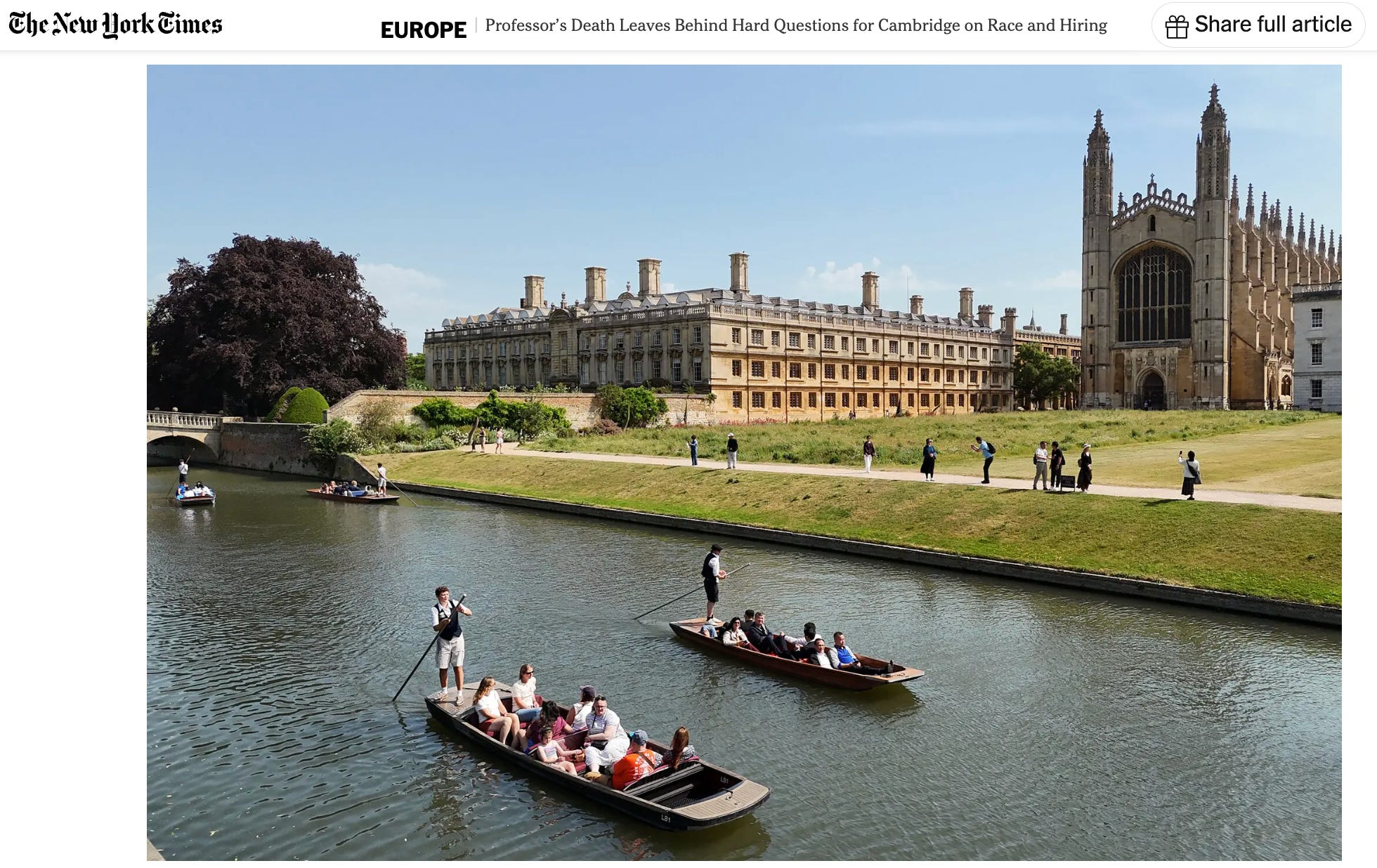
When Cambridge University interviewed Jason Arday for one of the most prestigious sociology positions in the world, he was an early career scholar and underqualified, by the school’s own standards.
Cambridge’s requirements, reviewed by The New York Times, called for “an outstanding research record of international stature” and a “proven successful track record” supervising Ph.D. students. Dr. Arday had a modest publication record and had bounced from one university to the next — not staying long enough to oversee a full three-year-or-more doctorate.
Cambridge hired him anyway in 2023, making him, at 37, the university’s youngest Black professor at a time when the school was under pressure to diversify.
That news story ends:
… But the fallout from Cambridge’s enthusiastic promotion of Dr. Arday’s story could last for years. “This has really done some harm,” Dr. Camarata, the speech specialist, said before Dr. Arday’s death.
He said that over the years, he heard from families of children with severe autism hoping for a miracle. “I never want to take away anybody’s hope,” he said, “but this story really has created some unreasonable expectations and false hopes, and I hate that.”
Heidi Mirza, an emeritus professor of education at University College London who once mentored Dr. Arday, said in an interview this past week that he had been ill-served by university administrators’ carelessness in their efforts to demonstrate their commitment to diversity.
“He’s a pawn,” she said, “whose ambition made him vulnerable.”
I couldn’t have asked for all that much better of an approach from the New York Times news desk.
The one NYT opinion article I recall reading was pretty good too:
After a Scholar’s Awful Death, Mistaken Calls for Censorship
Aug. 17, 2026
by Michelle Goldberg
… In the wake of Arday’s death, many on the left are blaming the media. “The media lynched Jason Arday,” declared Ibram X. Kendi. The head of a Cambridge college called for an official inquiry into the “media onslaught.”
Important British progressives, including Zack Polanski, leader of the Green Party, and several Labour M.P.s, signed an open letter demanding some sort of official oversight of journalistic decision making. “Self-regulation of the press has comprehensively failed,” it said. The writer Will Self called, in an open letter to Prime Minister Andy Burnham, for the police to begin “impounding computers,” presumably belonging to people involved in covering the scandal.
Those pressing for new controls on the press are making a serious mistake. Some who once championed Arday seem to be trying to deflect from their own embarrassing credulity, and it is unlikely to work. A deep resentment of both growing societal diversity and bureaucratic diversity initiatives, or D.E.I., fuels the right; it’s why Arday’s story was such catnip to the conservative press. But heavy-handed progressive attempts to stifle questions about those initiatives — to use institutional power to police the boundaries of public discourse about race, gender and religion — have a way of making that resentment even more politically potent.
An interesting question is what do New York Times subscribers (who number over 13 million) think. The best source would be the comments on Goldberg’s op-ed. Below are the top twenty most upvoted comments:
Paywall here.
