

From Theory and Society, the abstract of a new paper analyzing the ideological tilt of the abstracts of a vast number of social science papers:
The ideological orientation of academic social science research 1960–2024
James Manzi
James Manzi is a doctoral student in Sociology at the University of Oxford.
This study analyzes approximately 600,000 English-language social science abstracts published between 1960 and 2024 to estimate the long-run ideological orientation of disciplinary research output. Large language models (LLMs) were applied to each abstract using a fixed 2025 U.S. ideological spectrum, enabling consistent coding across six decades. Five key findings emerged.
First, roughly 90 percent of politically relevant social science articles leaned left 1960–2024, and the mean political stance of every social science discipline was left-of-center every year during the period.
Manzi does something that academics ought to do more often: he includes a table of examples of what he means:
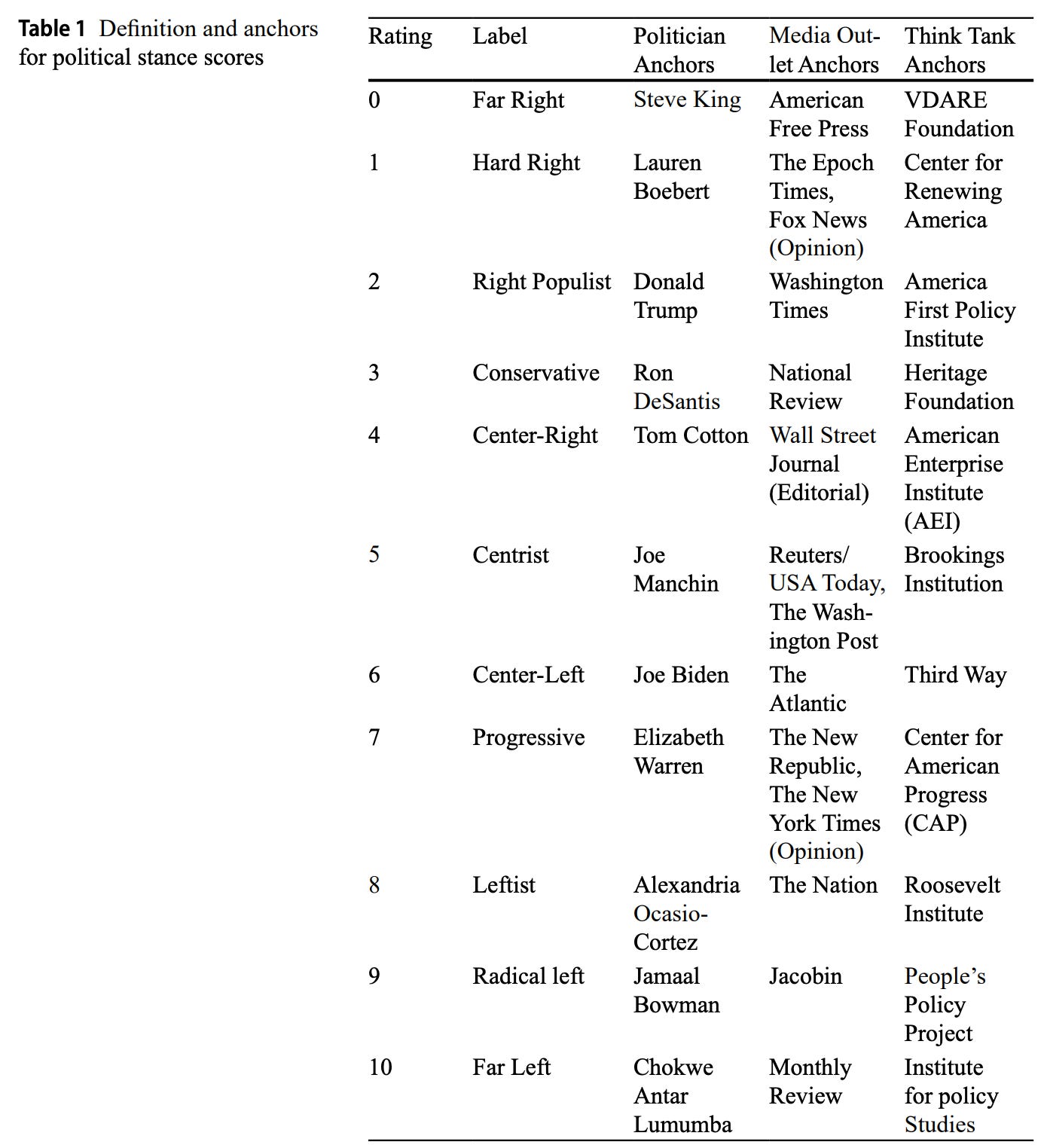
Manzi writes:
Measurement of political stance was validated by applying the Prompting Method to material produced by the anchor think tanks. Recent substantive research articles were scraped from the homepages of 10 of the 11 anchor think tanks. The number of articles by think tank ranged from 30 to 67. The exception was the VDARE Foundation (the most far-right think tank) whose website has been shut down; therefore, 20 prior VDARE articles were hand collected from the Internet Archive (Internet Archive, n.d.).
Manzi also provides examples of prominent papers and their rankings: e.g., 2005’s “Hegemonic Masculinity” in Gender and Society ranks as an 8 on a 0 to 10 scale of leftism, while 1972’s “The Agenda-Setting Function of Mass Media” (which argues that the media is powerful in determining what are considered current political controversies) in Public Opinion Quarterly is a middle of the road 5.
I’d also like to see examples of prominent papers from the extremes. Judging from the hundreds of articles I wrote for VDARE, the most deplorably far right articles will be highly data-driven like Arthur Jensen’s 1969 magnum opus “How Much Can We Boost IQ and Scholastic Achievement?”, while the most popular left wing articles will be ones introducing new epithets for why White Men Bad.
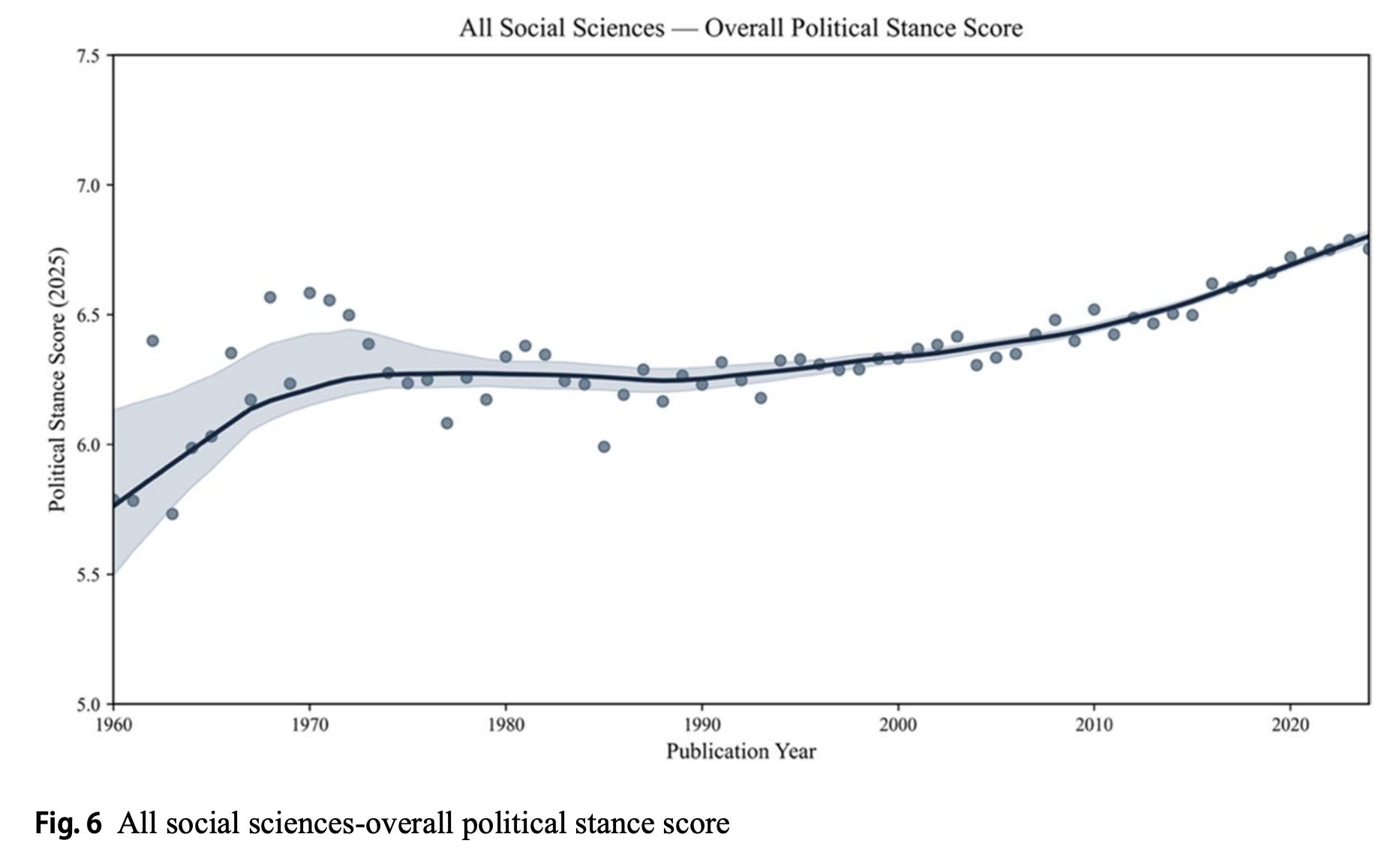
Overall, the 1960s saw the social sciences move dramatically to the left (higher on this graph), then stabilize in mid-1970s to late 1980s, then rise steadily after the collapse of the Muscovite empire liberated Anglophone academic leftism from defending its depressing Soviet embodiment. Then leftism exploded during the late Great Awokening.
It may (or may not) have diminished in 2024.
A small drop in leftism in 2024 might herald the much discussed Vibe Shift. Or it might wind up being swamped by the long term trend toward the left.
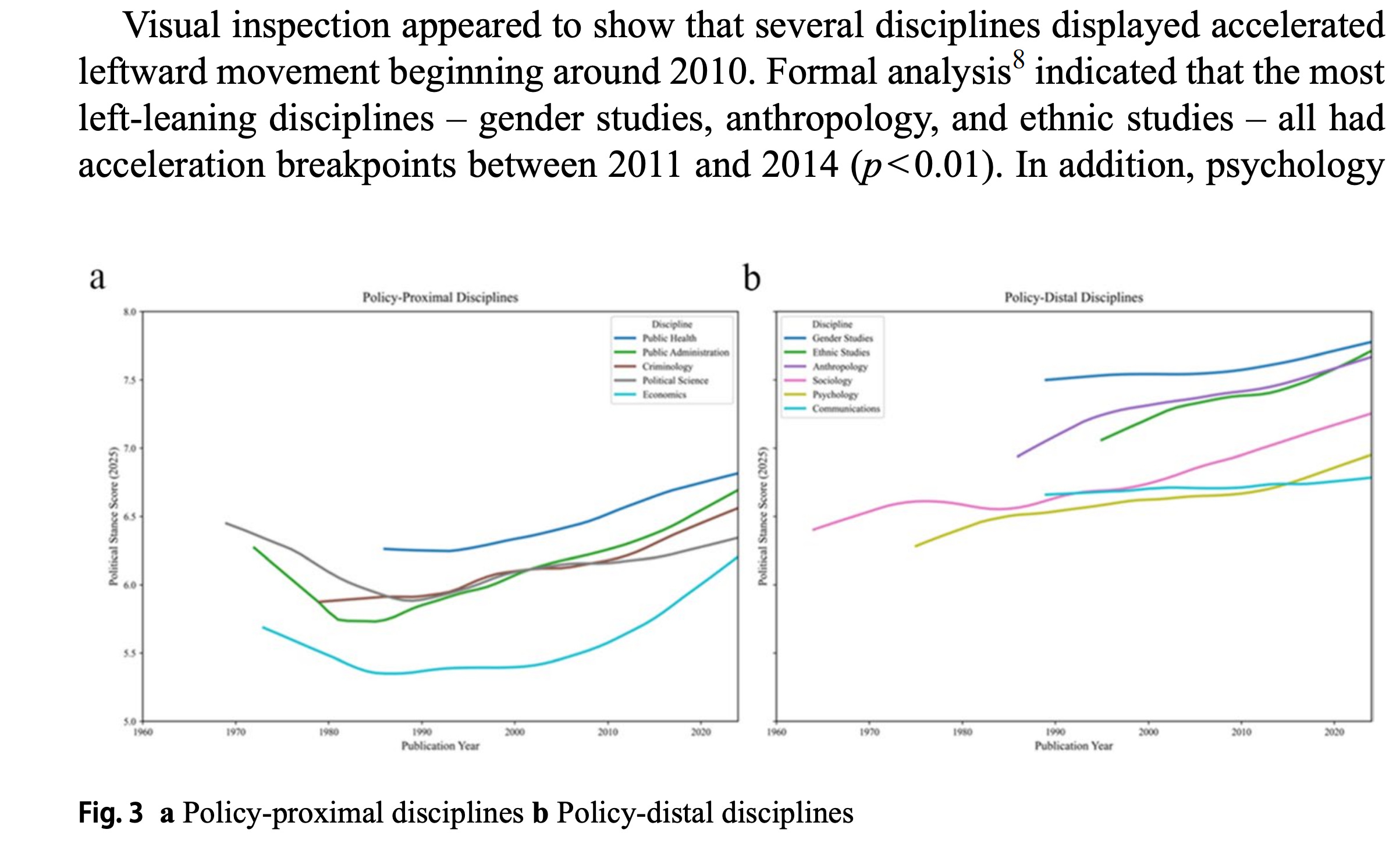
Second, all disciplines showed leftward movement between 1990 and 2024.
Disciplines concerned with public policy (“policy-proximal disciplines), such as economics and political science, tend to be less fanatically leftist than disciplines concerned more with feelings, such as psychology, sociology, and gender studies (“policy-distal disciplines”).
The feely discipline with the most abstracts from the 1960s, sociology, unsurprisingly moved left during the 1960s, then stabilized during the Sociobiology era of 1975-1985, then moved steadily left through 2024.
Third, policy-proximal disciplines generally showed limited rightward moderation between roughly 1970 and 1990, though policy-distal disciplines did not.
Economics, political science, and public administration (“policy-proximal disciplines”) all became less leftwing in the 1970s.
That was my impression at the time: I started reading social science studies when I was 13 in 1972 for high school debate, and the ground-breaking intellectually interesting work right then was being done more on the right than the left. Although today I’m associated with the most extreme “Far Right” in this study, my views in 2026 are representative of those of the most prestigious 1970s Harvard social scientists of my youth such as Senator Daniel Patrick Moynihan (D-NY, 1977-2001), James Q. Wilson, and Richard Herrnstein.
I was at Rice from 1976-1980 and at UCLA business school from 1980-82, when the brightest professors tended to be moving to the right. One professor at Rice explained to me c. 1979 that Rice professors hated …
Paywall here.
