

Homer’s Iliad and Odyssey were only two of the eight ancient books recounting the full story of the Trojan War. Many of the most famous episodes, such as the Trojan Horse and the sacking of Troy, the child sacrifice of Iphigenia by Agamemnon, and the murder of Agamemnon by his wife Clytemnestra in revenge, are not in Homer’s books. Instead, they are in ones we only know from summaries, fragments, Virgil’s Aeneid, stage tragedies based on their plots, and the like.
The six lost books of the Epic Cycle appear to have been written down by later authors to fill in the parts of the tale that Homer left out to focus on his two chosen topics, the wrath of Achilles and the long homecoming of Odysseus.
(By the way, this poses a problem for filmmakers of movies like Troy and The Odyssey. Audiences paying to see a film about the Trojan War based on Homer want to see, for example, the Trojan Horse, dammit. They don’t care if the Trojan Horse is not in The Iliad and is only briefly mentioned in The Odyssey. But film critics tend to be English majors who have read their Homer, so they tend to take pedantic pride in pointing out what’s not in Homer.)
All eight books, the two attributed to Homer and the other six, presumably emerged from the enormous Greek dark age oral tradition.
Importantly, the lost six were not seen in the ancient world as challenging Homer’s primacy in precedent or quality, but were instead created later to complement Homer’s two classics. In Aristotle’s Poetics, for example, the philosopher explains why The Iliad and The Odyssey are better works of literature than the rest. The others’ lesser reputations help explain why they didn’t survive intact.
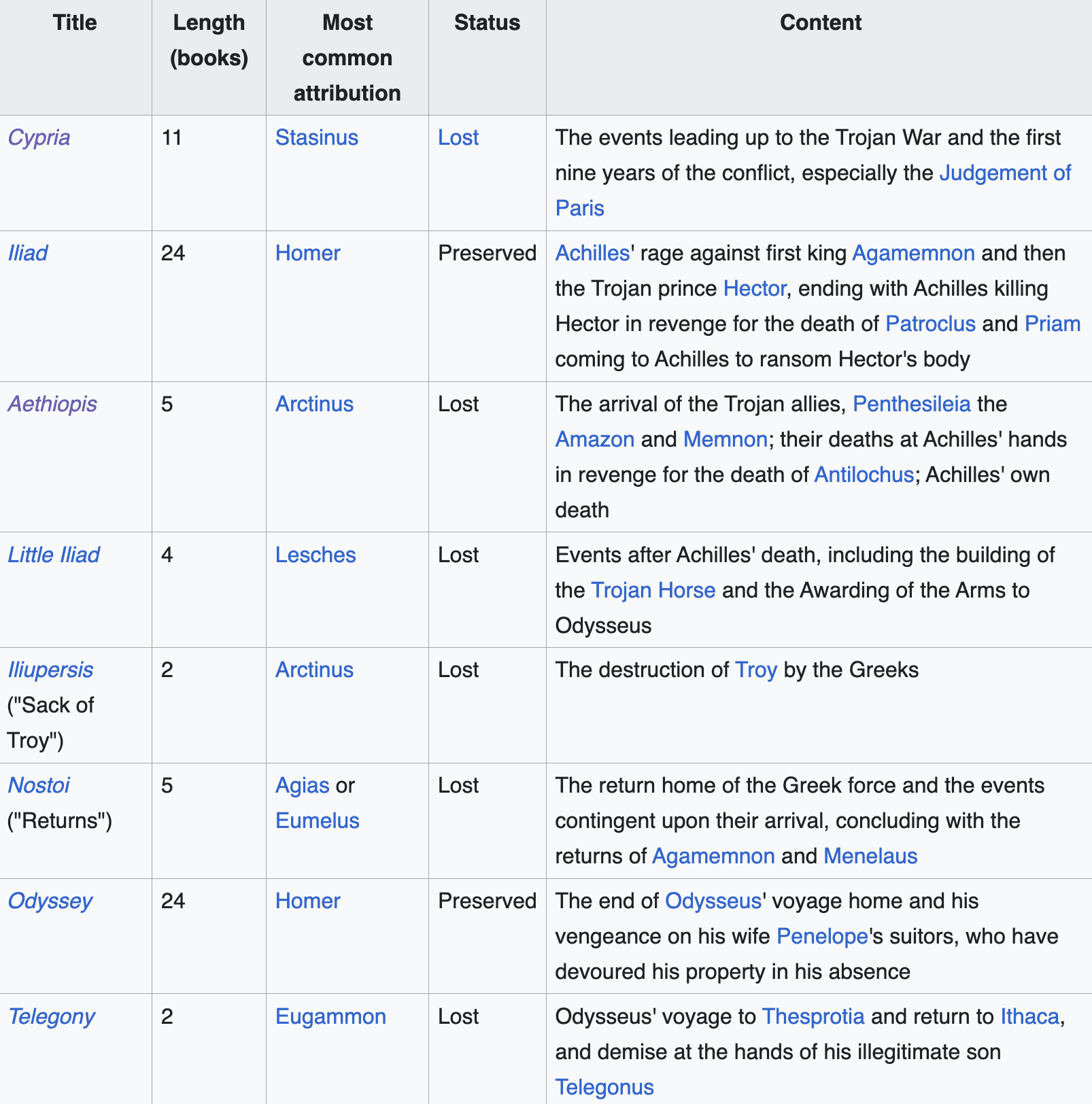
Here’s Wikipedia’s table of how the eight books once fit together chronologically.
Here’s Edward N. Luttwak’s 2024 article in The New Criterion on the Epic Cycle.
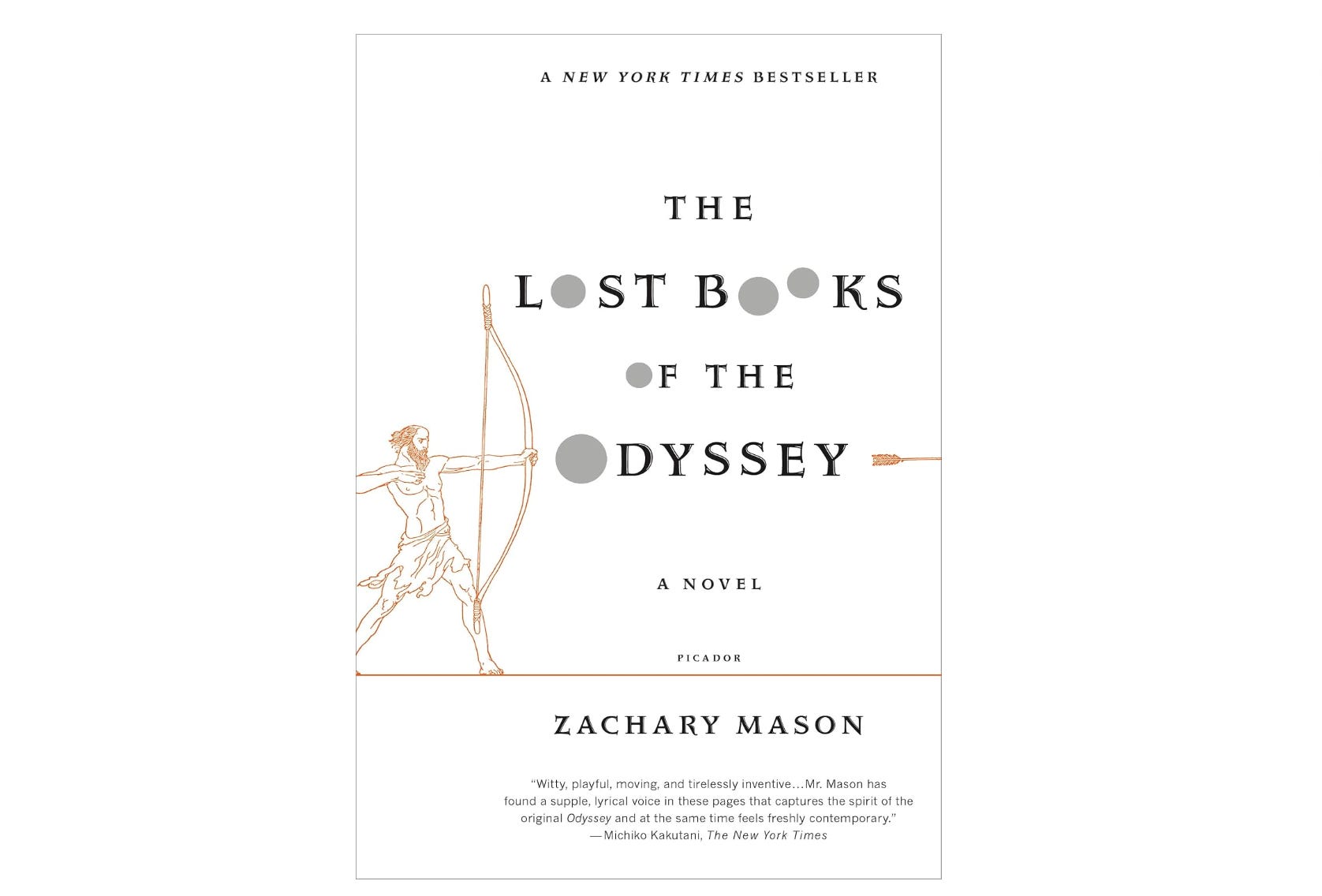
These lost books of the Trojan War evidently inspired a terrific 2010 work of fiction, The Lost Books of The Odyssey by Zachary Mason, which I reviewed for Taki’s Magazine.
Mason is an interesting but not prolific writer because his Computer Science Ph.D. dissertation, A computational, corpus-based metaphor extraction system, was in artificial intelligence. So he can presumably make more money these days on his day job.
Mason’s conceit in The Lost Books of The Odyssey is that before the Homeric crystallization there once existed an immense body of alternative tellings of the Trojan War legends with the familiar characters such as Odysseus, Achilles, Agamemnon, Helen, Penelope, Athena, and so forth, but with wildly different plots in which the classic personalities make different (but not implausible) choices, and that he is presenting a new translation of a (fictitious) palimpsest of 44 short fragments.
I reread it a couple of years ago and enjoyed it just as much the second time.
Due to a kind of digital decay analogous to the physical decay suffered by papyrus manuscripts, my old writings are becoming harder to find and then read online. So, here’s a cleaned-up version of my 16-year-old review of The Lost Books of the Odyssey. …
Paywall here.
