The Southern Poverty Law Center is in the news today, so I’m going to post a number of old articles I’ve written over the decades about that hilarious yet baleful operation. I’ll put it up without a paywall so that more people can read them.
It was a bad week for polite society’s most respectable conspiracy theories, with the debunking of the Trump-Putin collusion allegation and more implosions among the conspiracy-theory-mongers at the Southern Poverty Law Center.
Shortly after suddenly firing Morris Dees, the SPLC’s living-legend cofounder, president Richard Cohen, himself quit unexpectedly.
Why?
There’s the macro reason: As has been repeatedly documented by disillusioned SPLC employees, Morris is basically a Southern TV-evangelist type, but one who long ago figured out that rich Northern liberals have more money to give him than do poor Southern fundamentalists.
But the micro reason explaining why now, after all these decades of impunity, remains obscured.
The New York Times, which has long conspired with the SPLC to promote hate hysteria, such as in its ill-fated “This Week in Hate” column, dispatched ten reporters. They returned with a decorous account of modest #MeToo mesoaggressions: Morris has occasionally put his hands on the shoulders of female staffers and once supposedly said, “I like chocolate” in the presence of a black woman.
One conspiracy theory is that the current purges of the SPLC’s Old Guard are the result of a conspiracy by unnamed parties to get their hands on the nearly half-billion dollars in assets that supersalesman Dees has piled up in the SPLC’s onshore and offshore accounts over his 48 manic years of always-be-closing fund-raising.
Which is getting us deeper into conspiracy theorizing than even I want to go…
So let’s step back and think about “conspiracy theory” in the current conceptual vocabulary.
The term “conspiracy theory” is largely a pejorative about the social standing of those offering the theory.
After all, very little gets done in this world without people plotting together to take action, contrivances that at least some hostile outsiders would consider nefarious. So conspiracies, broadly defined, are everywhere.
Interestingly, powerful insiders, such as Hillary Clinton, tend to see conspiracies, narrowly defined, everywhere.
In 21st-century America, however, to call something a “conspiracy theory” is to say that the kind of person to whom the idea appeals, such as Randy Quaid’s not-quite-right-in-the-head Vietnam-vet character in Independence Day (or Randy Quaid in real life lately), is disreputable.
Not all cultures associate conspiracy theorizing with addled burnouts. In Turkey, for example, he who comes up with the most byzantine conspiracy theory is admired for being the most intelligent.
In 1970s Hollywood movies, sexy rebels played by Warren Beatty and Robert Redford battled malevolent conspiracies. Up through the winter of 1992, when it looked like Oliver Stone’s JFK might sweep the Oscars, the cultural prestige of conspiracy theorizing persisted. But the serious press lashed back at JFK, and ever since conspiracy theories have been seen as the province of the lower orders.
Hence, the theories about conspiracies between Trump and Putin to steal the election from poor Hillary that were endlessly offered by well-groomed talking heads on CNN and MSNBC couldn’t possibly be “conspiracy theories,” because, well, because they don’t let conspiracy theorists on the better sort of networks.
Similarly, Dees’ lucrative conspiracy theory about how America is under siege from an ever-vaster shadowy network of “hate groups” is seldom labeled a “conspiracy theory.”
After all, Dees is vastly respectable. He holds nearly two dozen honorary degrees, has been played by Corbin Bernsen in a TV movie, and is a member of the Direct Marketing Association Hall of Fame. And, no doubt, not all of Morris’ four ex-wives hate him quite as much as some of them do.
In reality, though, rightist hate groups are close to the least of our troubles.
America does have a problem with Lone Wacko shooters, some of whom have rightist motivations. But virtually none of the right-wing terrorist attacks after Oklahoma City in 1995 involved more than one criminal. They didn’t have anybody to conspire with.
Rightist Lone Wackos do tend to be more effectual at racking up big body counts than do leftist Lone Wackos, like the gay-rights terrorist who tried to shoot up the Family Research Council after reading on the SPLC’s website that the FRC was a hate group. The gay-marriage gunman shot the front desk guard, Leo Johnson, in the arm, but Johnson still wrestled him down one-handed.
In contrast, some cities in Blue State America have had an ongoing problem with sizable, violent Antifa hate groups who attempt to beat up dissidents demonized by the SPLC, such as Charles Murray. After a leftist hate mob attacked Murray in 2017, hospitalizing a woman professor, the Associated Press reported that Murray had it coming because:
The Southern Poverty Law Center considers him a white nationalist who uses “racist pseudoscience and misleading statistics to argue that social inequality is caused by the genetic inferiority of the black and Latino communities, women and the poor.”
After all, as comic-book writer Ta-Nehisi Coates has proved, American history is an immense conspiracy among people who think they are white to plunder black bodies.
In this era of video and facial-recognition technology, it’s not particularly hard for the police to deter would-be Eric Clanton-style masked marauders by enforcing old anti-KKK laws against wearing masks in public. These days, if you wreak violence on your political enemies unmasked, you will likely be identified, as Zachary Greenberg recently found out.
But in some towns, such as Berkeley and San Jose, the politicians are on the side of the SPLC and the violent hate groups, and thus keep the cops from keeping the peace.
“Projection” was one of Freud’s best insights: It’s tempting to accuse our enemies of our own foibles. For example, the SPLC has been ranting for decades about how an ophthalmologist in Petoskey, Mich., named John Tanton is the evil “puppeteer” who manipulates American citizens into having any doubts at all about immigration.
My guess is that Morris’ minions project their own guilty awareness of the truth about Dees, a roguish junk-mail genius, the Elmer Gantry of liberalism, onto Tanton.
It’s often argued that conspiracy theories couldn’t possibly be true because once somebody inside the organization leaked the truth, the whole world would instantly know.
But it doesn’t actually work that way. For instance, Theranos had scores of disillusioned ex-employees. But for a decade the world wanted to believe that Elizabeth Holmes was proving that a sexist conspiracy was all that held women back from making their deserved billions in Silicon Valley.
Similarly, various investigative reporters have revealed the ignominious truth about the SPLC for a quarter of a century now, going back to the in-depth Montgomery Advertiser series in 1994.
But virtually nobody noticed. Instead, millions wanted to believe that Morris Dees was a hero single-handedly battling the rising tide of Hate for us.
Bogus as the SPLC is, its mythmaking is extremely useful to the Democratic Party, furnishing the KKKrazy Glue that holds the Coalition of the Fringes together by telling them that a vast right-wing conspiracy, from the KKK to Charles Murray, is holding down everyone who isn’t a straight white male.
Hence, the SPLC has recently gone from one triumph to another, taking in heaps of money ($129 million in contributions and grants in fiscal year 2017, $70 million more than it spent) and conspiring with tech monopolies such as Amazon to decide who would be denied service due to their political views.
Amazon, by the way, is run by the world’s richest man, who recently accused the National Enquirer of conspiring with Trump and Saudi Arabia to obtain pictures of his shortcomings.
But it turned out that the source was Mr. Bezos’ girlfriend’s brother.
You see, not all conspiracy theories are true.
The SPLC’s board promised the world in 2019 an in-depth report on Morris’s high crimes and misdemeanors, but seven years later, no such report has yet been seen.
It’s widely assumed in thriller movies that if ever the truth is allowed to leak out about a powerful institution’s fundamental corruption, then its reputation must come crashing down once and for all.
But in real life, multiple disgraces can have negligible impact on an organization’s reputation in the prestige press as long as it continues to serve its function in furthering The Narrative.
I notice that among intelligent but naive young people of a scientific bent, there is a recurrent assumption that once the facts get out, then everything will change. If the 1887 Michelson-Morley experiment about the speed of light turns out negative, then the Newtonian model is shattered and eventually there must be a paradigm shift to Einsteinian relativity.
But that’s not the way it works in public affairs, where control of The Megaphone is what matters because most people can’t remember much. You have to repeat the facts over and over and over to have any chance of ever moving the needle.
For example, since the 1990s close observers of the Southern Poverty Law Center, one of America’s most profitable nonprofits (endowment in fiscal year 2018 was $471,000,000, up from $319,300,000 just two years earlier), have recognized that it is America’s most lucrative hate organization.
The SPLC’s legendary founder Morris Dees (currently on his sixth wife) is basically a sleazy Southern TV preacher type, but one who long ago figured out that poor Southern Baptists had less money to send him than rich Northern liberals. This junk-mail genius realized he could monetize the regional, ethnic, and class hatreds directed against his own people.
But isn’t it a little crass to whip up hatred of poor white Southerners among rich white Northerners? Morris had the perfect answer: He’s not the hater; it’s the people he hates who deserved to be hated because they are the haters.
This logic, such as it is, proved utterly convincing to the mainstream media, who anointed the SPLC as the grand arbiter of whom to hate. As the satirical Babylon Bee reported in 2018:
…After the announcement, major media outlets accepted the SPLC’s new distinction without question, but immediately ran into a catch-22—how to malign the newly-anointed hate group without citing the newly-anointed hate group. At publishing time, the press was still unsure how to deal with the paradox.
The SPLC suffered a disastrous March 2019 with three consecutive scandals exposing the SPLC, seemingly once and for all, as a clownishly transparent fund-raising operation that whips up hate for cash.
Yet, just a few months after all the bad publicity, there are no noticeable effects on how the wire services and The New York Times treat the SPLC as the objective authority on who are the Bad Guys you are obligated to hate. They simply assume most people won’t remember that the SPLC humiliated itself last March.
As you may recall, however, back in mid-March SPLC president Richard Cohen fired Dees for unspecified reasons, but which were rumored to be racism and sexism.
Cohen announced that Michelle Obama’s chief of staff Tina Tchen had been engaged to sniff out any remaining unwokeness in the organization.
But Cohen was soon out the door as well.
And within another week it turned out that it was Tchen who had made the phone call to Chicago DA Kim Foxx to tell her to let hate-hoaxing actor Jussie Smollett walk.
To have your founder disgraced could be seen as a misfortune, but to have your founder, CEO, and designated savior all shamed in two weeks bespeaks of venality.
You might think that these events would leave the SPLC permanently tarred with adjectives such as “scandal-plagued” or at least “controversial.”
But no, a few months later, it’s as if the SPLC has a spotless history, at least judging from all twelve New York Times articles published in August that cite the SPLC.
…“It’s a step in the right direction,” said Keegan Hankes, research analyst for the Southern Poverty Law Center’s intelligence project, who focuses on far-right extremist propaganda. But, he added, Twitter is essentially arguing “that hate speech can be in the public interest. I am arguing that hate speech is never in the public interest.”
And if you can’t trust the SPLC to sum up, who can you trust?
…The mass shooting followed a rise in the number of hate crimes and the number of hate groups in the United States, according to separate reports from the Federal Bureau of Investigation and the Southern Poverty Law Center….
And then there was this hilariously stupid brouhaha:
A Justice Department newsletter that is distributed to federal immigration judges and other employees contained a blog post this week from an extremist group that included an anti-Semitic reference, a national union for the judges said….
On Monday, the newsletter summarized and linked to a post from VDare, a website that regularly publishes white nationalists, according to the 440-member union, the National Association of Immigration Judges. The Southern Poverty Law Center classifies VDare as an anti-immigration hate website.
The VDare post described the Justice Department’s recent efforts to decertify the judges’ union. It published photographs of two judges, one of Iranian descent and one of Pakistani descent, and referred to them as “kritarch.”
Kritarch is another Greek term like oligarch. Kritarchy means “rule by judges.” Wikipedia lists historical examples, such as the Book of Judges in the Old Testament, ancient Ireland, the medieval Iceland beloved by libertarians, 16th-century Frisia, and modern Somalia. It is not anti-Semitic.
Earlier, The New York Times Magazine ran yet another long article about the Mounting Slavery Crisis of 2019 relying upon an SPLC operation to convince the gullible that what American students really need right now is more Slavery Literacy:
…In 2017, the Southern Poverty Law Center, a nonprofit organization that researches and monitors hate groups, pored over 12 popular U.S. history books and surveyed more than 1,700 social-studies teachers and 1,000 high-school seniors to understand how American slavery is taught and what is learned. The findings were disturbing: There was widespread slavery illiteracy among students.
…The rumors of white supremacy amid the stalls of clover honey and sweet corn left farmers and shoppers reeling…. Deep in the 200-page document was a 2018 F.B.I. interview in which Mr. Brewer briefly mentioned meeting with “Sarah and Douglas,” and reported that the woman had been posting as “Volkmom” on a chat board of Identity Evropa, which the Anti-Defamation League and the Southern Poverty Law Center call a white nationalist or white supremacist group….
And then there’s the NYT assisting in the SPLC’s mania for personally demonizing everyone, living or dead, who ever dared disagree with them:
The newspaper printed an elaborate graph sourced to the SPLC depicting how the late Cordelia Scaife May (1928–2005) funded Dees’ bête noire, the late John Tanton, the patriotic small-town eye doctor upon whom Morris appears to have projected his own guilty conscience.
Here’s the only sentence all August admitting that not everybody is wholly persuaded of the SPLC’s fairness and accuracy:
The Center for Immigration Studies sued the Southern Poverty Law Center for designating it a hate group, a label the law center has also applied to FAIR.
The above were all supposedly “News.” But here’s a rare piece actually labeled “Opinion”:
Tucker Carlson was amused by the transcript of NYT editor Dean Baquet explaining to his depressed minions that while their conspiracy to dump Trump by hyping the Russian conspiracy theory had disastrously cratered, the Times already had a new conspiracy theory ready to roll out: racism! Not surprisingly, the Times was not amused at Tucker’s laughing at their expense:
…Bob Hopkinson, a spokesman for the Southern Poverty Law Center, which tracks hate groups, said tracking membership numbers is “extremely difficult.”… Precise numbers aside, the center says hate crimes and hate groups are on the rise in America.
Sure, they are. Just look at how a certain hate group has added over $150,000,000 to its endowment in two years.
…The ideas espoused in the great replacement build on the most popular white supremacist talking point—the false notion that white people are at risk of genocide, said Heidi Beirich, the director of the Intelligence Project at the Southern Poverty Law Center.
…David Neiwert, who has long reported on extremism in the Northwest and has worked with the Southern Poverty Law Center, said he sees the threat of the Northwest’s racist groups returning to levels of the 1980s, when neo-Nazi elements around the country had moved into the Northwest in a bid to create a white ethnostate.
Finally, here’s an article that makes the concession that the SPLC is “liberal.” That’s not exactly the first adjective I would use for the SPLC, which is in the racket of labeling other organizations hate groups so that they will be hated. But once in the month of August the NYT admitted that the SPLC has a point of view.
Along the way, Mr. Trump has empowered groups like the Federation for American Immigration Reform, which has been designated a hate group by the liberal Southern Poverty Law Center.
In summary, The New York Times ran a dozen articles in August citing the Southern Poverty Law Center as the expert authority on who deserves to be hated.
One of the twelve articles mentioned that the SPLC is “liberal,” while another one deigned to report that some of the hate groups singled out for hate by the SPLC disagreed with that attribution.
But the other ten articles admitted no question of the SPLC’s credentials.
And none of the dozen stories brought up the three scandals in March, much less the quarter century of investigative journalism revealing the dark side of the SPLC.
Just mentioning the SPLC’s many disgraces might lead to an undesirable chain of thought: “Are we the baddies?”
But we live in an age of intellectual inertia when what dominates is who has the biggest megaphone for shouting the loudest that they are the Good Guys and the people they hate are the Bad Guys.
From Taki’s back in 2017, here’s an article where I posted the first half behind the paywall yesterday, but didn’t post the second half, which contains links to some of the investigative journalism about the SPLC going back to 1994:
It was a bad week for the Southern Poverty Law Center, America’s self-appointed witch-sniffers-in-chief. For decades, the SPLC, despite its comic history of money-grubbing and out-of-control vilification, has been treated by the mainstream media as the unquestionable authority about who the Bad Guys are.
Finally, however, doubts have been allowed to surface about an organization that is in reality America’s richest hate group (with financial assets of $302,800,000).
Since the American people elected Donald Trump, the SPLC has been doing what the SPLC does best — whipping up fear and loathing among both violence-prone young thugs and elderly, affluent, easily confused Jewish donors nervous that the Cossacks will soon be riding through the streets of Brookline.
But the SPLC stumbled into two embarrassments last week.
After months of promoting hysteria over anti-Semitic terror threats by supposed Trump supporters, the news that a black leftist journalist had been arrested for sending eight bomb threats to Jewish community centers was excused by the SPLC as “not necessarily anti-Semitism as such.”
Almost simultaneously, masked anti-First Amendment vigilantes assaulted social scientist Charles Murray and professor Allison Stanger (who had offered to question him).
Murray’s crime? Daring to try to give a speech at expensive Middlebury College in Vermont’s ski country. A student group justified the assault by claiming, “Professor Stanger’s hair was not intentionally pulled but was inadvertently caught…”
Obviously, Murray was exercising his White Male Privilege of being bald, so the Blackshirts had to send the female scholar to the hospital instead.
The reason there is so much rage and violence against Charles Murray is because, 23 years after The Bell Curve was published, it’s pretty obvious that Murray and his late coauthor Richard Herrnstein were largely right about how the world works. As I pointed out in Taki’s Magazine on the 20th anniversary of The Bell Curve, their predictions have largely panned out.
There’s nothing that elicits more hate than being right.
And nobody is more talented at stirring up hate than Morris Dees, cofounder of the SPLC.
The Associated Press and The Washington Post initially wrote up the Middlebury riot as the 74-year-old Murray getting what was coming to him:
The Southern Poverty Law Center considers him a white nationalist who uses “racist pseudoscience and misleading statistics to argue that social inequality is caused by the genetic inferiority of the black and Latino communities, women and the poor.”
But mainstream media types for once took issue with the SPLC being assumed to be an objective authority. Brit Hume, for instance, tweeted in response to the AP/WP article:
No way a claim by the leftist Southern Poverty Law center belongs in the lead of this story. Bias, pure & simple—>
Benjamin Zuckerman, the group’s president, vehemently objected to the characterization. The organization’s objectives, he said, are twofold: environmental conservation and fairness to working Americans who are harmed by “over immigration.” I consider us pretty much just ordinary people,” said Dr. Zuckerman, who is also an astronomy professor at U.C.L.A.
Accusing a Jewish environmentalist astrophysicist of leading a hate group might seem a little implausible to you or me, but the SPLC doesn”t worry much about credibility. “If it feels good, smear them” has been its de facto motto.
I don’t feel all that sorry for the SPLC because it has enjoyed a most remunerative last 46 years.
You may recall the SPLC backing its first president, Martin Luther King Jr., in its heroic civil rights battles of the 1950s.
(Except, technically, that wasn’t the SPLC, that was the SCLC: Southern Christian Leadership Conference.)
Or you may remember the brave black radicals of the SPLC, such as John Lewis, Stokely Carmichael, and H. Rap Brown, fighting bigoted Southern sheriffs in the 1960s. (Except that wasn”t precisely the SPLC either, that was the SNCC: Student Nonviolent Coordinating Committee.)
The oddly named Southern Poverty Law Center was actually founded in 1971, well after the great victories of the Civil Rights Era had been won, by two white guys, Joseph J. Levin Jr. and Morris Dees, the latter a member of the Direct Marketing (i.e., junk mail) Association’s Hall of Fame.
It’s not all that clear what the SPLC has to do with “poverty,” other than in helping to erase the last trace of it from Mr. Dees’ gaudy lifestyle. But it likely hasn’t hurt fund-raising that the acronym SPLC is easily mistaken for the legendary SCLC and SNCC.
Perhaps the confusion is just a coincidence. On the other hand, it’s reminiscent of the movie Boiler Room, a predecessor of The Wolf of Wall Street, in which the penny-stock peddlers work for a firm named “J.T. Marlin” to get the readily perplexed to mistake it for J.P. Morgan.
For about three decades now, investigative journalists have looked into the SPLC’s machinations and come away shaking their heads. I want to take this opportunity to make available in one place links to many years of research into the sainted SPLC.
Here’s the rest of this column I left out yesterday:
For example, Jim Tharpe, the deputy metro editor of The Atlanta Constitution, remarked at a Harvard conference in 1999 about his experiences editing a Pulitzer-nominated series on the SPLC for the Montgomery Advertiser:
I had no idea how sophisticated they were, how much money they raised, and how little access you have to them as a reporter….
Our series was published in 1995 after three years of very brutal research under the threat of lawsuit the entire time….
The center was building up a huge surplus…. A sampling of their donors showed that they had no idea of the center’s wealth. The charity watchdog groups, the few that are in existence, had consistently criticized the center, even though nobody had reported that.
Ironically:
There was a problem with black employees at what was the nation’s richest civil rights organization; there were no blacks in the top management positions. Twelve out of the 13 black current and former employees we contacted cited racism at the center, which was a shocker to me.
In the end:
The story really didn’t get out of Montgomery and that’s a real problem. The center’s donors are not in Montgomery; the center’s donors are in the Northeast and on the West Coast.
Cofounded in 1971 by civil rights lawyer cum direct-marketing millionaire Morris Dees… “He’s the Jim and Tammy Faye Bakker of the civil rights movement,” renowned anti-death-penalty lawyer Millard Farmer says of Dees, his former associate, “though I don”t mean to malign Jim and Tammy Faye.”
Silverstein noted:
The Ku Klux Klan, the SPLC’s most lucrative nemesis, has shrunk from 4 million members in the 1920s to an estimated 2,000 today, as many as 10 percent of whom are thought to be FBI informants. But news of a declining Klan does not make for inclining donations to Morris Dees and Co., which is why the SPLC honors nearly every nationally covered “hate crime” with direct-mail alarums full of nightmarish invocations of “armed Klan paramilitary forces” and “violent neo-Nazi extremists”…
In a country where witch-hunting is a stable and lucrative career, and also an amateur pastime enjoyed by millions of hobbyists on the weekend, we know there are no real witches worth a damn.
Morris has dredged up so much money fighting the barely existent KKK that the SPLC has built in downtown Montgomery the “Poverty Palace,” which looks like a six-story trailer crossed with a secret police academy from the movie Brazil.
Yet the SPLC still goes out of its way to tar worthy scientists and conservationists, such as three-time Democratic governor of Colorado Richard Lamm. Dees gives the impression that he can’t control his own urges to pander and slander no matter how obviously devious his actions seem to objective observers.
Now 80, Morris is, at last report, onto his fifth wife.
Perhaps the first large-scale article on the SPLC to capture just how funny it is that this junk-mail-monger is treated seriously by the press was Charlotte Allen’s “King of Fearmongers” in The Weekly Standard.
Morris’ lavishly funded operation has been out to ruin my career for more than a dozen years now, but I have to say that I find him a likable knave. He’s both a force of nature and a tasteless buffoon, as the 60-photo lifestyle spread on his luxury estate in the Montgomery Advertiser illustrated. Ironically, Dees makes Trump seem as careful as Charles Murray.
Over the years, Morris’ racket has come to resemble Mel Brooks’ title for a proposed sequel to his Star Wars parody, Spaceballs:
Spaceballs 2: The Search for More Money.
Here’s a 2014 article from Taki’s Magazine about the quality of person that much of the SPLC’s hate is directed against. The SPLC is out there paying a neo-Nazi insider a million dollars, but then it turns around and uses the good will it generates by harassing white prison gangs and other lowlifes to defame leading scientists:
The dumbing down of the establishment left is amusingly illustrated by how the Southern Poverty Law Center, America’s most lucrative hate group, put the great scientist Henry Harpending (1944-2016) on their “Extremist Info” blacklist as a “White Nationalist” on the grounds that
Henry Harpending is a controversial anthropologist at the University of Utah who studies human evolution and, in his words, “genetic diversity within and between human populations.”
(Do you ever get the feeling that SPLC staffers are just going through the motions for the money, or perhaps even intentionally trolling their own racket?)
Henry, who died over the weekend, was the rare college professor whose career justified the concept of tenure. The holder of a chair at the U. of Utah in anthropology, the subject perhaps most emasculated by political correctness, he enjoyed a double-sided career as a cultural researcher in the field and as a quantitative genetic theorist at the whiteboard.
These days it’s hard to remember that in the mid-20th century anthropology was a subject of considerable glamour, with its two competing wings of physical/genetic anthropology (as exemplified by Francis Galton) and cultural anthropology (Franz Boas) both adding to its prestige. The Darwinians (such as Carleton Coon) argued in favor of nature and the Boasians (such as Margaret Mead) in favor of nurture, and there’s nothing much more interesting to debate.
The ‘60s, however, proved disastrous to anthropology, as the left grew increasingly hysterical, seeing a balanced perspective giving weight to both nurture and nature as concomitant to Hitlerism. At Stanford, eventually, the war within the anthropology department grew so heated that provost Condi Rice resorted to splitting the baby into two departments: anthropological sciences versus cultural and social anthropology, which seemed more a branch of postmodern literary criticism.
Not surprisingly, as noticing the broad patterns of similarity and difference among humans increasingly required career-endangering courage, the public lost interest in anthropology.
And yet the study of man couldn’t help but attract some of the most adventurous intellects. Harpending, a country boy from the northern Appalachians, spent close to four years in Africa living with tribes of hunting Bushmen and herding Herero.
Henry fell in love with Africa. He seriously considered leaving academia to take up being a Great White Hunter safari guide so he could stay in Africa.
Famous anthropologists tend to elicit or impress their own personalities upon their subject tribes in a sort of Heisenbergian process. Mead, for example, reported back that Samoan teenagers were sexually adventurous, rather like herself, while the macho Napoleon Chagnon found that the Yanomami of South America were as fierce as he was.
In Henry’s accounts, the Bushmen and Herero of the Kalahari Desert tended to be, as he was, cheerful, witty, insightful, and brave.
But they were also, he pointed out, quite different, a perception that cultural anthropologists were increasingly unwilling to recognize.
The small, yellow-brown Bushmen, hunters who mated more or less for life and put much effort into feeding their nuclear families, reminded Henry of his upstate New York neighbors. If fathers didn’t work, their children would go hungry.
In contrast, the Bantu Herero (distant relatives of American blacks) were full of surprises. In general, black African men seemed less concerned with bringing home the bacon to provision their children than did Bushmen dads.
In black African farming cultures, women do most of the work because agriculture involves light weeding with hoes rather than heavy plowing. Men are less expected to contribute functionally to their children’s upkeep, but are expected to be sexy.
Among the herding Herero, though, the men labored like American cowboys (but to support their mothers, sisters, and nieces rather than their wives and children), while the women gossiped, schemed, and slept around. Henry noted:
My own cynical perspective on it is that the Herero are a nearly perfect 1970s feminist version of Stepford Wives with the sexes reversed. The women pull all the strings and pursue their own interests while the men are droids run by the women, occupied mostly with mumbo-jumbo like witchcraft and the ancestor cult.
What Africans call “witch doctors,” anthropologists now call “traditional healers,” which is rather missing the point about the purpose of the dark arts. As Henry observed, “… semantic cleansing has led to the loss of a lot of knowledge about human cultural diversity.”
On his West Hunter blog, Henry observed how the most distinctively African aspect of the widespread belief in witchcraft is that a rival can project malevolent forces vast distances against you without his even consciously willing it:
A colleague pointed out a few weeks ago, after hearing this story, that if [a belief in witchcraft] is nearly pan-African then perhaps some of it came to the New World. Prominent and not so prominent talkers from the American Black population come out with similar theories of vague and invisible forces that are oppressing people, like “institutional racism” and “white privilege.”
Ta-Nehisi Coates should be proud of how deeply African his style of thinking is.
This Bushmen vs. Herero illustration of the plasticity of human behavior would likely have delighted Boas. But such insights are much too interesting for contemporary cultural anthropologists, since they are only interested in blaming whites, and men, and white men.
In 1999, I started an email group to discuss human biodiversity. Fortuitously, my project happened to bring Henry into contact for the first time with the physicist Gregory Cochran, who had developed an interest in applying and extending evolutionary theory. Together, they went on to set off sparks that might someday be recognized as the leading intellectual development of the early 21st century.
Their overarching breakthrough was the realization that the rapid development of human culture since the invention of agriculture roughly 10,000 years ago doesn’t mean that Darwinian evolution slowed down, as was nearly universally assumed in the late 20th century. Instead, the development of new and different cultural pressures on different continents implied that selection must have sped up, increasing the biodiversity of humanity.
In 2005, they illustrated their general thesis with a stunning paper on “The Natural History of Ashkenazi Intelligence.” One of the great scientific papers of the age, it elicited admiring attention from Steven Pinker and Nicholas Wade. Henry and Greg noted that the proliferation of European Jewish genetic diseases such as Tay-Sachs and torsion dystonia are likely offshoots of selection pressure for literacy and numeracy in white-collar occupations in medieval Europe. Just as black Africans are more prone to sickle-cell anemia because it’s a quick and dirty malaria-fighting mutation, European Jews may have evolved IQ-boosting mutations that extract a medical price.
Harpending and Cochran followed with a mass-market book, The 10,000 Year Explosion: How Civilization Accelerated Human Evolution, which featured their prediction that modern humans would have some DNA descended from the otherwise extinct Neanderthal species. This was soon confirmed, although to their surprise it turned out that sub-Saharan Africans lacked whatever useful genes the rest of humanity had acquired from Neanderthals.
In 2013, Harpending and Cochran drafted a paper on how the Amish have been evolving over the ten generations they’ve been in America toward “plainness.” While it was formerly assumed that Amish culture would collapse under the blandishments of American consumer society, the opposite appears to be happening: The rate of Amish young adults abandoning their arduous faith is, if anything, dropping. Harpending and Cochran calculated that the Amish have been here long enough for a significant fraction of the DNA that would incline them to join the general population to have “boiled off,” leaving a more concentrated set of genes adapting the rapidly growing remainder toward the Amish lifestyle.
One of Harpending’s most interesting mathematical solutions was calculating just how much individuals of different racial groups differ. The Leninist biologist Richard Lewontin had famously observed in the 1970s that only about 15 percent of genetic variation among humans could be attributed to racial differences.
Lewontin, however, didn’t provide the public with a scale for evaluating how large that figure is. After all, there is considerable genetic diversity even among siblings who aren’t identical twins, and yet the Arabs politically organize their cultures around the maxim: “Me against my brother, my brother and I against my cousin, my cousin and I against the world.”
Henry long dismissed the concept of ethnic nepotism, until he finally sat down to do the math in the early 2000s. Then he discovered that the similarity within racial groups was comparable to the degree of relatedness between an uncle and his nephew…which is where the word “nepotism“ comes from.
In other words, on average, people are as closely related to other members of their subracial “ethnic” group (e.g., Japanese or Italian) versus the rest of the world as they are related to their nephew versus the rest of their ethnic group.
When you stop and think about it, that sounds about right. As Henry pointed out, he’d have a hard time identifying a nephew he’d never met from a group of white children, while he’d have no problem identifying a white child in a group of nonwhite children.
Henry was as brave at defying cowardice in the classroom as at hunting Cape buffalo in Botswana.
The SPLC’s hate campaigns against leading scientists like Henry Harpending, Charles Murray, Ray Blanchard, Michael Bailey, etc. have real world consequences in shutting down intelligent discourse because the Mainstream Media, despite all the SPLC’s scandals and stupidities, continues to cite them as a legitimate authoritative source.
For example, in 2019, New York Times neocon columnist Bret Stephens wrote a boastful column “The Secrets of Jewish Genius,” that linked to the great Cochran-Harpending paper.
But because the SPLC hated Henry for his scientific insights, the New York Times then deleted the link and posted this craven Editor’s Note:
Editors’ Note:
An earlier version of this Bret Stephens column quoted statistics from a 2005 paper that advanced a genetic hypothesis for the basis of intelligence among Ashkenazi Jews. After publication Mr. Stephens and his editors learned that one of the paper’s authors, who died in 2016, promoted racist views. Mr. Stephens was not endorsing the study or its authors’ views, but it was a mistake to cite it uncritically. The effect was to leave an impression with many readers that Mr. Stephens was arguing that Jews are genetically superior. That was not his intent. He went on instead to argue that culture and history are crucial factors in Jewish achievements and that, as he put it, “At its best, the West can honor the principle of racial, religious and ethnic pluralism not as a grudging accommodation to strangers but as an affirmation of its own diverse identity. In that sense, what makes Jews special is that they aren’t. They are representational.” We have removed reference to the study from the column.
By the way, the SPLC long hated me in part because I hinted in 2003 that golfer Annika Sorenstam was enjoying the greatest season in Ladies Professional Golf Association history because she had suddenly added massive musculature, as so many athletes like Mark McGwire, Sammy Sosa, and Barry Bonds were doing back then before steroid testing got more serious. I wrote:
So, the real problem for women’s golf in America is that young girls don’t think it makes them look sexy, and I’m not sure that Annika pumping herself up to look like Hans and Franz is going to solve that.
Five years later, the SPLC was still sore about that bit of noticing, complaining:
Sailer’s website is rife with primitive stereotypes. On it, Sailer mocks professional golfer Annika Sorenstam for having well-developed muscles and claims that Asian men have a hard time finding dates because they look “less masculine” than other men.
The SPLC tried hard to get transgender mania rolling in 2003-2005, but Morris Dees’ spidey-sense for making money was too far ahead of its time for once, so World War T didn’t take off until 2013-2015. I wrote in Taki’s Magazine in 2022:
The second and in some ways more socially important type [of transgenderism] is the male-only disorder of late-onset gender dysphoria. This is frequently (and perhaps always) related to a rather comic sex fetish called autogynephilia in which at puberty, a normally masculine boy begins dressing up in his mother’s lingerie and masturbating in front of the mirror, imagining himself as the beautiful girl he desires.
For reasons that I’ve never seen completely explained, those with the late-onset syndrome tend to be highly intelligent; ambitious in their stereotypically masculine careers (e.g., Tur insisted on being called “Chopper Bob”); fans of hard science fiction (with Robert Heinlein a favorite); and, often, not very nice. They tend to be highly insistent that others validate their sex fantasy about themselves and relentless trouble to those who won’t.
It’s important to note that there is no female equivalent to late-onset gender dysphoria. Instead, rapid-onset gender dysphoria in which conventionally feminine little girls hit the emotional turmoil of puberty and decide that the cause of their unhappiness must be that they have always been transgender is a new thing spread by social and legacy media in recent years. It’s a fad, a catastrophic fad.
The existence of the late-onset type among some males is well-known among scientific specialists in the field, but has been almost completely covered up in the mainstream media due to furious campaigns by hyper-aggressive men in dresses to hush up the embarrassing news about their fetish.
Almost twenty years ago, I interviewed Northwestern U. psychologist J. Michael Bailey about his book The Man Who Would Be Queen, which brought down upon me the wrath of a small group of ex-men such as the brilliant libertarian economic historian Donald-Deirdre McCloskey and computer scientist Lynn Conway. Man for man, these guys were the Seal Team Six of proto–cancel culture.
They aligned with Southern Poverty Law Center cofounder Morris Dees, who is not, so far as I know, an ex-man—he was on his sixth wife last I checked. Morris is a junk mail genius and thus accurately anticipated that the madness of the times would eventually make transgenderism the Next Big Thing for him to raise funds over. But sometimes even a maestro can get too far out ahead of his era. So America wasn’t quite ready back in the 2000s for their Baileyian Jihad.
The Montgomery Advertiser has a 60-photo lifestyle spread on “The home of Morris Dees and Susan Starr in Montgomery, Ala.” Mr. Dees is, of course, the founder of the Southern Poverty Law Center, and poverty has been very, very good to him, judging by the staggering amount of expensive bric-a-brac he and Ms. Starr have accumulated.
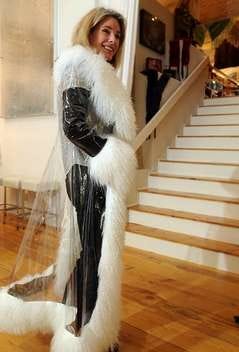
I’m not precisely sure what Morris’ wife is wearing in this photo (Barbarella’s coronation gown? Or, as a reader suggests, a shower curtain trimmed with fake fur?), but the caption reads “Susan Starr models a jacket she made in her studio at her home in Montgomery, Ala.”
This shiny thing-a-mabob with the #20 on it is described as “A poolside rickshaw at the home of Morris Dees and Susan Starr in Montgomery, Ala,” because nothing screams Equality! like a fancy rickshaw.
It would probably not occur to you to acquire what might possibly be a matador’s outfit to hang next to the washstand in an office bathroom of your compound, but then you aren’t the main man behind America’s most lucrative poverty organization, now are you?
This white and beigeish picture is described as “Guest house living area at the home of Morris Dees and Susan Starr in Montgomery, Ala.,” but the contents remain enigmatic. What exactly is on the coffee table? A nest of writhing snakes? A ton of old horseshoes? And what’s that spherical object behind the fuzzy couch? A giant ball of twine?
And then there’s this objet d’art. I wonder how much hate Morris had to spew and foment to get the donations to pour in to pay for that?
For some reason, the article accompanying the 60 pictures seems to have largely vanished, but it began:
It is hard to believe the home Susan Starr and Morris Dees purchased upon their marriage 11 years ago was once a very small cottage originally built in 1923.
Nah, by this point, I can believe anything about Morris.
This should be some sort of codicil to Conquest's various laws. Non-profit/NGOs, no matter what their stated purpose, end up being corrupt institutions whose primary purpose is grift meant to enrich only themselves and their clients (e.g. any organization ever created by lefties).






This should be some sort of codicil to Conquest's various laws. Non-profit/NGOs, no matter what their stated purpose, end up being corrupt institutions whose primary purpose is grift meant to enrich only themselves and their clients (e.g. any organization ever created by lefties).
"Barbarella’s coronation gown?"
I'm crying