

The standard issue critically acclaimed debut novel of the 21st Century is by some non-white woman who was born and raised in a seemingly pleasant American suburb shortly after her parents arrived in America. Yet her school days are absolutely ruined by racist blonde girls asking her, “No, I mean, where are you really from?”
Fortunately, at home she enjoys a vibrantly unique immigrant culture largely comprised of the extended family sitting around the table eating grandmother’s delicious dough-filled-with-cheese (or yogurt or meat) ethnic specialty.

On the other hand, among Anglos …
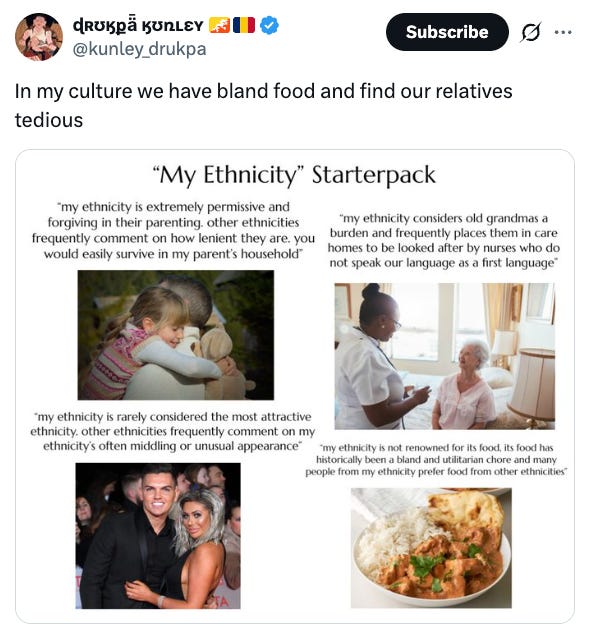
But now a young Indian-American woman has decided to follow the Philip Roth path and have a little fun at the expense of her elders:
From the New York Times:
The Women of New Jersey’s Little India Have a Story to Tell
“Men Like Ours,” a novel by Bindu Bansinath, follows an immigrant family through a community crisis.
By Dwight Garner
May 11, 2026
… Philip Roth took a lot of grief, for example, after the publication of “Portnoy’s Complaint,” for depicting Jews in suburban New Jersey in ways they thought lent credence to old stereotypes: overbearing mothers, emasculated fathers, guilt-ridden sexuality. He was declared to be “bad for the Jews.” …
It wouldn’t surprise me if Bindu Bansinath’s bold and darkly comic first novel, “Men Like Ours,” kicks up a Roth-like fuss, or at least a semblance of one, in the suburban New Jersey enclaves known collectively as Little India, in Middlesex County, N.J., where this novel is set and near where Bansinath was born.
These places (Edison, Iselin, Woodbridge) are dense with immigrant strivers. …
In many respects, “Men Like Ours” is a love letter to this area, and to the pluck and tenacity of a generation of South Asian women who were smart but poor and brought to America in arranged marriages. Bansinath sometimes narrates in the first-person plural, as Jeffrey Eugenides notably did in “The Virgin Suicides.”
We arrived at the homes of men like ours in the late ’80s and ’90s. Men like ours were last resorts, garden-variety men; if our small dowries hadn’t undermined us, they would have stayed bachelors forever. We came to them from faraway cities and forgot the shapes and bustle of our hometowns. The specifics of our histories didn’t matter here. The degrees that we earned elsewhere fell to the wayside. … We needed to know only how to set their tea, how to boil ourselves down into plain white rice.
The collective voice underlines the shared experience and the propinquity on display, even though the novel focuses primarily on a single Indian American family, the Sharmas. The mother, Anita, thin and beautiful, a “snob” with an unusable degree in software engineering, was brought over at 21 to marry a dull older man, the lowly employed Ashok, who spends his free time insulting Pat Sajak while watching “Wheel of Fortune.”
Their teenage daughter, Leila, straddles two cultures.
To be troublesome, I …
Paywall here.
