

Can you remember back to Friday, October 4, 2019, when the debut of Joaquin Phoenix’s Best Actor Oscar-winning movie Joker that evening was widely anticipated to unleash a vast tide of mass shootings by white male incels armed with AR-15s?
From Wikipedia:
Security concerns
On September 18, 2019, the United States Army distributed an email warning service members of potential violence at theaters screening the film and noting the Joker character’s popularity among the incel community. A separate memo revealed the Army received “credible” information from Texas law enforcement “regarding the targeting of an unknown movie theater during the release”. The film, forbidden to minors under 17 in the US, was feared to possibly encourage imitations of the criminal behaviors represented in the film in ordinary life. …
In an interview with TheWrap, Phillips expressed surprise at criticism of the film’s dark tone, stating “it’s because outrage is a commodity” and calling critics of the film “far left”. Phoenix walked out of an interview by The Telegraph when asked if the film could inspire mass shooters. He later returned to finish the interview, but did not answer the question. Following this, journalists were disinvited from the premiere at TCL Chinese Theatre, with only photographers being allowed to interact with the filmmakers and cast on the carpet. …
Here’s a deranged racist anti-white article that appeared in the New York Times on October 9-11, 2019:
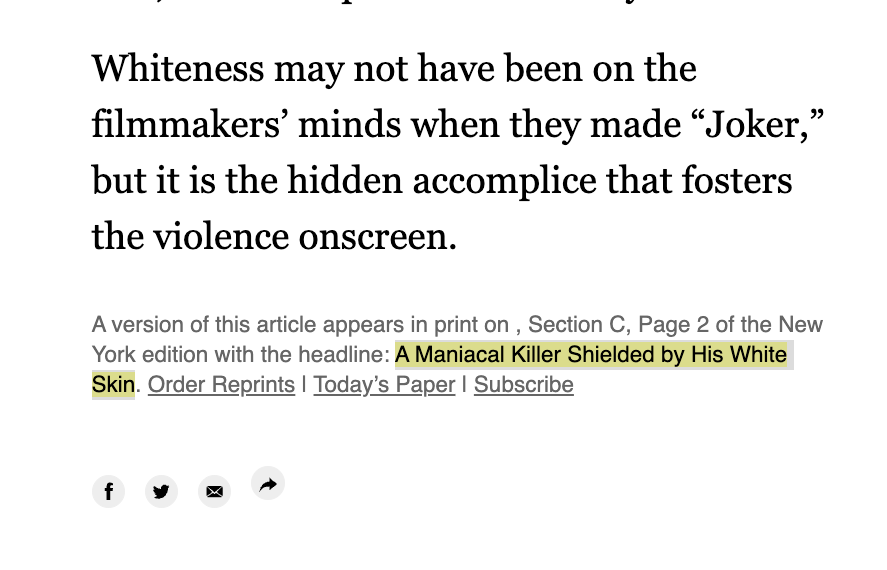
The NYT’s paper edition had earlier run an even more racist anti-white headline: “A Maniacal Killer Shielded by His White Skin.”
What the film wants to say — about mental illness or class divisions in society — is not as interesting as what it accidentally says about whiteness.
By Lawrence Ware
Published Oct. 9, 2019
Updated Oct. 11, 2019
This article contains spoilers for “Joker.”
Before “Joker” opened last weekend, much was being made of how its tale of a murderous villain echoed news stories of mass shooters and incel threats, and how the film might encourage unbalanced viewers to commit acts of violence. As it turned out, it mainly inspired audiences to open their wallets for the biggest October opening ever. …
Still, what struck me most is that what the film wants to say — about mental illness or class divisions in American society — is not as interesting as what it accidentally says about whiteness. For it is essentially a depiction of what happens when white supremacy is left unchecked. It shows the delusions that many white men have about their place in society and the brutality that can result when that place is denied.
The fact that the Joker is a white man is central to the film’s plot. A black man in Gotham City (really, New York) in 1981 suffering from the same mysterious mental illnesses as Fleck would be homeless and invisible. He wouldn’t be turned into a public figure who could incite an entire city to rise up against the wealthy. Black men dealing with Fleck’s conditions are often cast aside by society, ending up on the streets or in jail, as studies have shown.
And though Fleck says he often feels invisible, had he been black, he truly would have been — except, of course, when he came into contact with the police. They’d be sure to see him.
Though Fleck is pursued and investigated by Gotham’s finest, his whiteness acts as a force field, protecting him as he engages in the violent acts of the latter half of the film. Consider his appearance on the live talk show hosted by Murray Franklin (Robert De Niro). A black man acting as strangely as Fleck does would not have been allowed to go on the air. But the white Fleck is given access, and bloodshed soon follows. …
There are other ways that whiteness informs Fleck’s character. He anticipates he’ll be treated as a son by the Wayne family, and assumes he’ll be given medical records just by asking the hospital orderly (played by the great Brian Tyree Henry). The privileges that come with Fleck’s race set him up for these unrealistic expectations. When they’re not met, the consequences are deadly.
Whiteness may not have been on the filmmakers’ minds when they made “Joker,” but it is the hidden accomplice that fosters the violence onscreen.
Uh … It’s a comic book movie. That stuff didn’t happen.
Jim Goad wrote in Taki’s Magazine on October 7, 2019:
I Went to See Joker and Didn’t Get Shot
Jim Goad
October 07, 2019
On Friday at high noon, I saw a matinee of the feverishly hyped film Joker at a megaplex in rural Georgia on the first day of its official release. As we handed our tickets to the small, doughy, middle-aged female theater worker, she demanded to inspect my girlfriend’s purse.
She found no weapons, and I have no idea whether or not this disappointed her.
I don’t go to the movies much—Joker marks only the third time I’ve been in a movie theater since the turn of the millennium—but this was definitely the first time I’ve been treated by ticket-checkers as a potential mass shooter.
As I said, I’m not really the guy to ask about such matters, but I’m under the impression that most Hollywood action movies feature, on average, about a thousand people being slain by bullets and maybe another hundred by incendiary devices, right? What makes this movie such a potential powder keg?
I’m not the Amazing Kreskin, but as far as I can discern, all the terror hype is based on movie critics’ prematurely ejaculatory declamations that Joker would be a love letter to lonely and socially dispossessed young white males who feel, without a hint of evidence, that society is defaming them merely for being white and is mocking them for the fact that they can’t get laid because every cute girl in town ran off with the black football team.
Much of the pre-release hysteria focused on the fact that Joaquin Phoenix, who plays Arthur Fleck/Joker in the film, is white. But most of it zeroed in on the film that Arthur is also an “incel”—which is a portmanteau of “involuntary celibate” and is pronounced “IN-sell.”
Last year in Toronto, a 25-year-old male from Toronto plowed through unsuspecting citizens on a mile-long stretch of sidewalk, killing ten. Minutes before his rampage, he posted on Facebook that “The Incel Rebellion has already begun!”
A few months later, Warner Brothers and director Todd Phillips began hyping Joker’s imminent release. Almost immediately, the howling macaws of uber-wokeness issued baleful warnings that the film would be all the excuse that sexually frustrated and incurably racist white men would need to justify further shooting rampages.
The film premiered at only a handful of festivals this past summer, so it’s impossible to discern how many of the critics who were issuing baleful warnings about how the Alt-Right ideological coup masquerading as a film called Joker would spark one—or possibly (hopefully?)—many mass shootings by the unfuckable, unemployable, unloved, but yet still somehow unjustifiably bitter white males whose toxic ideology and very existence the film supposedly glorifies had actually seen the movie before predicting it would lead to mass murder.
Joker was released on Friday, October 4, 2019. All of these warnings about a violent white male incel uprising were written prior to that date:
…the aggressive and possibly irresponsible idiocy of Joker is his (director Phillips) alone to answer for….[Arthur Fleck] could easily be adopted as the patron saint of incels.
—Stephanie Zacharek, TIME
As Hannah Arendt saw banality in the supposed evil of Nazi Adolf Eichmann, I see in Joker an attempt to elevate nerdy revenge to the plane of myth.
—David Edelstein, Vulture
Joker is the antihero the alienated and angry have been waiting for, and that’s precisely the problem….I do yawn at the idea of another story in which white men are offered a sort of understanding for their violence.
—Sarah Hagi, Globe and Mail
[Joker] shows the toxic white male in all his ugliness ….After Joaquin Phoenix gets mugged in Joker and a co-worker lends him a weapon to protect himself, I thought about the times last month when a white man used a gun in a mass shooting: 22 killed in El Paso, Texas and nine in Dayton, Ohio. Yes, Phoenix’s Joker in the latest film by Todd Phillips is a villain we’ve seen before—not as the nihilist clown to an archetypical Batman, but as the angry white man obsessed with validation.
—Noel Ransome, VICE.com
Did we really need a brutal movie about a white terrorist figure who uses gun violence to enact revenge on the society that rejects him?
—Kathleen Newman-Bremang, Refinery29
Again, I have no clue whether any of these scrubs saw a movie called Joker or not, but it DEFINITELY was not the same film I saw.
I subsequently wrote in Taki’s Magazine on October 9, 2019 in my review “Arkham’s Razor:”
Like Westerns, movies about crime-fighting superheroes tend to be inherently right-wing. Granted, Superman was usually associated with FDR’s cheerful liberalism, but Batman was always a reactionary proponent of order. Thus, the conservative director Christopher Nolan made a formidable Batman trilogy in 2005–2012.
Way back then before the Great Awokening, critics simply assumed that anybody as talented as Nolan must of course be liberal, so they didn’t give The Dark Knight a very hard time. But these days, reviewers worry that gifted white men like [actor Joaquin] Phoenix and [writer-director Todd] Phillips, no matter how generous their leftist campaign contributions, must actually be Secret Nazis. If they weren’t racists, why would they humiliate Women of Color by making a good movie?
Thus, Joker has gotten berserk negative reviews, noteworthy for their incoherence and anger at the film’s evenhanded politics. The New York Times film critic, for example, lamely argued that the film is “not interesting enough to argue about,” even though Joker is more fun to debate than to sit through.
The New Yorker, in contrast, was enraged by the lack of racial animus in Joker: By portraying individuals of different races as a mix of good and bad, Joker undermines The Narrative that whiteness is the root of all evil.
Phillips was born in Brooklyn in the early 1970s, but then his family white-flighted out to Long Island. My guess is that Phillips is an old-fashioned Jewish liberal being driven to the center by the ongoing revolt of the humorless who feel themselves oppressed by the existence of men with a sense of humor.
Yet, as I pointed out back in mid-October 2019: during the very night that Joker was unleashed on a highly suspecting America, something did happen: there was a horrific mass murder in New York City, where Joker is set.
But nobody except me has ever pointed out the ironic inverted connection between the media’s fears and the bloody reality of what happened in lower Manhattan that night … because it didn’t fit racist anti-white who-whom prejudices. Instead, it validated stereotypes found by science, which is the worst thing imaginable.
So, the real life Joker-style mass murder of the night of October 4-5, 2019 got memoryholed, and it only shows up in police blotter items in the press.
Thus, from today’s New York Times local news section …
Paywall here.
