

I was really into saving the ecology in 1971, so I volunteered (for one of the few times in my life) to take on a household chore: recycling.
I’d stack up the newspapers and I’d flatten the aluminum beer cans with a sledgehammer.
That was about it for recycling 55 years ago. Back then, we weren’t as advanced, technologically and morally, so that’s about all we recycled.
Now, all these decades later, there is barely any newsprint, but recycling aluminum cans still makes lots of sense. Vagrants will take beer cans out of your garbage pails for free if you don’t watch out.
But, for some reason, homeless dudes won’t take the rest of your recyclable junk away.
Other recycling … well, there are Doubters. From Works in Progress:
Alex Chalmers & Rob Wiblin
1st September 2026
What if everything we know about recycling is wrong?
Every child is taught that landfill is the worst place our trash can end up. It is the sad consequence of a failure to recycle: a mountain of waste leaking chemicals and smells, blighting the land forever.
What if that picture is wrong? What if landfill, properly done, is actually one of the cleanest, cheapest, and most environmentally sensible things we can do with our waste? It turns out that for much of what we throw away, the humble landfill beats the recycling bin.
This reminds of the Great Landfill Shortage of the 1990s. The Atlantic Monthly, a.k.a. the Journal of Genteel Foreboding (I’m still shaking over an Atlantic cover story about how if the Gulf Stream stopped flowing, there’d be another Ice Age and then London and Paris would be covered by mile-thick glaciers), used to run terrifying articles about how we had practically filled up every possible landfill site in America.
Soon, we’d be knee-deep in garbage.
Finally, The Atlantic published one last article, in effect apologizing for the previous ones, saying they’d discovered that this had all just been a cunning PR offensive by Waste Management Inc. to buffalo cities into paying them higher fees by pretending America was running out of places to dump garbage. In reality, it turns out, America is a huge country with countless potential dump sites.
So why are so many people really into recycling?
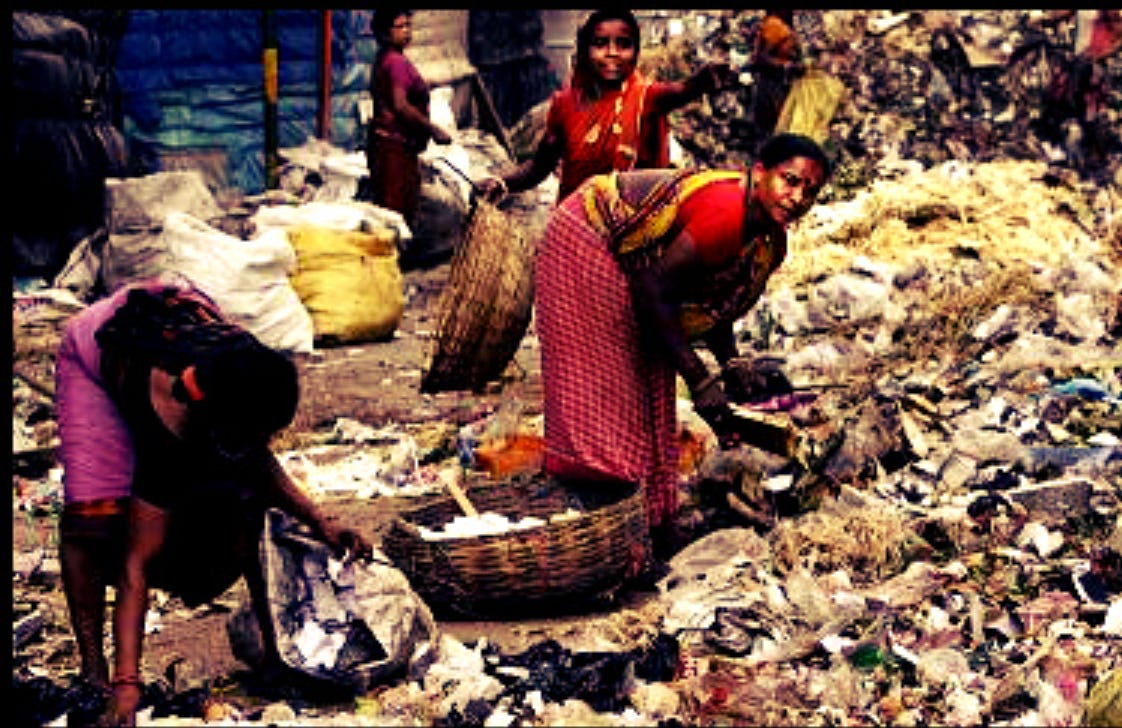
Somebody named @londinburgh offers an interesting theory about the psychological appeal:
I have this weird idea about recycling. In the 90s and early 2000s images of impoverished people picking through rubbish dumps in the third world were incredibly ubiquitous. I suspect they influenced people’s attitudes to recycling in the west.
India’s ragpicker cities are indeed memorable. From Borgen Project:
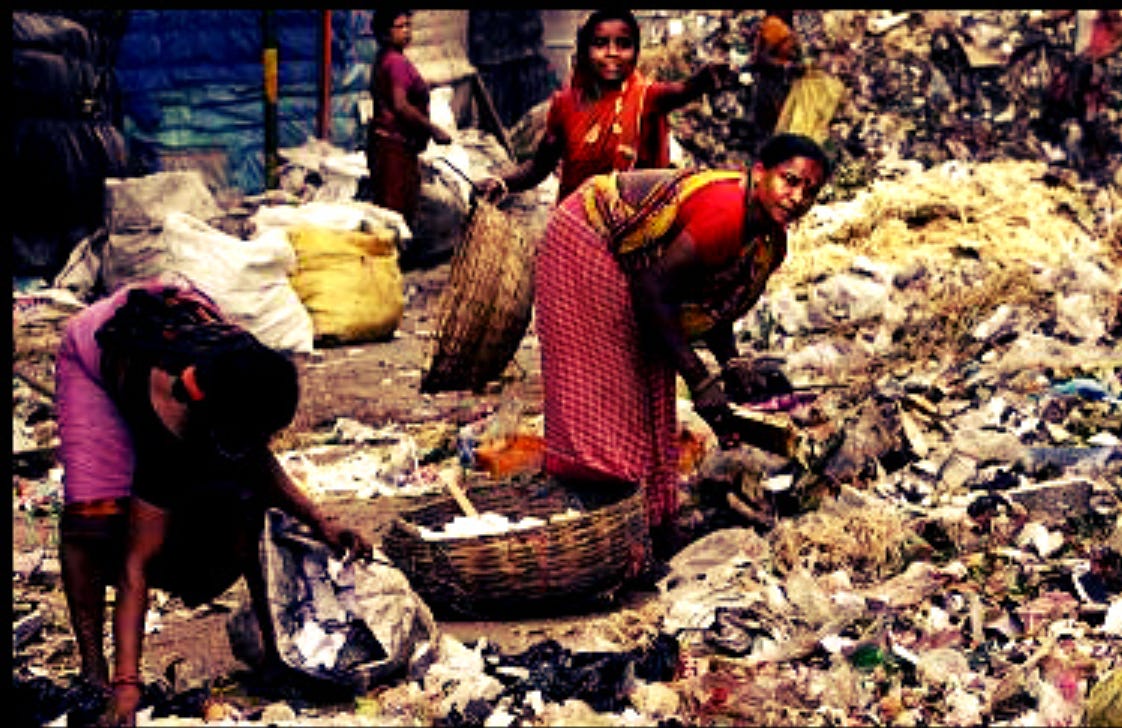
Indian Rag Pickers Live in Landfill Slums
… In the New Delhi 70-acre Ghazipur landfill alone there are an estimated 350,000 scavengers, or ‘rag pickers’. Living in filth, people spend their days sorting the endless trash into towering mountains, searching for items they can sell.
Plastic bags go for 5¢ a pound, and human hair fetches $18 a pound.
Sheikh Habibullah, has built a dirt-floor hut for his family of six by hanging rice-bags for walls, palm-leafs as a roof, and a Bollywood poster board for the door. The family collectively earns $60 a month, half of which pays a local boss for rent and the electricity to power a single light bulb.
For most, a doctor is out of the question and with boundless toxins leaking into the landfill from local dairies, slaughterhouses and a crematorium, cancer and birth defects are common.
Nevertheless 60-year-old Sheikh Abdul Kashid claims he’s “much freer here…I’ve given four children some education. I could never do that back home.”
– Lydia Caswell
@londinburgh speculates:
The mechanism is one of two things
1. People were made to feel guilty about throwing out their rubbish because of the association with the depredation of the worlds poorest
2. people came to believe that sorting rubbish was moral as it brought them closer to the worlds poor
It may have been an oblique combination of the two, whereby people indirectly imagined that by picking through their own rubbish, they would somehow relieve the worlds poor of having to do it.
Something notable I think we forget is how saturated by images our world has become in the last twenty years. In 1995, you may have seen one picture of some children picking rubbish and that would be your only impression of the world’s poor.
But I have a slightly different take on the influence of photos of ragpickers on recycling ideology from my own thought processes: …
Paywall here.
