

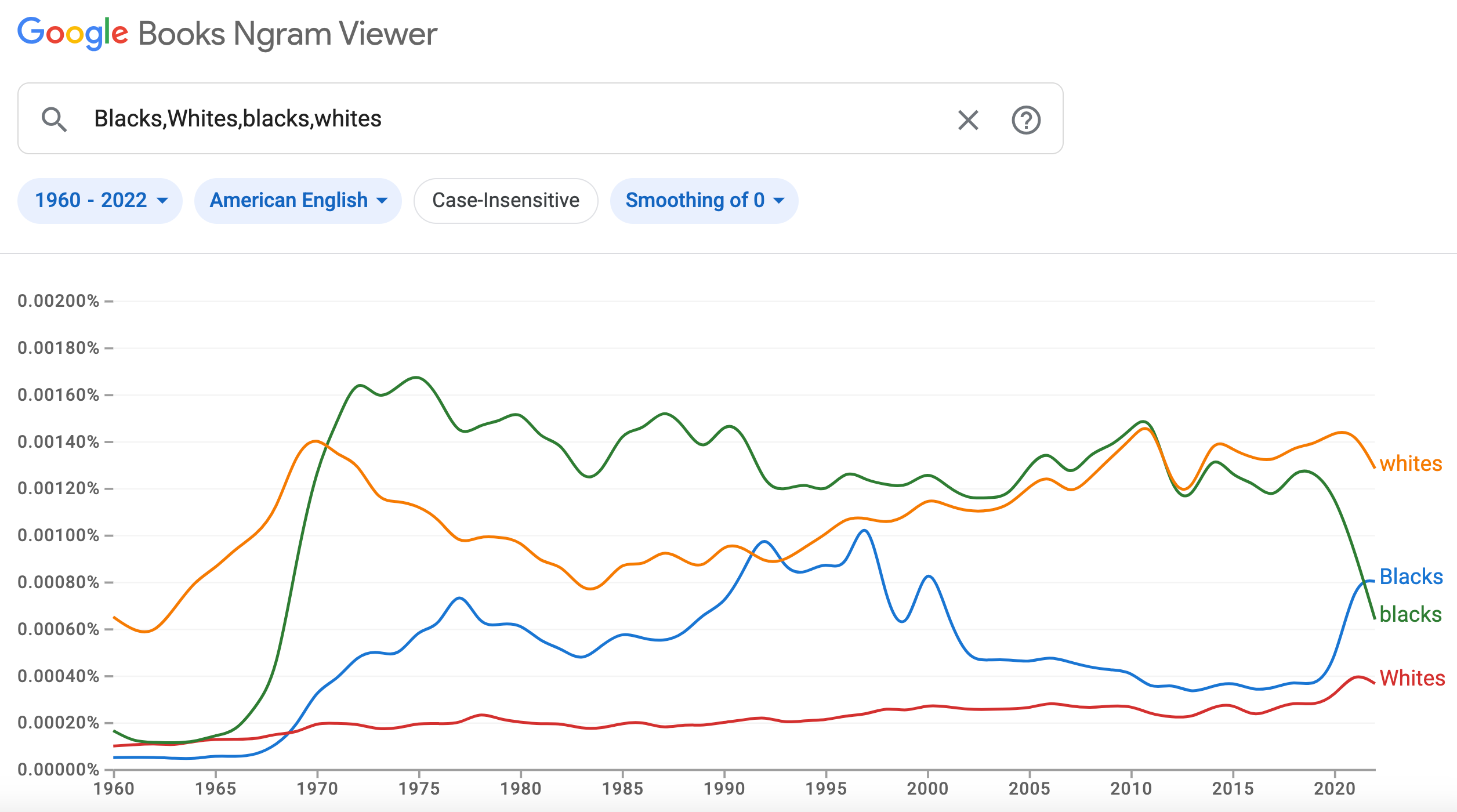
It’s time to take steps to reduce the amount of racial animus in American life.
One obvious progression toward greater racial amity would be for the national press to repeal its ludicrous decision during its psychotic break in the weeks following George Floyd’s demise on May 25, 2020 to capitalize “Blacks” but to not capitalize “whites.”
What could have made clearer the media’s racist hatred of whites?
With the exception of the Washington Post’s awkward but at least fair-minded choice to capitalize both “Blacks” and “Whites,” the prestige press resolved that some words that refer to peoples would be capitalized, not because they are proper nouns that refer to single, unique entities, but as honorifics, while certain other peoples did not deserve capitalization.
For example, back in the mad month of June 2020, the New York Times announced it would henceforth spell “Black” with a capital B, but continue to spell “white” with a lowercase w:
Dear Colleagues,
At The Times and elsewhere, the nationwide protests over racism and police violence have prompted discussions about many aspects of our coverage. One element has been a renewed focus on a longstanding debate: whether to capitalize the term “Black.”
We have talked to more than 100 staff members to get their views, reviewed the arguments that have been made over many years, and consulted with colleagues at other news organizations. The feedback has been thoughtful and nuanced, with a wide range of opinions among colleagues of all backgrounds.
Based on those discussions, we’ve decided to adopt the change and start using uppercase “Black” to describe people and cultures of African origin, both in the United States and elsewhere. We believe this style best conveys elements of shared history and identity,
Aren’t we always being told that Africans are the most diverse people on earth in terms of genes and cultures?
Now, all of a sudden, blacks are so homogenous that they qualify as a single, unique proper noun?
(Actually, I’m not wholly averse to saying, yes, blacks are singular and unique enough to qualify for the proper noun of “Blacks.” But to not also capitalize “Whites” is obviously the product of vicious racist hate.)
and reflects our goal to be respectful of all the people and communities we cover.
Well, of course, except for “whites,” those despicable cretins who don’t deserve capitalization.
The change will match what many readers are seeing elsewhere. The Associated Press and other major news organizations have recently adopted “Black,” which has long been favored by many African-American publications and other outlets.
Hey, don’t blame us, we are just piling on mindlessly! We are an ignorant swarm! We have been waiting for this moment for decades, so now we are getting while the getting is good.
The new style is also consistent with our treatment of many other racial and ethnic terms: We recently decided to capitalize “Native” and “Indigenous,” while other ethnic terms like “Asian-American” and “Latino” have always been capitalized.
“Asia” and “Latin America” are proper nouns, while “native” and “indigenous” are not. Asia and Latin America are unique, specific places, while native and indigenous are not.
This is not complicated. You have to be awfully racist to be too stupid to understand this.
The NYT’s recent rule of always capitalizing “Indigenous” to refer to groups from around the world who are distinctive mostly for never getting far from home to spread their genes is so bizarre that I will leave it for another post.
We will retain lowercase treatment for “white.” While there is an obvious question of parallelism, there has been no comparable movement toward widespread adoption of a new style for “white,” and there is less of a sense that “white” describes a shared culture and history.
After all, Blacks have The Culture, while whites, those boring white bread losers, don’t have any culture. (Personally, I frequently capitalize words that shouldn’t be capitalized in proper English to facetiously imply pompous Germanic ideologues.)
Moreover, hate groups and white supremacists have long favored the uppercase style, which in itself is reason to avoid it.
So if capitalizing one race but not the other is a tell-tale sign that you are a hate group, what does the New York Times deciding to capitalize one race but not other say about the New York Times in June 2020?
Right.
The term “brown” as a racial or ethnic description should also generally remain lowercase and should be used with care. “Brown” has been used to describe such a disparate range of people — Latin, Indigenous, Asian, Middle Eastern — that the meaning is often unclear to readers. A more specific description is generally best.
Of course, American whites are such a disparate range of people — Swedish-Americans, English-Americans, German-Americans, Italian-Americans — that the meaning is often unclear to readers.
Or something.

You have to be awfully motivated to break the symmetry between “black” and “white.” You have to be as filled with racist hate as the mainstream media was in June 2020.
… — Dean and Phil
So, why not just apologize for your racist hate and change your policy?
Paywall here.
