

I haven’t read it, but this sounds like an interesting book that I missed hearing about when it came out last summer, probably because it was promoted as true crime rather than science: Murderland: Crime and Bloodlust in the Time of Serial Killers by Caroline Fraser.
I’m more of a big picture kind of guy, so true crime isn’t a favorite genre for me because I worry that spending a lot of time learning about one colorful crime isn’t that informative simply because the reason this one case is so interesting is because it’s so idiosyncratic.
But like Jill Leovy’s Ghettoside a decade ago, Murderland appears to be both true crime and social science. (As I mentioned in my obituary for geneticist J. Craig Venter, when I pointed out that his ex-wife Barbara Rae-Venter used genetic genealogy to catch the Golden State Killer, I’m a big fan of smart women who are into true crime.)
Baseball statistician Bill James read a huge number of true crime books for fun and then wrote a 2011 book about which patterns he’d observed. One of his more memorable assertions is that serial killing, while long existent, didn’t appear to be a big Thing until the late 1960s.
Somebody at Radford University kept a database of known serial killers showing a sharp rise in the 1960s-1970s and a peak in the 1980s before a decline:
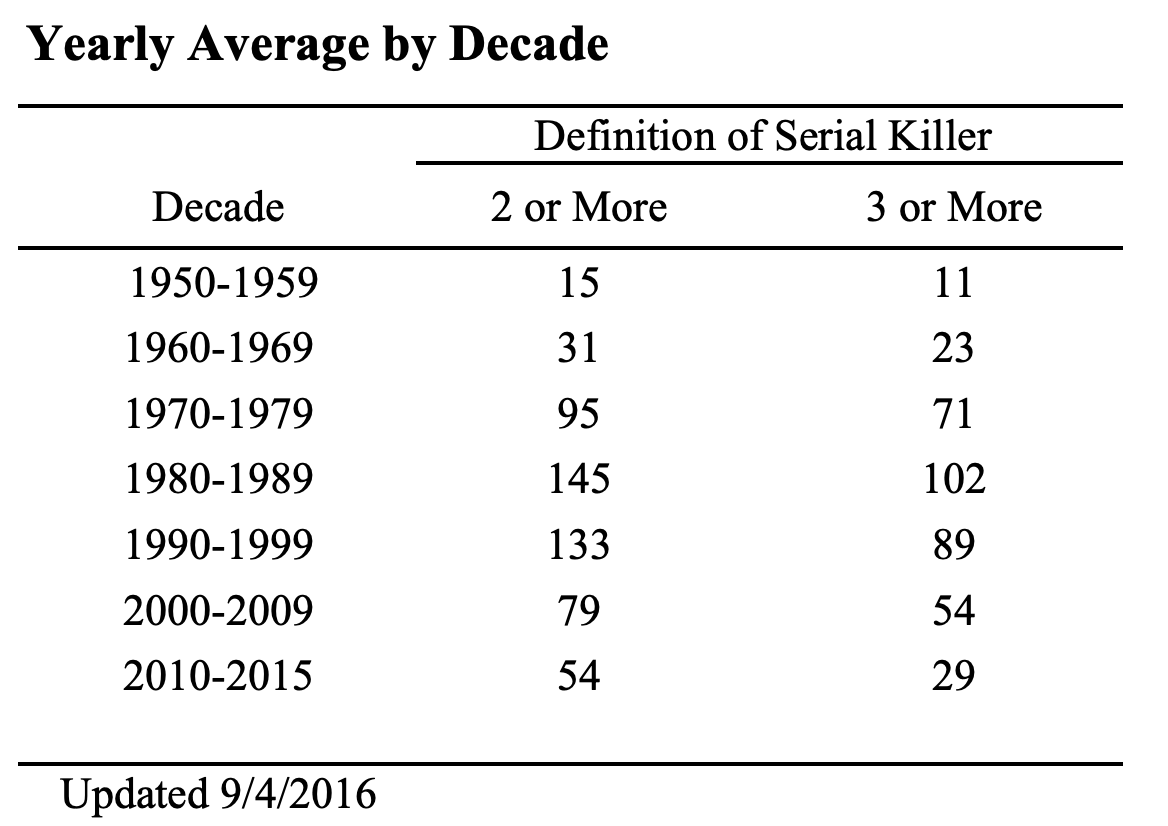
A lot of things changed in American society in the later 1960s.
So, what’s Fraser’s theory?
Paywall here.
