

Nobody seems to be too sure which Canadian political genius coined the term “First Nations” about a half century ago during the constitutional disputes between Canada’s French nation and its British nation, But it has proved popular in obtaining privileges for Amerindians in Canada.
Although, the term “First Nations” is rejected by Canadian Inuit (i.e., Eskimos) and Metis (mestizo French and Indian people), the term is spreading broadly in the Anglosphere. For example, Australian Aborigines are increasingly referred to in Australia as First Nations or First Peoples. (Native Australians were so scattered and disorganized into bands when the British arrived that the political-anthropological term “nations” seems like a stretch, while “First Peoples” gets around that embarrassing question).
The Australian media constantly mentions that Aborigines got to Australia about 50,000 years ago, reinforcing their claim (moral? political? legal?) to the continent.
Maoris in New Zealand are sometimes mentioned as First Nations too, although these proud Polynesians don’t much like being verbally linked with the more troubled Australian Aborigines with whom they have few racial and no cultural ties.
Since Scandinavians speak so much English, lately the “First Nations” term has sometimes been applied to the not-all-that indigenous Sami of Lapland, who appear to have arrived from the East during the Bronze Age.
On the other hand, in English-speaking South Africa, blacks avoid the term “First Nations” because it would open a whole can of worms about how Bantus were not the first settlers of much of the country. San (Bushmen hunter-gatherers) and their Khoi (Hottentot herdsmen) cousins have been there since time immemorial. Heck, the Dutch Boers arrived in the Cape in 1652 long before the Bantu Expansion finally got close. Even the Cape Colored people (mixtures of Boers, Khoi-San, and southeast Asians shipped in as slaves) have a better historical claim to the Cape than South Africa’s ruling majority.
The logical/satirical term “Zeroth Nations” has only been used a handful of times in the history of Internet. But it can help explain the growing trend toward accommodating science denialism.
What is a Zeroth Nation? It’s a group that may have been indigenous in a place before an acknowledged contemporary Indigenous population.
For example, the Dorset culture of the eastern Canadian Arctic and a bit of Greenland disappeared about the time the ancestors of the modern Inuit, the Thule Culture, started to arrive.
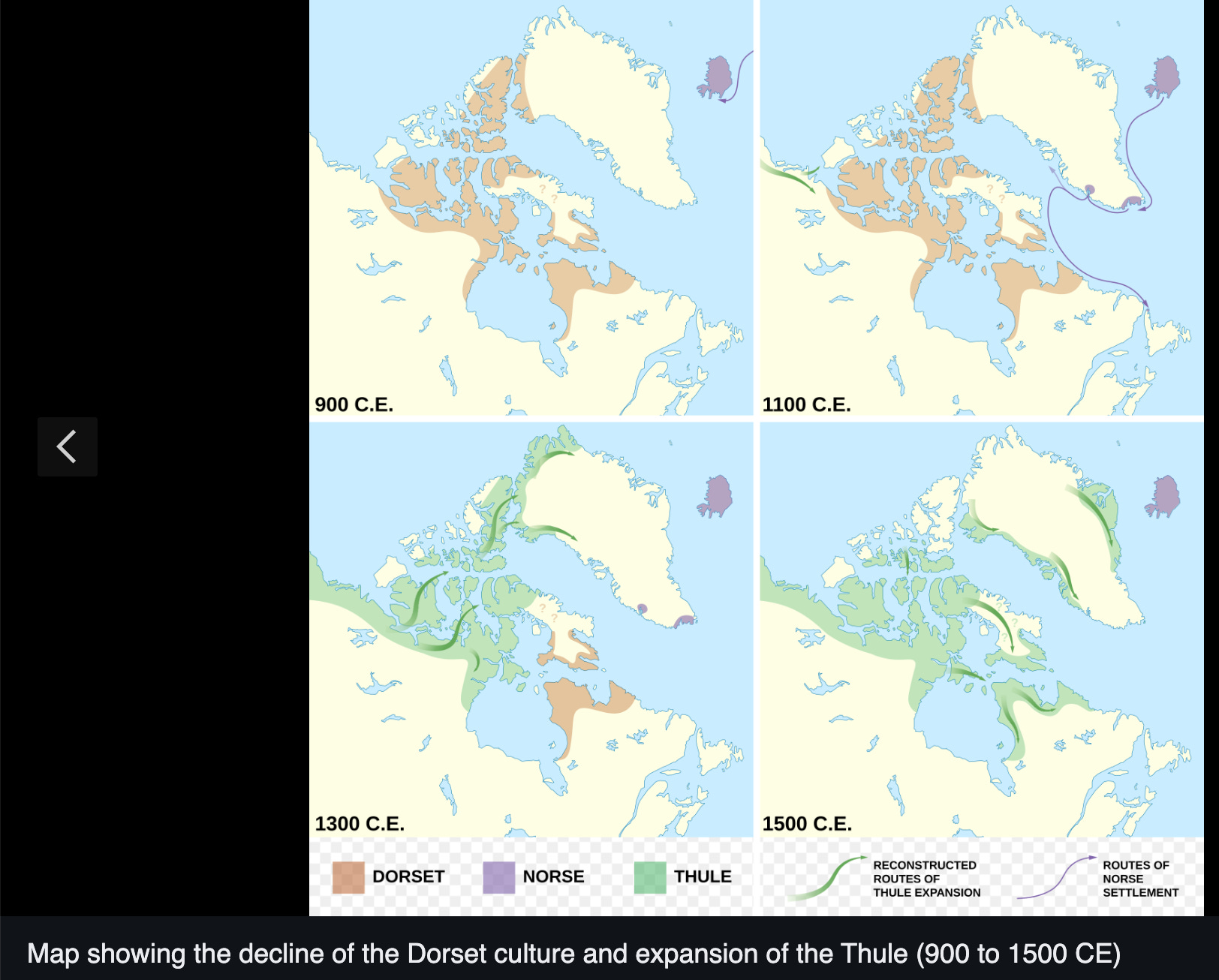
What happened to the Dorset?
There is little genetic evidence so far that they have any living descendants.
Did they die from climate change just before the Inuit arrived, a popular theory?
Their territory was so harsh that there are a lot of ways to go extinct.
But the Inuit themselves have legends about encountering earlier inhabitants who lacked bows and arrows and who fled from them.
Perhaps the Inuit accidentally introduced a disease the Dorset had no resistance against?
Perhaps the Inuit outcompeted them for food sources?
Perhaps the Inuit killed them?
Nobody seems to know.
So, were the Dorset the local Zeroth Nation?
Well, there appears to have been people in the Arctic before them, sometimes called the Pre-Dorset. They may have turned into the Dorset through cultural evolution, or they may have been somewhat replaced by the Dorset.
So, don’t assume that the Zeroth Nation got there first. There may have been a Minus Oneth Nation before them.
A well-documented recent case of one set of Indigenous people, the Maori of New Zealand, stomping on another set, the Moriori of the Chatham Islands, took place in the 1830s when musket-armed Maori took a European boat to the Chatham Islands and exterminated or enslaved the locals. The Moriori were fellow Polynesians, perhaps Maoris from New Zealand, who had settled the uninhabited archipelago in the 1400s. There, they developed a pacifist ideology which seemed to serve them well … up until their long-lost cousins, who were definitely non-pacifists, arrived in 1835.
The Sami of Lapland are widely considered “Europe’s only Indigenous people.” But they arrived from the east only in the Bronze Age or early Iron Age. Since the Ice Age, Lapland had been thinly populated by Scandinavian Hunter-Gatherers. But who knows what Negative First Nation might have lived there before the Last Ice Age.
What about New World Indians?
Paywall here.
