

As you’ll recall, way back in the Cancel Culture Dark Ages of the 2010s, University of Pennsylvania Law School professor Amy Wax got in big trouble for telling economist Glenn Loury:
“Here’s a very inconvenient fact, Glenn: I don’t think I’ve ever seen a black student graduate in the top quarter of the class, and rarely, rarely, in the top half,” said Ms. Wax. “I can think of one or two students who scored in the top half of my required first-year course.”
Everybody was shocked, shocked by this observation. Much of the Establishment was outraged at Professor Wax for obviously lying, and the rest of the Establishment was outraged at her for telling the truth. Thus, from the Washington Post:
Penn Law professor who said black students are ‘rarely’ in top half of class loses teaching duties
By Derek Hawkins March 15, 2018
A University of Pennsylvania law school professor will no longer teach required courses following outcry over a video in which she suggested — falsely, according to the school — that black students seldom graduated high in their class.
Amy Wax, a tenured professor, will continue to teach electives in her areas of expertise but will be removed from teaching first-year curriculum courses, Penn Law Dean Theodore Ruger said in a statement Wednesday.
Ruger said Wax spoke “disparagingly and inaccurately” when she claimed last year that she had “rarely, rarely” seen a black student finish in the top half of their class.
“It is imperative for me as dean to state that these claims are false,” he said, according to the Daily Pennsylvanian, the student newspaper.
“Black students have graduated in the top of the class at Penn Law,” Ruger said.
So, you see, it’s not that blacks have rarely graduated in the top half, it’s that blacks have graduated in the top half.
Or something.
Here we are, nine years later, and Penn Law School is still keeping its data secret: What kind of racist are you to want to know facts relevant to justice? Only bigots could be interested in the actual numbers.
However, there was a leak last year of Columbia data to Cremieux and now we apparently have the graduating class rank numbers for Columbia Law School. Like Penn, Columbia is likely one of the top ten in the country, although not the top three (Yale, Harvard, and Stanford). Off hand, Columbia and Penn appear to be pretty comparable, so let’s look at Columbia’s numbers
During the decade from 2007 through 2016, Columbia had an average of 35 black graduates per year, or 8% of total graduates. What percentage did blacks make up of grads who ranked in the top 25% of their Columbia Law School classes?
Here’s a graph from Werner Zagrebbi’s site Right Rationalism. I don’t know how he crunched the numbers, so I can’t swear they are accurate. (One issue might involve multiracial students. Like the old joke about all the girls at Harvard being bi: you just have to figure out if they are bisexual or bipolar, there’s a newer joke about all the blacks at Harvard being bi: you just have to figure out if they are biracial or Biafran. Anyway, a lot of colleges tend to lump all multiracial people into one category — thus both Patrick Mahomes and Keanu Reeves could get classed as “multiracial.”)
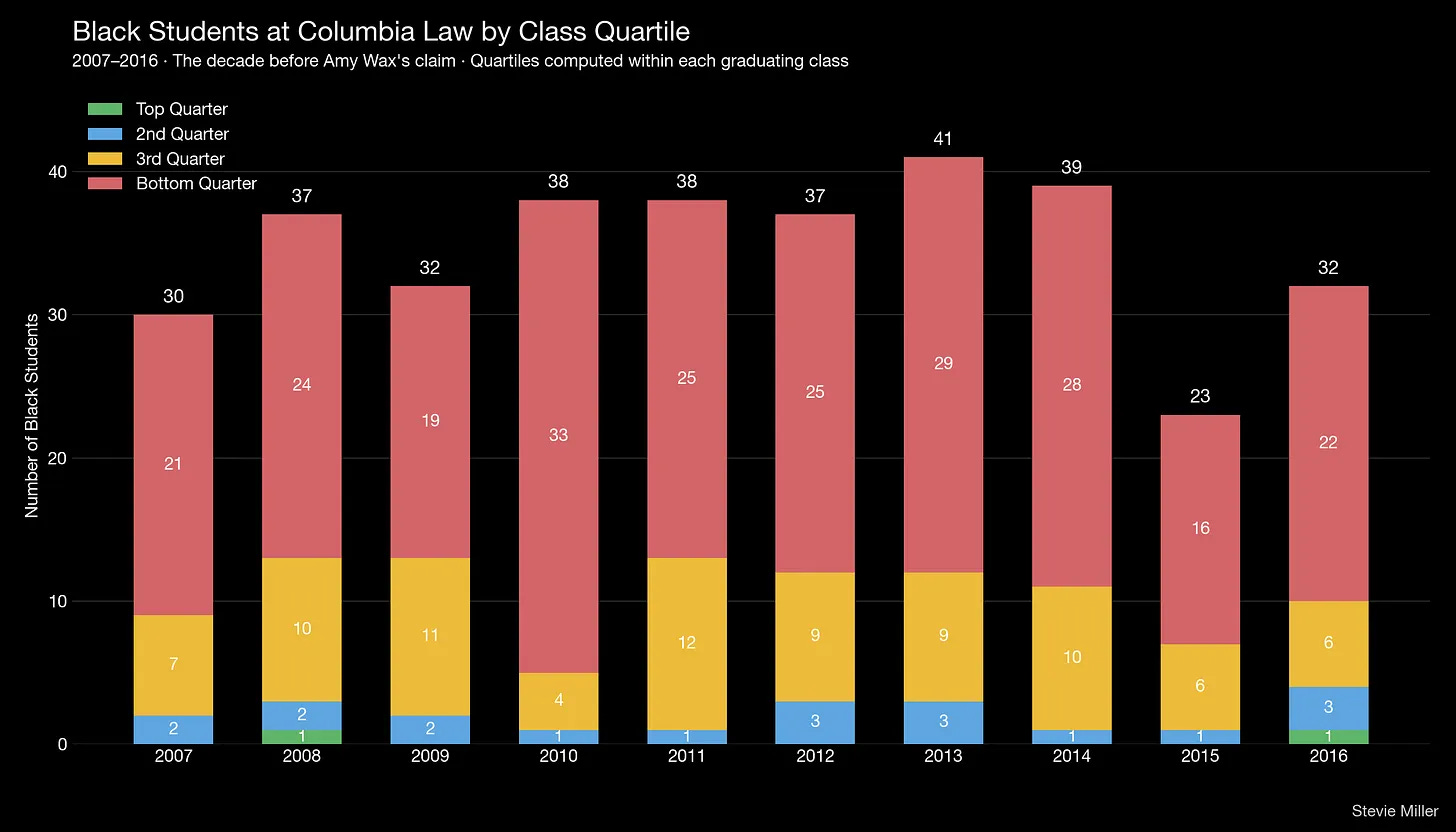
Zagrebbi writes:
Over the period, there were 2 top quartile Black graduates at Columbia Law. If you take into account that Penn Law is half the size and slightly worse (thus doesn’t get the pick of the litter of smart Black law students), it’s entirely plausible there were literally zero Black students in Penn’s top quartile, and certainly reasonable a professor who taught a few sections a year could go a whole career without seeing one.
The same pattern stated the other way: Black students are about a tenth of the class and about two thousandths of the top quarter.
(Once again, I haven’t seen the exact methodology behind this graph, so it could be wrong for all I know.)
So if blacks performed exactly equal to the average Columbia Law student (average including blacks), 87 of the 347 black graduates would have made the top quartile of the graduating classes from 2007 through 2016. Instead, only 2 ranked that high. Blacks were thus only 1/43rd as likely to take the top quarter as the average grad.
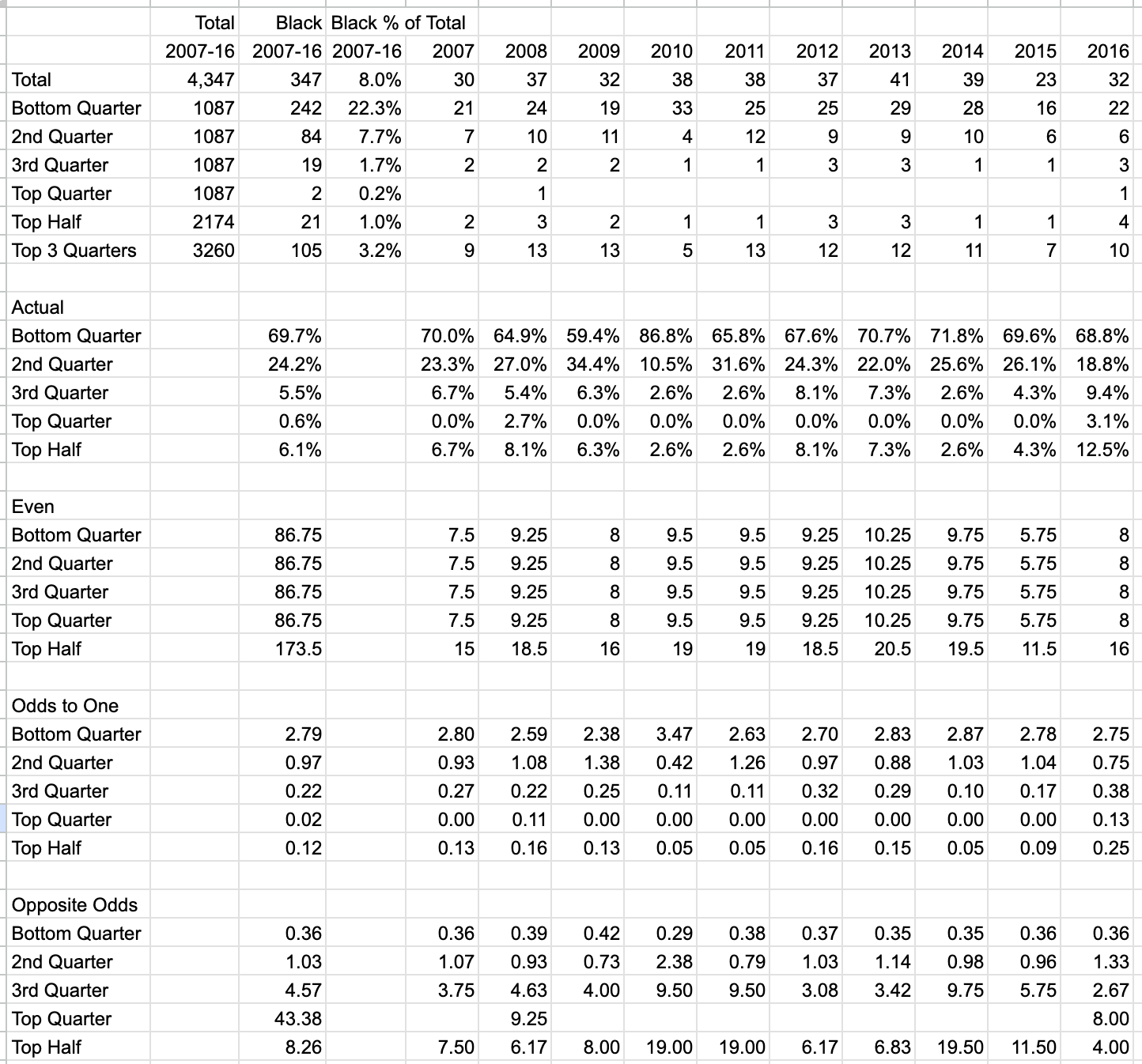
On the other hand, the second quartile from the top wasn’t as dire, with blacks making up 1.7% of the 51st to 75th percentiles.
Blacks comprised 347 or 8% of the graduating classes (probably slightly more of the entering classes, but at Columbia Law a very large majority of first year students graduate and ultimately pass the bar exam, so it’s not a big deal) of 4,347 grads over that decade. So the black performance compared to nonblack students rather than compared to total students was slightly worse.
Once again, this data is for Columbia rather than for Penn. Still, it’s illuminating for the Amy Wax Question.
Probably at Yale, Harvard, and Stanford, there are more top black students. Barack Obama passed up a three-year full ride to Northwestern to go to Harvard. So, it’s likely that most superstar black students go to YHS rather than the next tier, whereas lots of white and Asian superstars don’t get into YHS.
On the other hand, Harvard also let Michelle Obama in, so it’s not like Harvard was overwhelmed with top tier black talent.
But who knows for sure? It’s a secret. We’re lucky to have this leak from Columbia.
But this shortage of excellent black students at a distinguished law school like Columbia, which is a short walk north of Manhattan’s Upper West Side, raises the Ruth Bader Ginsburg Law Clerk conundrum once again.
As I may have pointed out once or twice over the years, Bader Ginsburg believed in “affirmative action for thee, but not for me.” Out of the 159 law clerks she hired, only one, Paul Watford, was black. She was important and she needed top talent, so she couldn’t afford to use quotas goals or whatever the Supreme Court said you had to call them, not like you hoi polloi employers.
But what about diversity, our greatest strength? What about representation, Justice Ginsburg?
Personally, I don’t take very seriously the conventional wisdom that we need more black astronauts or airline pilots or air traffic controllers because only blacks could come up with brand new genius black ideas about flying, as Senator Mark Kelly (D-AZ) recently suggested.
But … elite law does seem like a field in which the concept that the country needs some diversity of demographic representation isn’t obviously comic. Different races might tend to have different ideas about justice, and they might also tend to know different facts about daily life.
But of the 1,087 Columbia Law Students who ranked in the top quarter of their class over the decade of 2007-2016 (just before the Great Awokening got really virulent), i.e., the natural prospects for federal clerkships, only two were black.
2/1087 is 0.18%.
I don’t know what to say about that number.
Other than that it’s really low.
Let’s say you asked the public: “About 14% of Americans in their 20s are black. What percentage of the top quarter of the graduating class at Columbia Law School is black?”
Paywall here.
